
Author: Dev Patel | EQMint
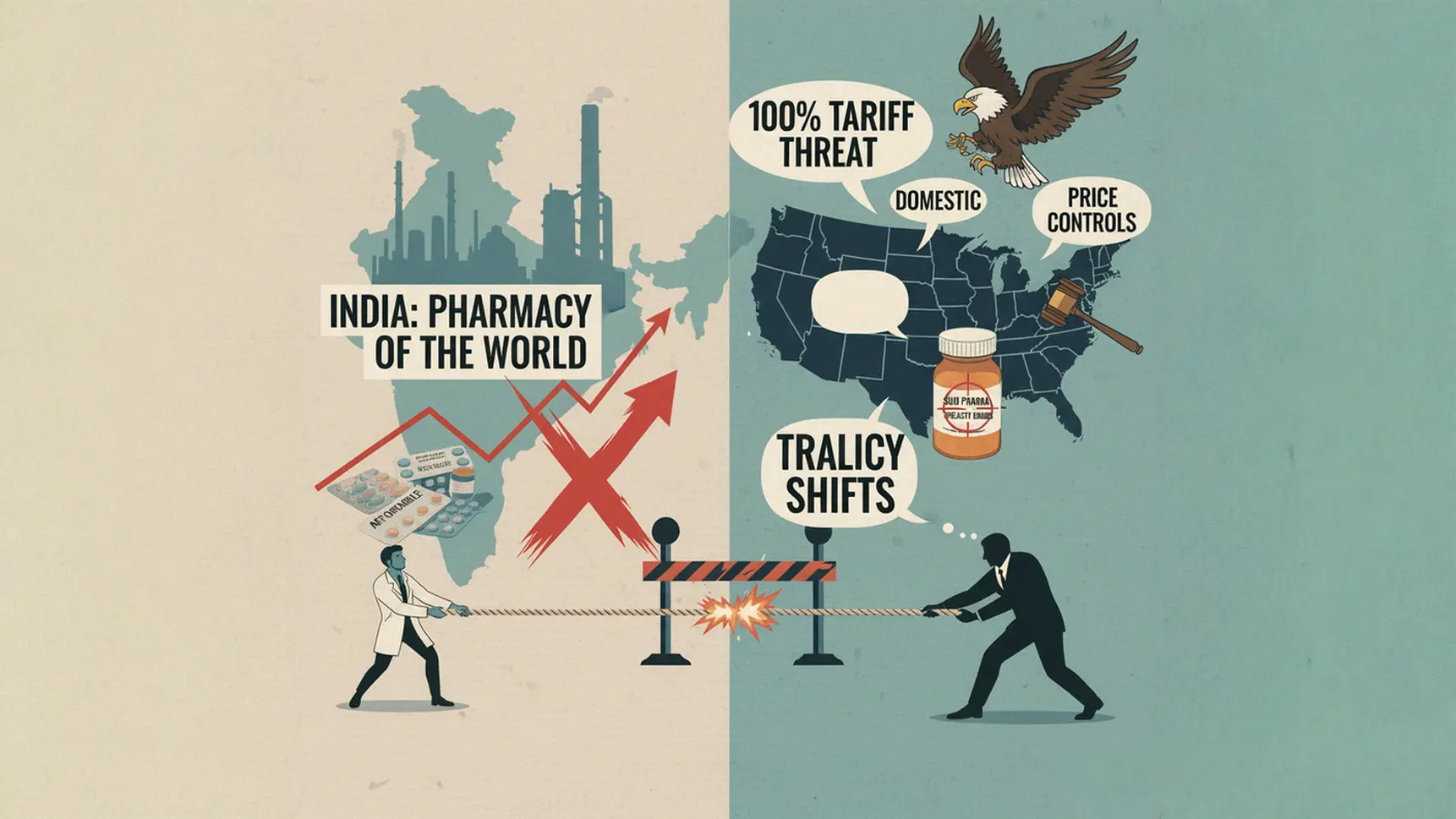
The Indian pharmaceutical industry, one of the world’s largest suppliers of affordable medicines, is facing new headwinds from the United States. A series of policy shifts and tariff threats from Washington are reshaping the landscape for drug exports, particularly in high-value specialty products. According to brokerage Nomura, Sun Pharmaceutical Industries—the country’s largest drug maker—could face tariff costs of up to $100 million, posing a risk to its profitability and competitive edge.
Washington’s Two-Pronged Strike on Global Pharma
In the span of a week, the United States government has fired two major shots at global pharmaceutical supply chains.
-
- Executive Order on Domestic Supply: An order was signed to strengthen the domestic manufacturing of essential medicines and build a national stockpile of active pharmaceutical ingredients (APIs).
-
- Tariff Threat on Branded Drugs: Soon after, the US President threatened on social media to impose a 100% tariff on patented and branded drugs imported into America, unless the manufacturer is already setting up plants within the country.
While these moves have triggered alarm across the industry, Indian officials and experts clarified that generic medicines are not covered under the order.
“The executive order refers to patented / branded products supplied to the US. It is not applicable to generics medicines,” explained Sudarshan Jain, Secretary General of the Indian Pharmaceutical Alliance (IPA).
Why the US Market Matters for India
India is the world’s largest supplier of low-cost generic medicines to the US, a market where affordability and accessibility have made Indian drug makers indispensable. However, the real concern lies in specialty and branded products, which contribute disproportionately to revenues and profits.
Nomura’s research highlights that:
-
- The US remains the largest and most lucrative market for Indian players in specialty drugs.
-
- Sun Pharma generated $1.0 billion in US specialty sales in FY25, out of a global specialty revenue of $1.2 billion.
This heavy reliance makes Indian pharma—particularly Sun Pharma—highly vulnerable to any changes in US trade or tariff policy.
How Tariffs Could Be Applied
Nomura expects tariffs to be applied selectively rather than across the board. The deciding factor will be the “country of origin”—the location where the drug undergoes its most substantial transformation.
This creates complications for complex biologics and specialty drugs, which often have ingredients and formulations manufactured in different countries. For example:
-
- A biologic with active ingredients made in South Korea, formulated in Ireland, and packaged elsewhere would be classified as Irish origin.
-
- Under US-EU trade pacts, such drugs would face 15% tariffs instead of the full 100%.
This rule significantly impacts how Indian companies structure their supply chains.
Sun Pharma: The Most Exposed
Nomura identified Sun Pharma as the most at risk among Indian drug makers. Its dependence on US specialty sales leaves it vulnerable to tariffs. Key details from the report include:
-
- Ilumya (psoriasis treatment): $550 million in FY25 US sales. Active ingredient made in South Korea, formulation in Europe → subject to 15% tariff.
-
- Winlevi (dermatology): $110 million sales, made in Italy → tariff risk but already under pressure from generics.
-
- Cequa (ophthalmology): $155 million sales, made in France → tariff risk, but company may absorb costs to defend market share.
-
- Odomzo (oncology): $47 million sales, made in Canada → faces full 100% tariff.
-
- Leqselvi (new US launch): Produced domestically → no tariff risk.
-
- Unloxcyt (upcoming launch in FY26): Made in South Korea → faces 100% tariff exposure.
Nomura’s calculations suggest Sun Pharma could face an additional $100 million in costs, equal to 5% of projected FY26 EBITDA.
Generics: Safe for Now, But Not Forever
Generics, India’s backbone in the US market, appear shielded for now. The economics of the American healthcare system relies heavily on low-cost generics, making a 100% duty impractical.
However, the US executive order also emphasizes the need for domestic API production and strategic reserves. India is a key global supplier of APIs, and if the US pushes self-reliance further, Indian API exports could shrink in the medium term.
Contract Manufacturers Face Added Pressure
Contract Research, Development, and Manufacturing Organisations (CRDMOs) such as Divis, Syngene, Sai Life Sciences, Laurus, and Cohance supply intermediates and APIs globally. While most exports are currently tariff-light, risks are mounting:
-
- Many CRDMO contracts operate on Free on Board (FOB) terms, where US buyers pay import duties.
-
- Customers may eventually demand that Indian suppliers share tariff costs.
-
- A proposed US law, the Halting International Relocation of Employment (HIRE) Act, could add a 25% excise tax on outsourcing payments, directly hitting Indian CRDMO services.
Nomura on Pricing Squeeze
In July 2025, the US President wrote to 17 major pharmaceutical companies demanding Medicaid drug prices be aligned with global “Most Favoured Nation” levels.
For Sun Pharma:
-
- Medicaid accounts for just 5% of sales, limiting immediate impact.
-
- Even a 50% price cut would cost around $30 million.
-
- The larger risk is that future launches may face stricter global price alignment, reducing profitability at the entry point.
Indian Pharma at a Crossroads
Nomura’s assessment underscores the difficult path ahead for Indian drug makers. The US remains too important a market to abandon, but tariffs, outsourcing taxes, and price controls are steadily eroding the economics of specialty exports.
-
- Generics provide a cushion, but growth increasingly depends on specialty drugs, which are directly in the firing line.
-
- Companies may need to reconfigure supply chains, invest in US-based manufacturing, and diversify across other geographies to reduce dependency.
As Nomura puts it, the “pharmacy of the world” can no longer assume its largest customer will play by the old rules.
Market Reaction: Nifty Pharma Slips
The immediate market reaction was cautious. Since the tariff announcement, the Nifty Pharma index has dropped 2.3%.
-
- The index closed at 21,454.25, down 21.05 points (0.1%).
-
- Individual stocks saw sharper moves:
-
- Abbott India fell 1.26%
-
- Lupin slipped 1.13%
-
- Mankind Pharma dropped 1.07%
-
- Individual stocks saw sharper moves:
-
- On the upside, Ipca Laboratories gained 1.67%, Cipla rose 1.03%, and Sun Pharma edged up 0.31% to Rs 1,594.
Conclusion
The US policy shift marks a potential turning point for India’s pharmaceutical exports. While generics remain safe in the short term, specialty and patented drugs face mounting risks from tariffs, supply-chain scrutiny, and price controls. For Sun Pharma, the stakes are especially high, with a projected $100 million hit to earnings.
Unless Indian companies adapt through localized manufacturing, strategic alliances, and market diversification, the coming years could reshape the global balance in pharmaceuticals.
References
- “US tariff on Indian pharma: Nomura sees $100 million tariff risk for Sun Pharma” — Financial Express
- “Trump’s latest 100 percent tariff on pharmaceuticals: What we know” — Al Jazeera
- “Generics give Indian drugmakers safe ground in Trump’s tariff storm” — Economic Times / ET Pharma
- “The Global Fallout Of US Pharma Tariffs For Health And Innovation – Analysis” — Eurasia Review
- “100% Tariff on Medicine exported to USA” — TaxTMI (analysis of legal & commercial impact)
Disclaimer: This article is based on information available from public sources. It has not been reported by EQMint journalists. EQMint has compiled and presented the content for informational purposes only and does not guarantee its accuracy or completeness. Readers are advised to verify details independently before relying on them.