

Author: Aarya Shah | EQMint | General News
Mumbai witnessed a significant moment in UK-India economic diplomacy as British Prime Minister Keir Starmer addressed the Global Fintech Festival, openly inviting Indian fintech and tech companies to expand into the UK. In an assertive speech laced with high ambition, he said the UK is “rolling out the red carpet” for Indian firms, vowing to simplify rules, bolster infrastructure, and deepen collaboration between the two nations.
UK Positions Itself as the Global Gateway for Fintech Innovation
Starmer’s visit to Mumbai was part of a larger UK business delegation of 126 British leaders—the largest ever to travel to India under a UK prime minister. He opened his address in Hindi, proclaiming, “Mujhe yahan aakar bahut khushi hui,” to applause, before moving into his core message: “If you want to create great jobs, great growth and succeed, we are rolling out the red carpet. We want to see leading Indian firms flourishing in the United Kingdom … and British firms thriving in India.”
A fresh chapter in a “modern dynamic relationship”
The British PM emphasized that under his leadership, the UK intends to pivot toward a “modern dynamic relationship” with India—rooted in shared ambitions. “It will be a partnership defined by huge ambitions,” he said, underscoring that this is not just symbolic but backed by concrete plans.
Starmer outlined a sweeping set of reforms aimed at turning the UK into a magnet for innovation: fast-track authorisations, simplified compliance, eased regulations, and robust investment in digital infrastructure, AI and data-sharing frameworks. He also revealed the creation of a new dedicated office in the UK focused solely on attracting financial services investment from abroad—signalling that the government means business.
Beyond rhetoric, Starmer pointed to early proof of success. In the three months following a trade agreement with India, the UK reportedly achieved a boost of £6 billion in trade and investment. That figure, he said, shows that momentum is already building.
He also made pointed comments about past UK government engagements with India, suggesting a shift from “negotiate and walk away” tactics toward consistent follow-through and alignment with business needs.
CEO forum and strategic narratives
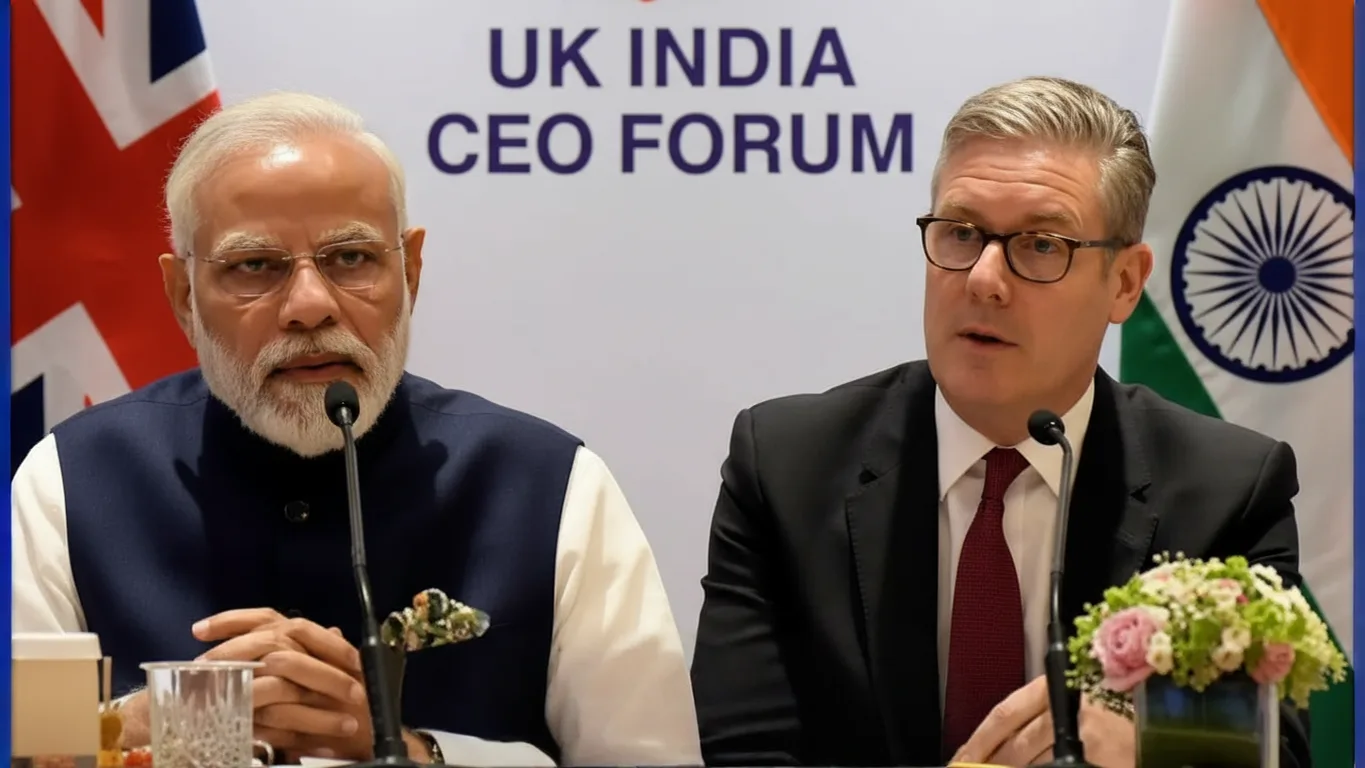
Earlier, during a joint India–UK CEO Forum at the same venue, Starmer and Indian Prime Minister Narendra Modi joined industry leaders in dialogue on investment, innovation and bilateral opportunity. Starmer called it “a celebration of partnership,” saying the gathering was intended to catalyse deal flow, ideation, and trust building. He added that the relationship is not just transactional—but foundational in reshaping future growth trajectories.
It’s worth noting that this visit and message come amid intensifying global competition over fintech, green tech, AI, and digital infrastructure. India, already a rising node in those sectors, holds significant appeal for Western firms seeking market access, talent, and scale. For the UK, deepening ties with India is part of its post-Brexit strategy to pivot eastwards and reduce dependency.
Strategic challenges and the road ahead
Of course, grand statements must translate into results for industry actors to have faith. While Starmer’s remarks signal serious intent, execution will be key. Indian fintech firms often cite regulatory complexity, uncertain governance in foreign markets, and cultural or technical barriers as major deterrents.
To address these gaps, the UK will need seamless legal alignment, reliable cross-border data frameworks, talent mobility visas, and strong bilateral support teams. In that context, the newly announced UK office for financial services investment could play a crucial role—if staffed and empowered.
Starmer’s wider foreign policy framing also surfaced during the visit. When questioned about the Israel-Gaza plan and the Russia-Ukraine conflict, he asserted British backing for peace processes and affirmed dialogues with India over oil purchases and energy strategy.
Through it all, his tone suggested he didn’t view India as merely a strategic ally, but a partner positioned to co-create global norms, regulation, and growth models in the digital age.
What this means for Indian fintechs
For Indian fintechs and deep tech firms, this moment may well mark a pivot: one where international growth could take shape on UK soil with fewer barriers. Establishing entities in the UK offers access to a trusted jurisdiction, strong regulation, and entry into European and Commonwealth markets.
Yet, the move must be judicious—firms will need market research, compliance support, local partnerships, and a clear value proposition. The UK’s invitation lowers entry hurdles; navigating operations and scaling will still fall on firms themselves.
If Starmer and his government deliver on what he promised—fast approvals, simplified compliance, and a supportive ecosystem—the “red carpet” may become a launching pad for India’s fintech champions to reach new global heights.
In Mumbai, the stage was set. Now the real test begins: can the words turn into doors—and can Indian entrepreneurs walk through them?
Disclaimer: This article is based on information available from public sources. It has not been reported by EQMint journalists. EQMint has compiled and presented the content for informational purposes only and does not guarantee its accuracy or completeness. Readers are advised to verify details independently before relying on them.