
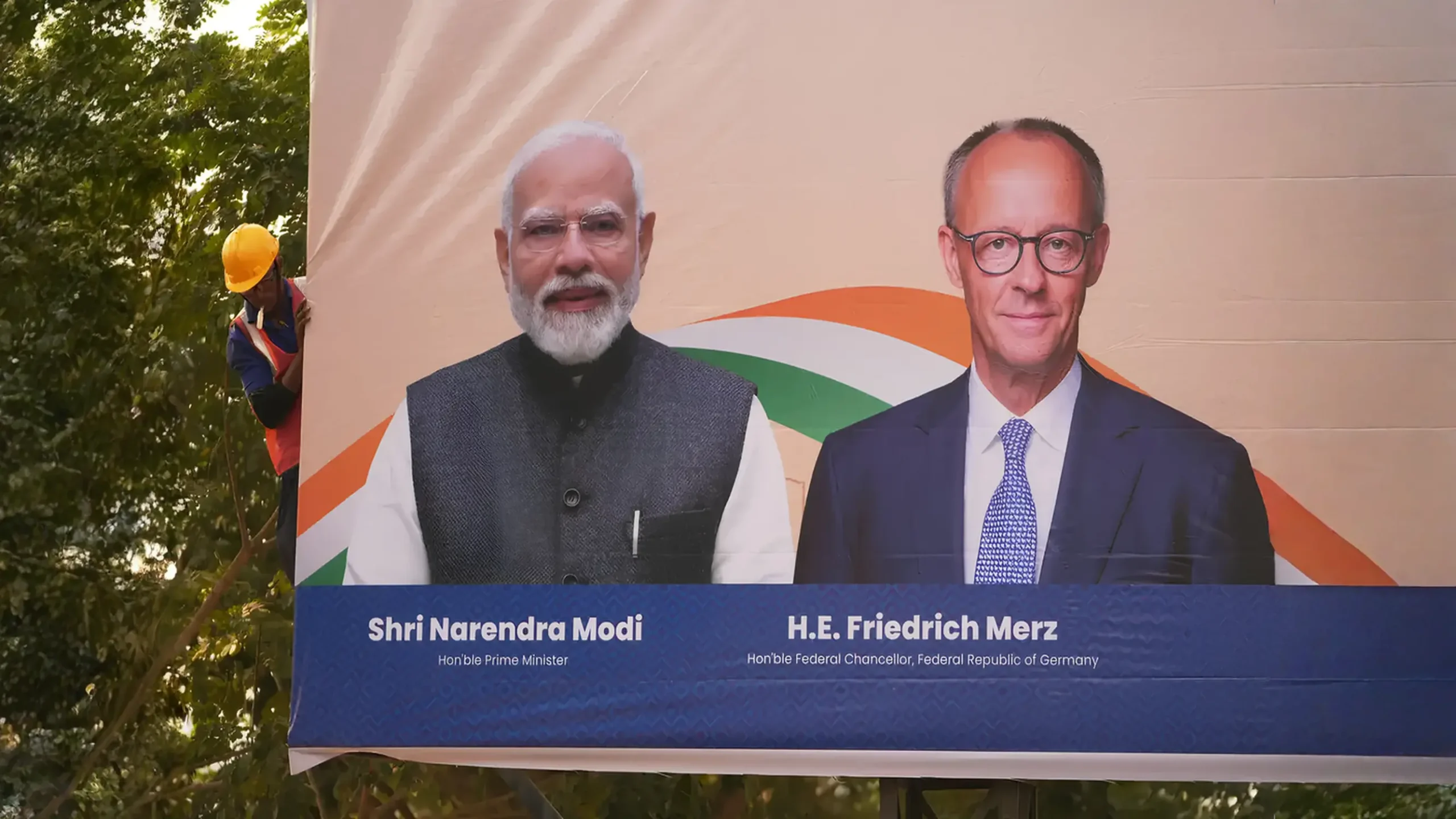
Prime Minister Narendra Modi is meeting German Chancellor Friedrich Merz in Ahmedabad to deepen cooperation in trade, technology, defence and semiconductors. The visit comes ahead of the EU–India summit and amid efforts by both nations to strengthen strategic and economic ties.
Author: Aditya Pareek | EQMint | Business News
PM Modi is set to meet German Chancellor Friedrich Merz on Monday in Ahmedabad, marking a key moment in India–Germany relations. This is Chancellor Merz’s first official visit to India since assuming office last May, and it comes at a time when both countries are looking to deepen strategic, economic, and technological cooperation amid shifting global trade and geopolitical dynamics.
The visit, spread over two days, is being closely watched by policymakers and industry leaders alike, as it coincides with major developments such as the upcoming EU–India summit and ongoing negotiations on a long-awaited India–EU free trade agreement (FTA).
A Warm Welcome and Symbolic Start in Gujarat
Chancellor Merz was received at the airport by the Governor of Gujarat, Acharya Devvrat. Welcoming the German leader, the Ministry of External Affairs said in a post on X that India and Germany are celebrating 75 years of diplomatic relations and 25 years of the India–Germany Strategic Partnership, underscoring the historical depth of bilateral ties.
“Chancellor Merz’s visit and his meeting with PM Modi will further strengthen the India–Germany partnership,” the MEA said, highlighting the strategic importance New Delhi attaches to Berlin.
Visit to Sabarmati Ashram and Kite Festival
The day’s programme blends diplomacy with cultural symbolism. According to the official itinerary, PM Modi and Chancellor Merz will begin the day with a visit to the Sabarmati Ashram at around 9:30 am, where they will pay tribute to Mahatma Gandhi. The visit reflects shared democratic values and a commitment to peace and cooperation.
At around 10 am, both leaders will attend the International Kite Festival at the Sabarmati Riverfront. The festival brings together kite flyers from 50 countries and more than 900 participants from across India, showcasing Gujarat’s cultural heritage through day and night kite flying, heritage havelis, and a dedicated kite museum.
Chancellor Merz is also scheduled to visit the Adalaj Stepwell, a renowned architectural and historical landmark, before formal talks begin.
Bilateral Talks at Gandhinagar
From 11:15 am onwards, PM Modi and Chancellor Merz will hold bilateral talks at Mahatma Mandir in Gandhinagar, where the focus will be firmly on the future of the India–Germany partnership.
According to officials, the leaders will review progress across multiple areas, including:
-
- Trade and investment
-
- Technology and innovation
-
- Pharmaceuticals and healthcare
-
- Defence and security
-
- Science, research, and education
They are also expected to meet business and industry leaders from both countries, reflecting the strong economic dimension of the relationship.
Semiconductors, Defence, and Critical Minerals in Focus
As per a report by Bloomberg, India and Germany are expected to sign agreements related to semiconductor development and defence projects during this visit. These areas have gained urgency as global supply chains are being reshaped and countries seek to reduce strategic dependencies.
Germany is particularly keen to secure better access to critical minerals from India, as Berlin works to reduce its dependence on China amid rising geopolitical disruptions. For India, this aligns with its push to become a key player in global manufacturing, electronics, and high-end technology supply chains.
The discussions are also likely to cover cooperation in advanced manufacturing, clean energy, and green technologies, areas where German companies have deep expertise and Indian markets offer scale and growth.
Why This Visit Matters Now
Chancellor Merz’s visit comes just two weeks ahead of the planned EU–India summit, giving it added diplomatic weight. Observers believe the German leader will use the opportunity to accelerate negotiations on the India–EU free trade agreement, which has been under discussion for years.
The timing is also significant as India seeks to diversify its trade partnerships. Since August last year, the United States imposed steep tariffs—up to 50%—on certain Indian exports, including a 25% penalty linked to India’s purchase of Russian crude. Against this backdrop, stronger economic engagement with Europe, and Germany in particular, has become a strategic priority for New Delhi.
Strong Personal and Political Rapport
PM Modi and Chancellor Merz have developed a cordial working relationship since Merz assumed office. Soon after his swearing-in, the two leaders spoke by phone and have since met twice in person—first on the sidelines of the G7 leaders’ summit in Canada last June, and later during the G20 leaders’ summit in South Africa in November.
These regular interactions have helped maintain momentum in bilateral ties and set the stage for more ambitious cooperation.
India–Germany Ties: A Snapshot
India and Germany have shared a robust partnership for over two decades:
-
- Over 2,000 German companies operate in India
-
- More than 700 Indian companies have investments in Germany
-
- Bilateral trade is close to $50 billion, making Germany India’s most important partner in the European Union
-
- Germany is India’s ninth-largest foreign direct investor, with cumulative FDI of $15.11 billion between April 2000 and March 2025
In FY25 alone, Germany invested $469 million in India, spanning sectors such as transport, electrical equipment, metals, services, chemicals, and automobiles.
Global and Regional Issues on the Table
Beyond economics, PM Modi and Chancellor Merz are also expected to exchange views on key regional and global issues, including geopolitical stability, security challenges, and international cooperation. These discussions aim to strengthen coordination between India and Germany on global challenges at a time of increasing uncertainty.
Bottom Line
Chancellor Friedrich Merz’s first official visit to India marks a pivotal moment for India–Germany relations. With a packed agenda covering trade, technology, defence, semiconductors, and global issues, the meeting with PM Narendra Modi is expected to give fresh momentum to a partnership that has grown steadily over the past 25 years. As India looks to diversify trade ties and Germany seeks reliable partners beyond China, this visit could help shape the next phase of strategic cooperation between the two nations.
For more such news visit EQMint
Disclaimer: This article is based on publicly available information and media reports at the time of publication. Developments may change as official statements emerge. The content is for informational purposes only.