

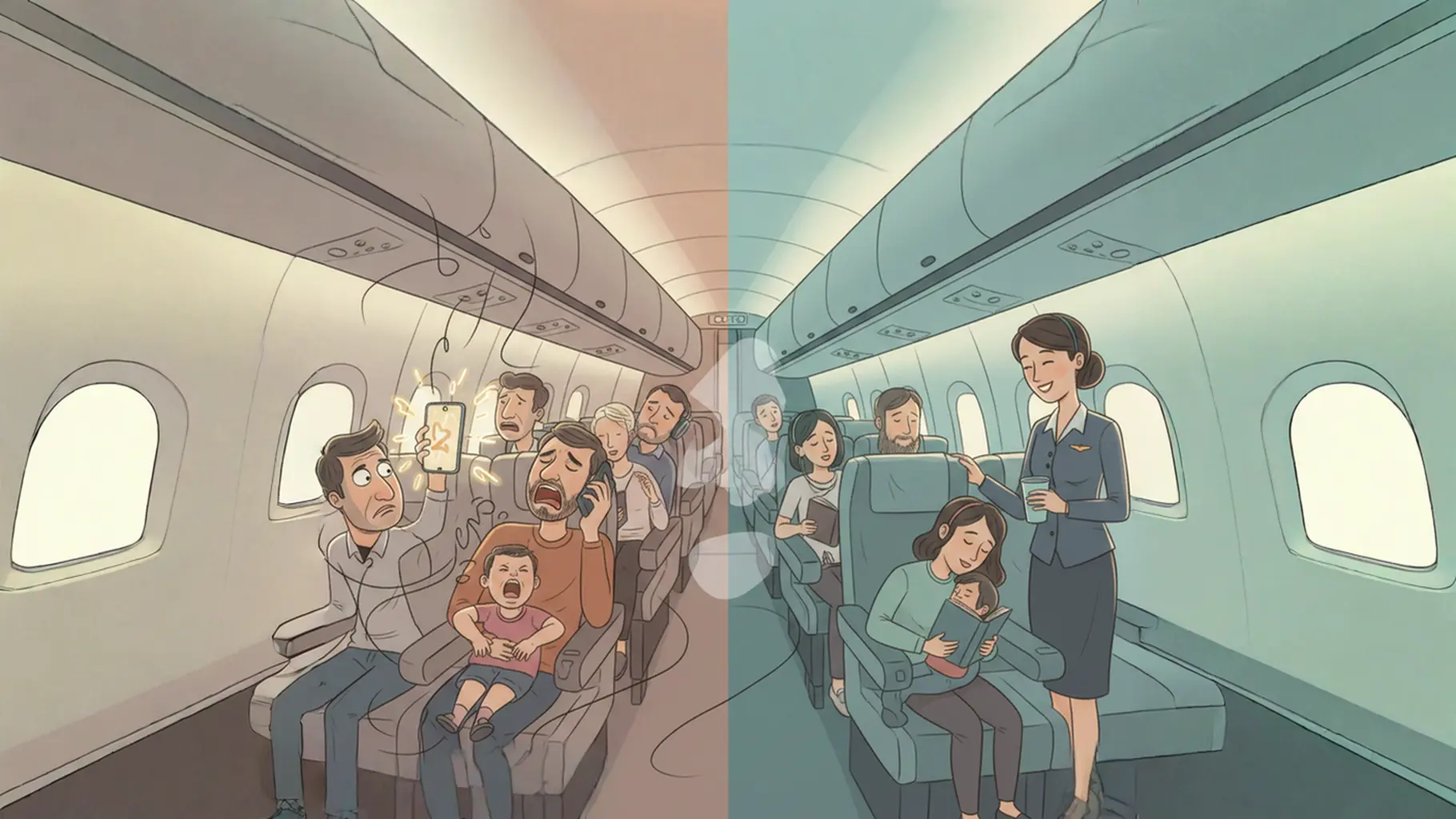
A thoughtful commentary on how everyday public spaces are witnessing a steady decline in civility and shared responsibility. The article explores why courtesy, awareness, and empathy are essential for harmonious coexistence in modern society.
Author: Shruti Swaroop | EQMint
In an age of instant expression and increased individualism, public spaces have become unintended mediums of uncontrolled behaviour. From in-flight cabins to crowded restaurants, Civility, once an unspoken social contract, appears increasingly strained. What was earlier governed by courtesy and mutual awareness is now often negotiated through indifference.
Public places, by definition, require a shared sense of responsibility. An aircraft cabin, for instance, is not merely a mode of transport; it is a confined, high-stress environment where hundreds of strangers coexist for hours. Yet, we find screaming children uncontrolled by parents, blaring phone calls and loud public viewing of personal content on phones, revealing a troubling disregard for collective comfort. In-flight courtesy is not just about compliance; it is about safety, respect, and empathy. Understanding that each one of us have their own set of challenges and may be looking forward to a quiet disconnected time during those flying hours requires just a simple understanding of humanity. Moderating noise levels, respecting personal space, and exercising patience during air travel are small acts that significantly improve the experience for all. An aircraft is the most literal reminder that individual behaviour can directly affect collective outcomes.
I have had similar experiences in theatres, movie halls, and restaurants. Dining out – once considered a social ritual – an experience shaped by conversation, attentiveness, and mutual respect is now continuously interrupted by people speaking above normal decibel levels, children running around places, photos and selfies being taken with other patrons in the background. Business dealings and negotiations happen during a movie screening, interfering with the movie experience for others. There is now a weird sense of entitlement that overlooks the presence of others. What is most disturbing is that any request for changed behaviour in the politest tone is met with accusations of “lack of understanding and empathy.” So, the one disturbing feel disturbed when their behaviour is pointed out.
We live in a world where people prefer tolerating and accepting bad behaviour rather than looking in the mirror and admitting that things are not perfect with them and their family. A crying, stubborn child who is disturbing fellow passengers in an aircraft is “just a child” who needs to be tolerated, and anyone complaining is low on empathy and tolerance. This narrative is better for some than admitting that “we have failed as a parent to teach civility to our children.” Civility is not about rigid formality. It is about awareness – lowering one’s voice, being mindful of shared space, treating others with respect and dignity, and remembering that a public place is a workplace for some as much as it is a leisure space for others. Unfortunately, service staff are often the first casualties of declining civility, enduring frustration that has little to do with them.
What explains this shift? Part of it lies in the blurring of private and public boundaries. Social media and digital life have accustomed us to being the centre of our own narrative, often at the cost of situational awareness. There is also growing impatience – with systems, with people, with inconvenience. When combined with stress, anonymity, and entitlement, courtesy becomes the first casualty. Civility is not an outdated virtue; it is a practical one. It reduces conflict, eases stress, and fosters environments where people feel safe and respected. Courtesy invites courtesy. Calm de-escalates tension. Respect humanises interactions that might otherwise turn transactional or hostile.
Reclaiming civility does not require grand gestures. It begins with simple, conscious choices: waiting one’s turn, acknowledging staff, apologising when at fault, respecting shared norms, lowering volumes both for us and our phones, and remembering that public spaces are collective experiences, not private extensions of our homes.
Institutions can set rules and enforce consequences, but the true guardians of public etiquette are individuals. Civility cannot be legislated into existence; it must be practised daily. In a world growing louder and more fragmented, choosing courtesy is a quiet but powerful act. Public spaces reflect who we are as a society. How we behave in an aircraft cabin or a restaurant says less about the place and more about us. Civility, after all, is not about perfection – it is about consideration. And in shared spaces, consideration is not optional; it is essential.
For more such news visit EQMint
