
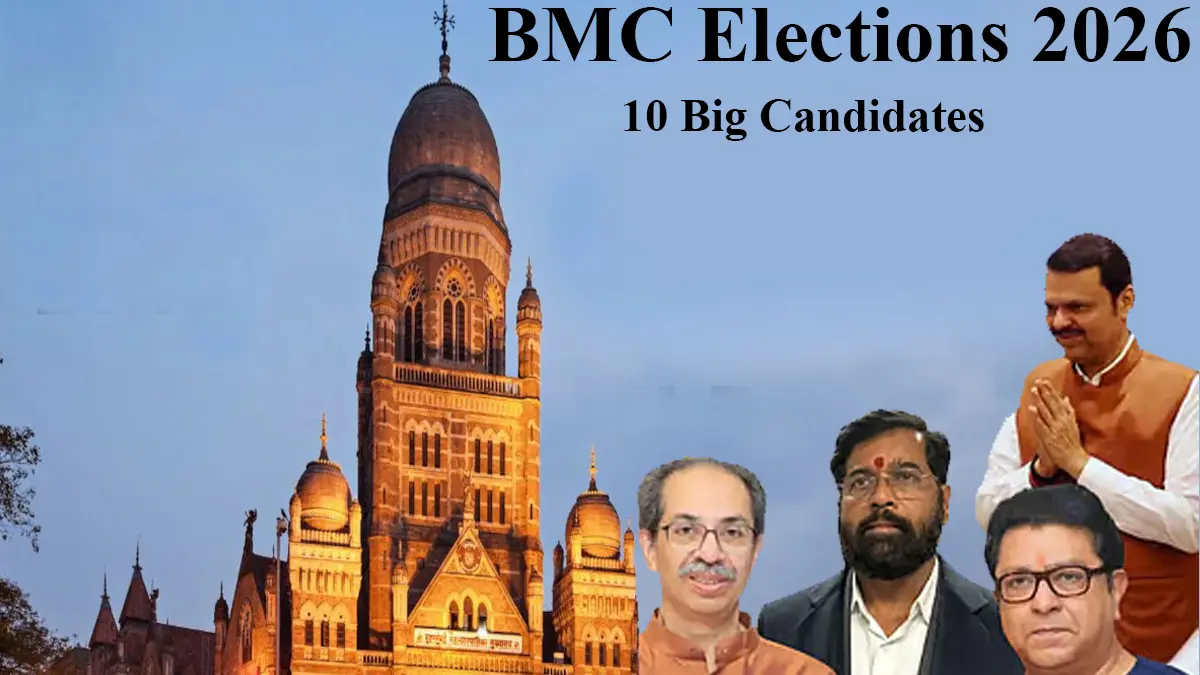
The 2026 Brihanmumbai Municipal Corporation (BMC) elections have emerged as one of the most consequential civic contests in recent years. After an unprecedented delay of nearly four years, Mumbai finally returned to the polls, drawing national attention. Early trends indicate that the BJP–Shiv Sena (Eknath Shinde) alliance is leading against the joint challenge mounted by Uddhav Thackeray’s Shiv Sena (UBT) and Raj Thackeray’s MNS. Beyond seat tallies, the results are being seen as a referendum on shifting alliances, leadership credibility, and the future direction of governance in India’s financial capital.
Author : Aashiya Jain | EQmint | Political News
Why Mumbai’s Civic Election Matters So Much
The BMC election is never just a local affair, but in 2026, its importance has been magnified many times over. Mumbai, the state capital and economic nerve centre of the country, depends heavily on the functioning of its civic body for infrastructure development, public health, transport, and urban planning.
At the heart of this political contest is the sheer scale of participation. Nearly 1,700 candidates are competing for 227 seats in the Brihanmumbai Municipal Corporation (BMC), a civic institution that commands an annual budget of over ₹74,400 crore. Few municipal bodies in India operate with such financial muscle or administrative reach. Adding to the significance is the fact that these long-pending civic polls are being conducted after an almost four-year delay, caused by prolonged legal disputes and administrative challenges that left the country’s richest municipal corporation without an elected council.
A Delayed Election, Renewed Public Interest
Despite voter fatigue and political churn, Mumbai recorded a turnout of around 52.94 per cent, suggesting that citizens were keen to have their voices heard after years of uncertainty. The delay had also intensified scrutiny on political parties, many of which campaigned heavily on issues of governance, accountability, and stalled civic projects.
For voters, the election was not only about party loyalty but also about restoring local decision-making in a city that has struggled with infrastructure strain, flooding, housing shortages, and public transport challenges.
The Major Players and the High-Stakes Face-Off
The 2026 BMC election turned into a dramatic political showdown shaped by fractured alliances and unexpected reunions.
BJP–Shiv Sena (Shinde): The Mahayuti Push
Early counting trends suggest that the BJP and the Eknath Shinde-led Shiv Sena faction, contesting as part of the Mahayuti alliance, have taken a decisive early lead. Their campaign focused on stability, development continuity, and alignment with the state government. The alliance’s performance is being viewed as a consolidation of power in Mumbai, following its success in recent state level political battles.
The Thackeray Brothers’ Comeback Attempt
In a move that caught many by surprise, Uddhav Thackeray and Raj Thackeray joined forces, setting aside years of rivalry to challenge the ruling alliance. Their partnership was pitched as a fight to reclaim Mumbai’s political and cultural legacy. While the combined force showed strength in select pockets of the city, early trends indicate that the alliance has struggled to match the numerical momentum of the Mahayuti camp.
Looking Back to Understand the Shift
The contrast with the 2017 BMC elections is stark. At that time, the undivided Shiv Sena and the BJP were allies, and the Sena emerged as the single largest party. Since then, splits within the Shiv Sena, changing loyalties, and evolving voter expectations have dramatically altered Mumbai’s political landscape.
The 2026 results, therefore, are not just about who wins the civic body, but about how political legitimacy has shifted over the years. Old partnerships have dissolved, new alliances have formed, and voters have been forced to reassess familiar political identities.
What Early Trends Are Telling Us
As counting progressed, a few clear signals began to emerge:
- The Mahayuti alliance appears to be leading in a significant number of wards, indicating effective booth level mobilisation and organisational strength.
- The Thackeray-led alliance continues to hold influence in traditional strongholds, though not at the scale required to dominate the civic body.
- Smaller parties and independents have made limited inroads, suggesting that the contest remains largely bipolar.
These patterns underline how competitive and fragmented Mumbai’s politics has become.
Why the Outcome Goes Beyond Mumbai
Control of the BMC carries implications far beyond civic administration. The corporation’s budget rivals that of some Indian states, and its decisions directly impact millions of residents. Politically, a win in Mumbai boosts morale, strengthens negotiating power, and shapes narratives ahead of future assembly and national elections.
For Maharashtra, the BMC results serve as a political barometer, reflecting public sentiment toward leadership, governance, and alliance politics.
The Road Ahead
As final results are declared, one thing is clear: the 2026 BMC elections mark a turning point in Mumbai’s political story. Whether it leads to a period of stability or fresh contestation, the verdict will shape how the city is governed in the years to come. For Mumbaikars, the hope is that the end of prolonged uncertainty finally translates into responsive, accountable, and effective civic leadership.
For more such information : EQmint
Resource Link : ET