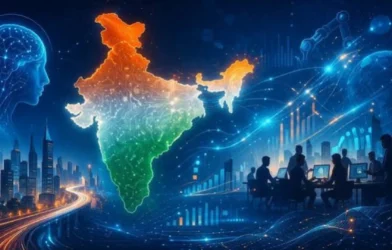


As artificial intelligence begins to shape everything from economic growth to national security, India is grappling with a critical question: can it build AI systems it truly controls? While the country has enormous talent, vast data, and a thriving tech ecosystem, its dependence on foreign AI models and computing infrastructure remains high. India’s push for AI sovereignty is therefore less about racing global giants and more about carefully building the foundation policy, infrastructure, talent, and trust that will define its digital future. The road ahead is long, complex, and deeply human in its implications.
Author: Aashiya Jain | EQMint | FinTech News
Why AI Sovereignty Matters to India
Artificial intelligence is no longer a futuristic concep it is already embedded in daily life, influencing how people work, learn, access healthcare, and interact with the state. For India, AI sovereignty means having the ability to design, deploy, and govern AI systems on its own terms, without being overly dependent on foreign technology providers.
This matters because AI systems handle sensitive data, influence public services, and increasingly shape economic power. When core AI tools are controlled elsewhere, countries risk losing autonomy over data security, policy choices, and even innovation priorities. For a nation as large and diverse as India, relying entirely on external AI systems raises important questions about inclusion, fairness, and long-term resilience.
Where India Stands Today
Globally, AI leadership is concentrated in a handful of countries. The United States and China dominate the development of large, powerful AI models, backed by massive investments in computing infrastructure and research. India, despite its reputation as a global IT powerhouse, does not yet have indigenous, frontier level AI models that can match these leaders.
Most advanced AI tools used in India today especially large language models are developed abroad and accessed through foreign cloud platforms. While these tools are useful, they also highlight a structural dependency that limits India’s ability to fully control how AI evolves within its borders.
The Biggest Roadblocks on the Path
India’s journey toward AI independence is shaped by several interconnected challenges.
One of the most pressing is limited access to high end computing power. Training advanced AI models requires enormous processing capacity, particularly specialised GPUs, which are expensive and largely controlled by global supply chains. India currently has only a small share of the world’s AI compute resources.
Another hurdle is investment depth. While interest in AI is growing, India still invests less in AI research and infrastructure compared to leading economies. This gap affects the scale at which homegrown innovation can grow.
There is also the challenge of coordination. Building AI sovereignty isn’t just about startups or government program it requires alignment between academia, industry, policymakers, and infrastructure providers. Without a cohesive long-term strategy, efforts risk remaining fragmented.
A More Realistic Indian Approach
Rather than attempting to outbuild global AI giants head on, many experts believe India’s strength lies in a different path. The focus is shifting toward purpose driven, context specific AI systems designed for India’s unique needs.
This includes AI tools for healthcare diagnostics in resource limited settings, agricultural advisory systems for small farmers, education platforms in regional languages, and governance tools that work at population scale. India’s linguistic diversity alone presents an opportunity few other countries face or can address as effectively.
India’s past digital successes, such as Aadhaar and UPI, offer a useful lesson. These systems did not dominate globally through sheer size or funding, but through thoughtful design, public private collaboration, and a deep understanding of local realities. A similar philosophy is now being applied to AI.
Policy, Partnerships, and Progress
The government has begun laying the groundwork through initiatives like the IndiaAI Mission, policy consultations, and national AI forums. These efforts aim to boost domestic research, improve access to compute infrastructure, and create ethical frameworks for AI deployment.
Private players are also stepping in, with collaborations between Indian firms and global technology companies helping bridge gaps in the short term. While such partnerships may not deliver full sovereignty immediately, they offer a pragmatic way to build capability while reducing long-term dependence.
Importantly, there is growing recognition that AI sovereignty is not about isolation. It is about informed participation knowing when to build independently, when to collaborate, and how to protect national interests in the process.
The Human Dimension of AI Sovereignty
At its heart, India’s AI journey is not just about technology it is about people. Decisions made today will affect how citizens access services, how workers adapt to automation, and how inclusive future growth will be.
True AI sovereignty means ensuring that technology reflects Indian values, languages, and social realities. It means building systems that serve the many, not just the privileged few. And it means creating safeguards so that innovation does not come at the cost of trust.
Looking Ahead
India’s path to AI independence will not be quick or easy. It demands patience, sustained investment, and long-term thinking. But it also offers a rare opportunity: to shape AI in a way that is democratic, inclusive, and aligned with national priorities.
Rather than chasing global dominance, India appears to be choosing a quieter, steadier route one that focuses on building strong foundations first. If done right, this approach may not only secure India’s digital future but also offer a new model of AI development for the world to learn from.
For more such updates visit EQMint
Resource Link : ET