
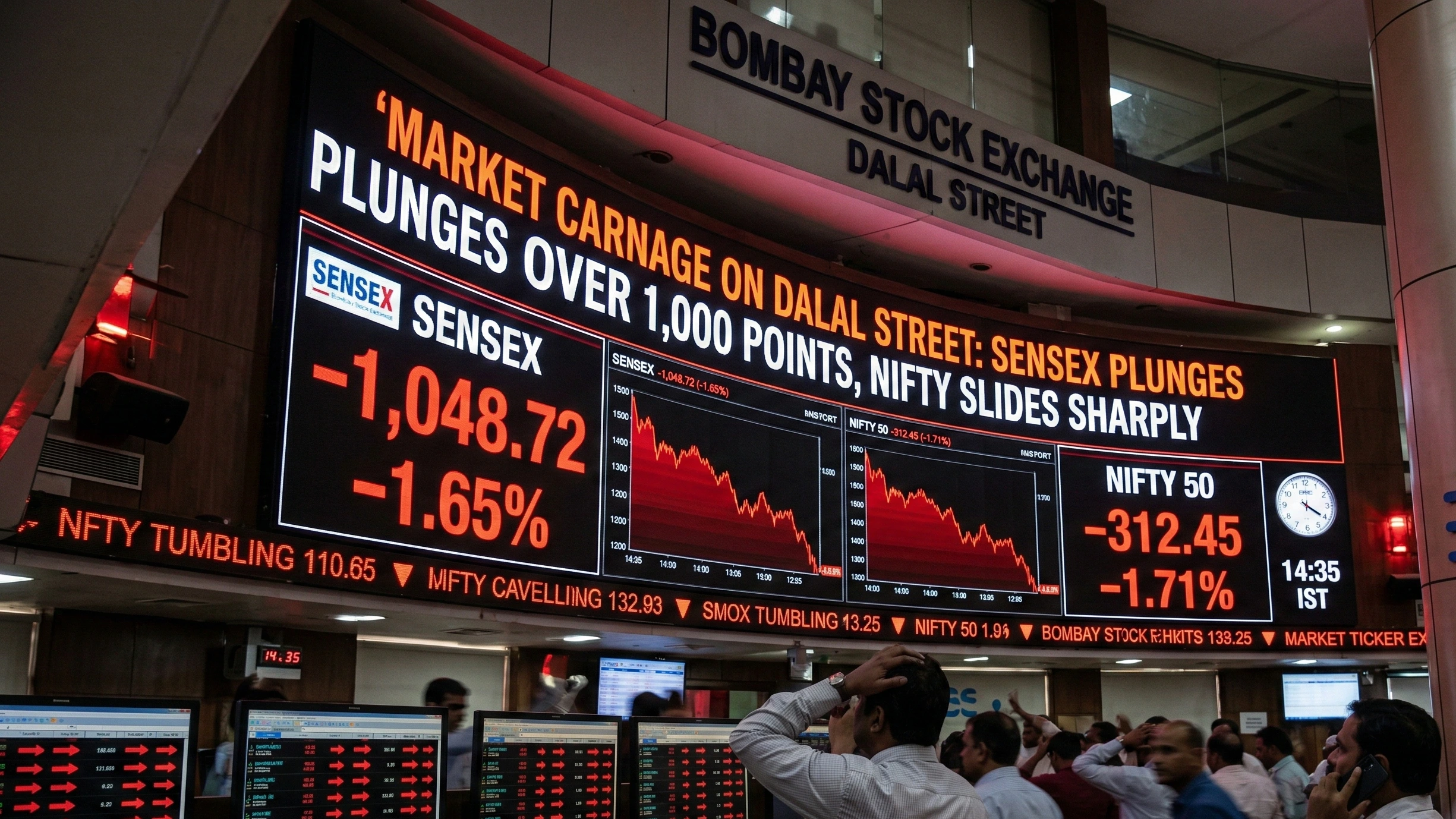
Indian equity markets experienced a dramatic sell-off on Monday, March 2, 2026, as major benchmark indices tumbled significantly. The BSE Sensex declined by 1,048 points to settle at 80,238, while the NSE Nifty 50 dropped 312 points to 24,865 marking a volatile start to the trading week. The sharp downturn was driven by escalating geopolitical tensions in the Middle East, surging crude oil prices, weak global markets, and heavy foreign fund outflows, leaving investors cautious and sentiment fragile. This market carnage was evident on dalal street, highlighting the volatility and uncertainty in the market.
Author : Aashiya Jain | EQmint | Market News
Markets Take a Sharp U-Turn
It was a harsh reality check for investors on Monday as Dalal Street opened under pressure and stayed that way throughout much of the trading session. The 30-stock BSE Sensex often seen as a barometer of market mood fell over a thousand points, ending the day down 1.29 % at 80,238.85. Simultaneously, the NSE Nifty 50 Index was not spared, closing 1.24 % lower at 24,865.70 after substantial selling across sectors.
What makes this slide notable is the breadth of selling. Nearly all major market sectors from energy and banking to consumer goods were weighed down by investor caution, while safe-haven assets like gold strengthened as participants fled riskier assets.
Geopolitical Stress and Crude Oil Surge
A key catalyst for Monday’s market slump has been geopolitical tensions in the Middle East. Global financial markets reacted sharply to news of intensified conflict involving key nations, which pushed crude oil prices sharply higher and stoked fears of inflationary pressure on the global economy. India, being heavily reliant on oil imports, naturally felt the pressure as higher crude prices pose a direct threat to the country’s trade balance and corporate margins for fuel-dependent businesses.
The spotlight on crude was sharp: with key oil shipping routes potentially affected and risk appetite declining globally, traders moved towards safer assets like the U.S. dollar and government securities. The Indian rupee weakened against the dollar, adding to the sense of unease among market participants.
Global Markets and Foreign Fund Outflows
Monday’s domestic slump was mirrored in global stock markets. Weak overseas cues especially in the wake of sell-offs in U. S. and Asian equities conveyed a risk-off sentiment. Investors in India reassessed positions and pared exposure to equities. Foreign Institutional Investors (FIIs) remained net sellers. This intensified downward pressure as they moved capital away from emerging markets including India back into safer assets.
Such outflows often amplify local volatility especially in situations where sentiment is already fragile. One region sells off and it kind of snowballs. India’s not immune to that. FIIs pulling money out just made things worse. It’s like a feedback loop. When they sell emerging markets get hit harder. And when sentiment’s already shaky well that’s when you really see the swings.
Sectoral Impact: Broad Market Weakness
The sell-off did not concentrate in one or two pockets; rather, it spread widely. Auto stocks, banks, consumer goods, and even cyclical sectors encountered heavy selling. In contrast, sectors traditionally seen as defensive and commodities such as gold managed to hold ground better as investors hedged against future economic uncertainty.
Market breadth turned decidedly negative, with significantly more stocks declining than advancing on the exchanges. Rising volatility often measured by the India VIX further reflected nervousness among investors uncertain about near-term outlooks.
What This Means for Investors
A 1,000-plus point fall in the Sensex is scary on the surface but market corrections are part of the broader economic cycle. Especially amid global uncertainty. For many long-term investors these sharp moves can be unsettling but they also spotlight key economic forces at play: geopolitical risk commodity price volatility and shifting capital flows.
Experts often suggest that investors view these periods as an opportunity to reassess risk tolerance and ensure portfolio diversification. While timing the bottom is notoriously difficult maintaining a balanced approach that aligns with financial goals can help weather such volatility.
Conclusion
Monday’s market rout on Dalal Street served as a stark reminder of how interconnected global geopolitics, commodity prices, and investor sentiment have become in guiding financial market movements. With the Sensex down over 1,000 points and the Nifty sliding substantially, caution prevailed across investor circles. Whether this marks a temporary correction or a longer trend hinges on developments both at home and abroad but one thing is clear: markets are sensitive to global shocks, and risk management has never been more pivotal for investors.
For more such information visit EQMint
Disclaimer: This article is not an investment advice and is for educational purpose only