
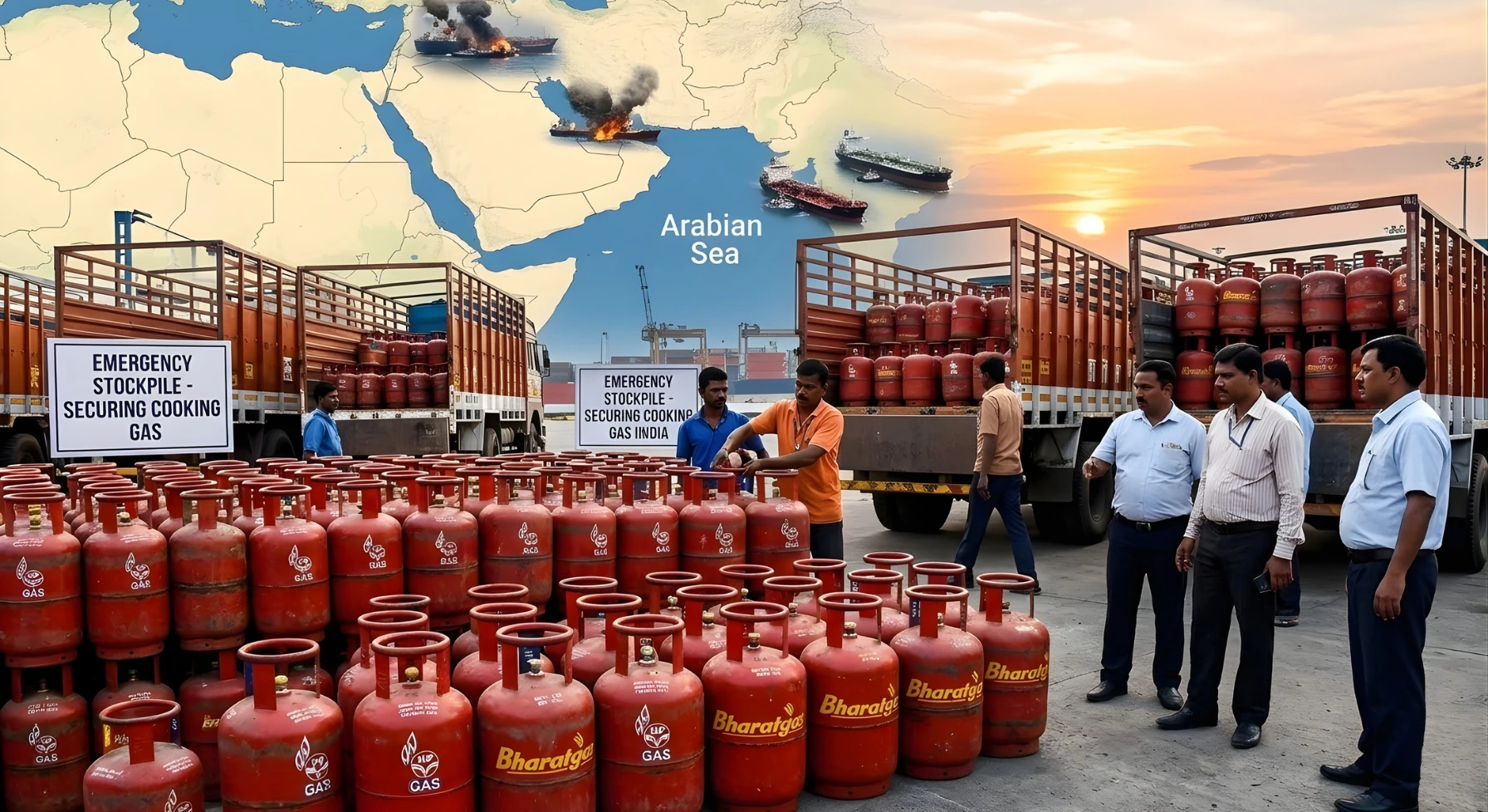
Amid rising geopolitical tensions in the Middle East and the ongoing conflict involving the United States, Israel, and Iran, the Indian government has taken urgent steps to prevent a potential shortage of cooking gas. Authorities have invoked emergency powers and directed domestic oil refiners to increase the production of liquefied petroleum gas (LPG). The move comes as disruptions in global energy supply routes particularly in the Gulf region raise concerns about India’s ability to maintain stable LPG supplies for millions of households.
Author : Aashiya Jain | EQmint | Business News
Emergency Measures to Protect Household Fuel Supply
India has activated emergency measures to make sure households across the country keep getting uninterrupted cooking gas supplies. The government has told domestic refiners to maximise the production of LPG after supply disruptions caused by the escalating conflict in the Middle East raised concerns about shortages.
This decision shows how global geopolitical events can quickly impact everyday life in India. LPG is the main cooking fuel for millions of families especially after the widespread expansion of household connections through government welfare schemes.
According to reports refiners have been asked to use as much propane and butane as possible for LPG production. These gases are usually used in petrochemical manufacturing too but the government has temporarily restricted their diversion to make sure there is enough cooking gas supply.
India’s Heavy Dependence on Imported LPG
India is one of the world’s largest consumers of LPG. In the past year alone, the country used around 33.15 million metric tonnes of LPG, which is mainly a mixture of propane and butane.
However, a large share of this demand is met through imports. Roughly two-thirds of India’s LPG requirement comes from overseas, and 85–90% of those imports originate from the Middle East.
This heavy dependence makes India particularly vulnerable when geopolitical tensions disrupt energy supply routes in the Gulf region. With the Middle East currently facing military escalation, energy shipments have become uncertain, forcing the government to take precautionary steps.
The Strait of Hormuz Crisis and Global Energy Shock
One of the major triggers behind the current energy concerns is the disruption in the Strait of Hormuz one of the world’s most critical oil and gas shipping routes. A significant portion of global energy supplies passes through this narrow waterway connecting Gulf producers with global markets.
Recent military actions and retaliatory strikes in the region have caused shipping disruptions and security risks for tankers. Some shipping companies have even suspended routes through the strait raising fears of global energy shortages and price spikes.
For India which relies heavily on energy imports from the Gulf such disruptions can quickly affect fuel availability and domestic prices.
Protecting Millions of LPG Consumers
India currently has over 330 million active LPG consumers, making cooking gas one of the most critical energy resources for households.
Any shortage could have widespread consequences, particularly for low-income families that rely on LPG as their primary cooking fuel.
To avoid such a scenario, the government has directed producers to supply LPG, propane, and butane directly to the three major state-run oil marketing companies Indian Oil Corporation (IOC), Bharat Petroleum Corporation Limited (BPCL), and Hindustan Petroleum Corporation Limited (HPCL). These companies are responsible for distributing cooking gas cylinders across the country.
By prioritising LPG production and restricting its use in other industries, the government aims to stabilise supplies and prevent panic buying or price spikes.
Exploring Alternative Energy Sources
Apart from increasing domestic production, India is also exploring alternative ways to secure energy supplies. Officials are looking at sourcing LPG and liquefied natural gas (LNG) from other countries to compensate for potential disruptions in the Middle East.
Additionally, India has been considering contingency measures such as increasing crude oil imports from alternative suppliers and tapping into available energy reserves.
These steps form part of a broader strategy to shield the country from the economic fallout of geopolitical conflicts.
A Reminder of Energy Vulnerability
India’s energy security is now more tied to global geopolitical stability than ever before. Even conflicts happening thousands of kilometres away can quickly affect fuel availability and prices back home.
The government’s quick response is meant to prevent any immediate cooking gas shortage but the situation shows just how important it is to diversify energy sources and boost domestic production capacity. For millions of Indian households that depend on LPG every day keeping the supply steady is a top priority especially during this time of global uncertainty.
For more such information visit EQMint