
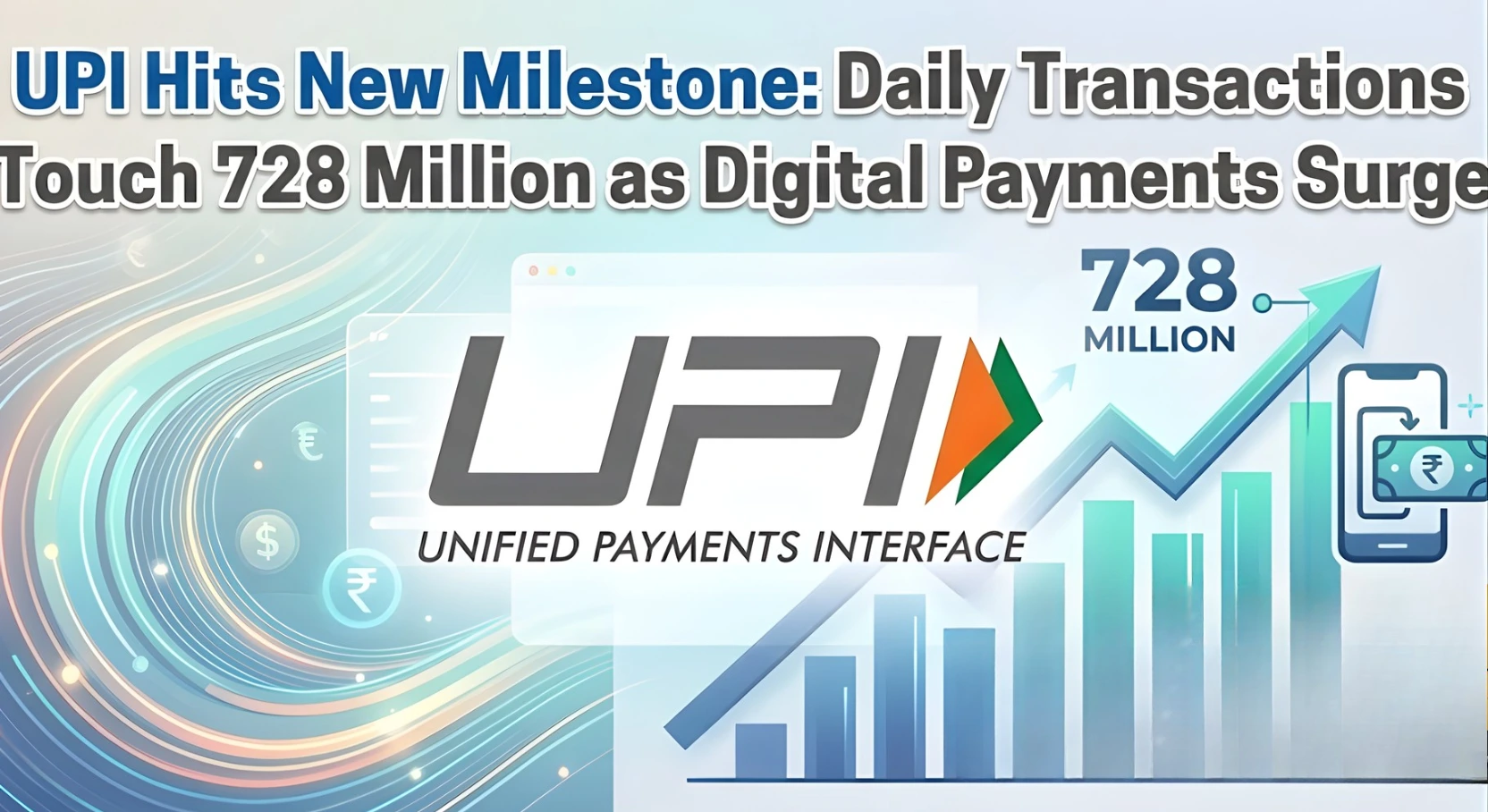
India’s digital payments ecosystem continues to expand rapidly as the Unified Payments Interface (UPI) recorded 20.39 billion transactions in February, reflecting a 27% year-on-year growth. Despite a slight month-on-month dip due to February having fewer days, the platform achieved a new milestone with average daily transactions reaching a record 728 million. The total value of transactions during the month stood at ₹26.84 lakh crore, highlighting UPI’s growing dominance in India’s payment landscape and its role as the backbone of the country’s digital economy.
Author : Aashiya Jain | EQmint | Business News
UPI Continues Its Remarkable Growth Story
UPI just keeps proving how massive India’s digital payment system really is. The numbers from NPCI are wild. In February UPI handled 20.39 billion transactions.
A 27% jump from last year. In terms of value the platform moved ₹26.84 lakh crore in payments. That’s a 22% increase year on year.
UPI processed an average of 728 million transactions every single day in February. That’s the highest daily volume ever recorded. These figures show just how much digital payments have become part of everyday life in India. From street vendors and small shops to big businesses and government services. UPI is everywhere now.
Why February Numbers Matter
While February recorded slightly fewer total transactions compared with January’s 21.70 billion, the drop was largely due to the shorter number of days in the month.
In fact, the average daily activity actually increased. January saw about 700 million daily transactions, while February pushed that number up to 728 million.
Similarly, the average daily transaction value rose to ₹95,865 crore, compared with ₹91,403 crore in January, showing that both the volume and value of transactions per day continue to grow.
This steady rise indicates that digital payments are no longer just a convenience they are becoming the primary financial transaction method for millions of Indians.
UPI: The Backbone of India’s Digital Economy
UPI was introduced in 2016 as an instant payment system developed by the National Payments Corporation of India to enable real-time bank-to-bank transfers through mobile devices. Over the years it has transformed the way Indians pay and receive money.
Users can send funds instantly using just a mobile number or a UPI ID without needing bank account details. The platform supports both person-to-person P2P and person-to-merchant P2M transactions making it widely used across retail payments bill payments online shopping and even small everyday purchases.
Today UPI is considered the largest real-time payment system in the world handling hundreds of millions of transactions daily. From roadside tea stalls to e-commerce platforms the system has become a universal payment method across India.
Growing User Base and Merchant Adoption
One of the main reasons behind UPI’s rapid growth is its expanding user base. According to industry estimates, the platform now has around 450 million users, with nearly 200 million active users every day.
The adoption of QR-code payments, integration with popular apps, and government initiatives promoting digital payments have further accelerated its usage.
Merchants, both large and small, have embraced UPI because it offers instant settlement, low transaction costs, and ease of use. This widespread acceptance has helped UPI penetrate even rural and semi-urban markets.
UPI Expanding Beyond India
UPI’s international growth is another big development. The platform has already launched in countries like UAE, Singapore, Bhutan, Nepal, Sri Lanka, France, Mauritius, and Qatar. This expansion lets Indian travelers and businesses abroad use the same digital payment system they rely on back home.
Cross-border partnerships are also being explored to connect UPI with other countries’ payment systems. This could make global transactions much simpler.
What Lies Ahead for Digital Payments
Despite its rapid growth, experts believe unified payment interface still has significant expansion potential. Industry leaders and policymakers are working on strategies to bring 200–300 million more users into the digital payment ecosystem.
Initiatives such as offline payments, voice-based transactions, and new fintech innovations are expected to make digital payments even more accessible.
For now, February’s record-breaking numbers serve as another milestone in India’s digital transformation journey. As it continues to grow, it is not only reshaping how people pay but also strengthening India’s position as a global leader in financial technology.
For more such information visit EQMint