
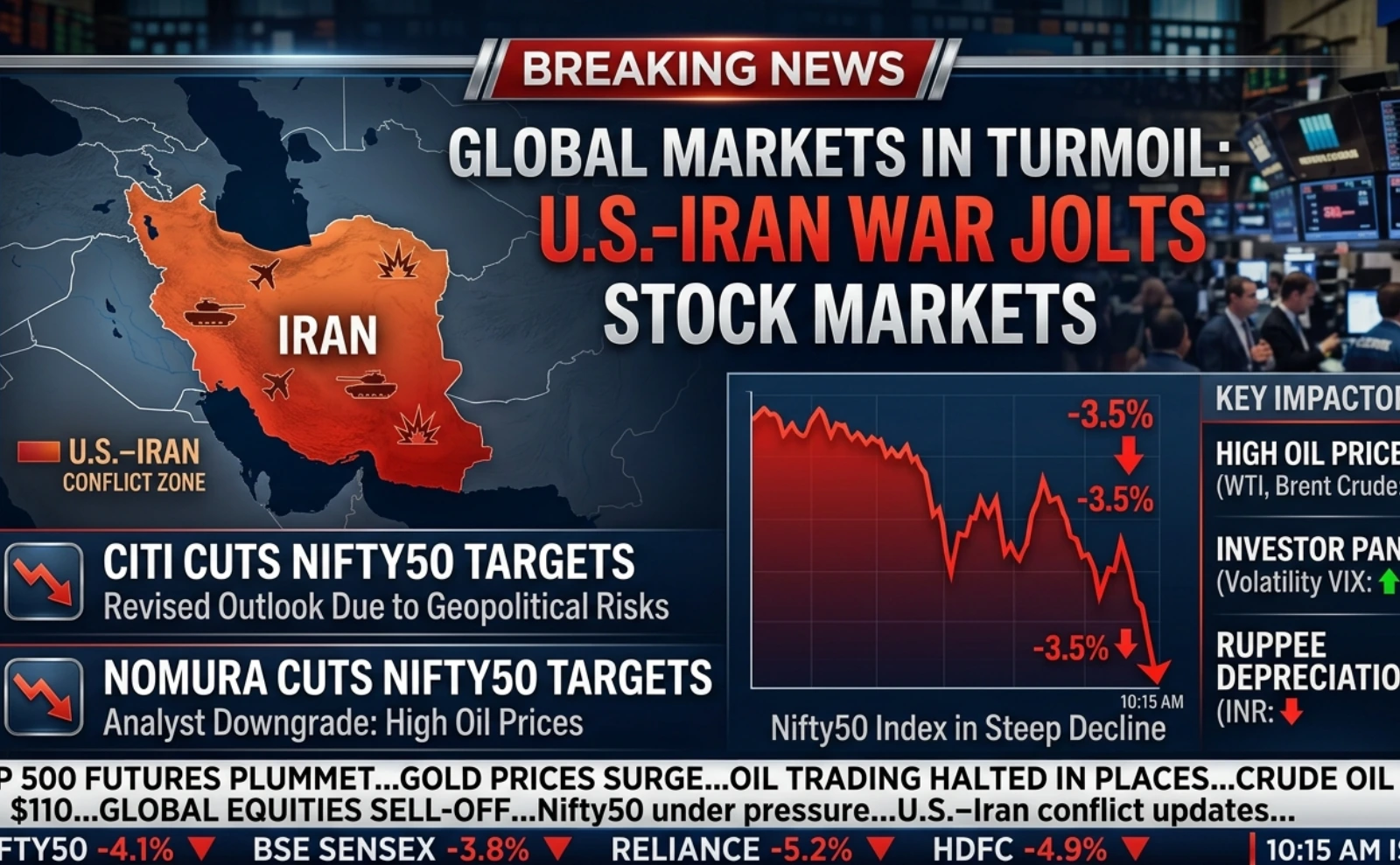
The ongoing conflict involving the United States and Iran has begun to ripple through global financial markets, including India’s stock market. Rising geopolitical tensions, surging oil prices, and fears of supply disruptions have forced major global brokerages such as Citi Research and Nomura to lower their outlook for India’s benchmark index, the Nifty50. While the Indian economy remains fundamentally strong, analysts warn that prolonged instability in the Middle East could weigh on market sentiment, corporate earnings, and economic growth in the coming months.
Global Conflict Sends Shockwaves Through Markets
Geopolitical issues tend to generate uncertainty in the financial markets, and the ongoing conflict between the United States and Iran is proving to be no exception. Investors worldwide have been cautious in their response to the ongoing developments in the Middle East.
The conflict has already affected the global energy supply chain and driven the price of crude oil to higher levels. Brent crude has broken the $100 per barrel level, and this is likely to have a negative impact on inflation and import costs for countries that import a large portion of their energy requirements.
The impact of higher crude oil prices could be significant for India, which imports a large portion of its crude oil requirements.
Citi and Nomura Revise Nifty50 Outlook
Reflecting the rising uncertainty, global brokerage firms have adjusted their market forecasts.
Citi Research has also trimmed its year-end target for the Nifty50 to 27,000 from its earlier estimate of 28,500. This still implies some upside from the current levels but also points to a cautious market given the rise in macroeconomic risks.
However, Nomura has taken a more conservative view, reducing its target to 24,900 from 29,300. This points to a minimal upside in the market.
Experts have also opined that the ongoing geopolitical tensions may have a higher disrupting potential compared to earlier crises given the region’s importance in global trade. In particular, the Strait of Hormuz, through which close to 20-25% of global oil and LNG trade passes, has become a major flashpoint in the ongoing tensions.
If there is a disruption in this route, then oil prices may rise again, leading to higher levels of inflation.
Market Volatility and Investor Concerns
The effects of the conflict have already been witnessed in Indian markets. The major indices, such as Sensex and Nifty, have witnessed sharp movements, with heavy selling pressure observed in various sectors.
Within a short period of one week, investor wealth worth close to $240 billion was erased as markets responded to the intensifying geopolitical crisis.
Foreign investors have also been cautious, with heavy outflows of capital observed in the past few weeks. However, sectors that are highly import-dependent, such as petrochemicals, fertilizers, and energy-intensive industries, are expected to be most affected by the rising prices of crude oil.
Small-cap and mid-cap stocks may also come under pressure if global uncertainty continues.
What Lies Ahead for the Indian Market
Despite the turbulence, experts believe that the situation will not permanently impact India’s long-term growth story. However, short-term volatility is expected to continue.
Citi estimates that if supply disruptions continue, India’s economic growth rate is expected to dip by 20 to 30 basis points, while inflation is expected to increase by 50 to 75 basis points.
Another correction of 5 percent in the markets is expected if geopolitical tensions increase and oil prices continue to rise.
Experts have recommended investors to remain cautious but not panic, as market cycles tend to react sharply to geopolitical events, but over time, they tend to stabilize as the situation begins to normalize.
A Test of Market Resilience
The US Iran conflict has once again highlighted how closely global geopolitics and financial markets are connected. From energy prices to investor sentiment, events unfolding thousands of kilometers away can quickly influence the performance of stock markets like India’s.
While the current situation has introduced volatility, the coming months will reveal whether the crisis remains a temporary disruption or evolves into a larger economic challenge for global markets.
For more such information visit EQMint
Disclaimer: This article is not an investment advice and is for educational purpose only