
The war for your data just got personal. Two of the world’s most powerful tech moguls are sounding the alarm on the world’s most popular messaging app.
Author: Ashish Pareek | EQMint
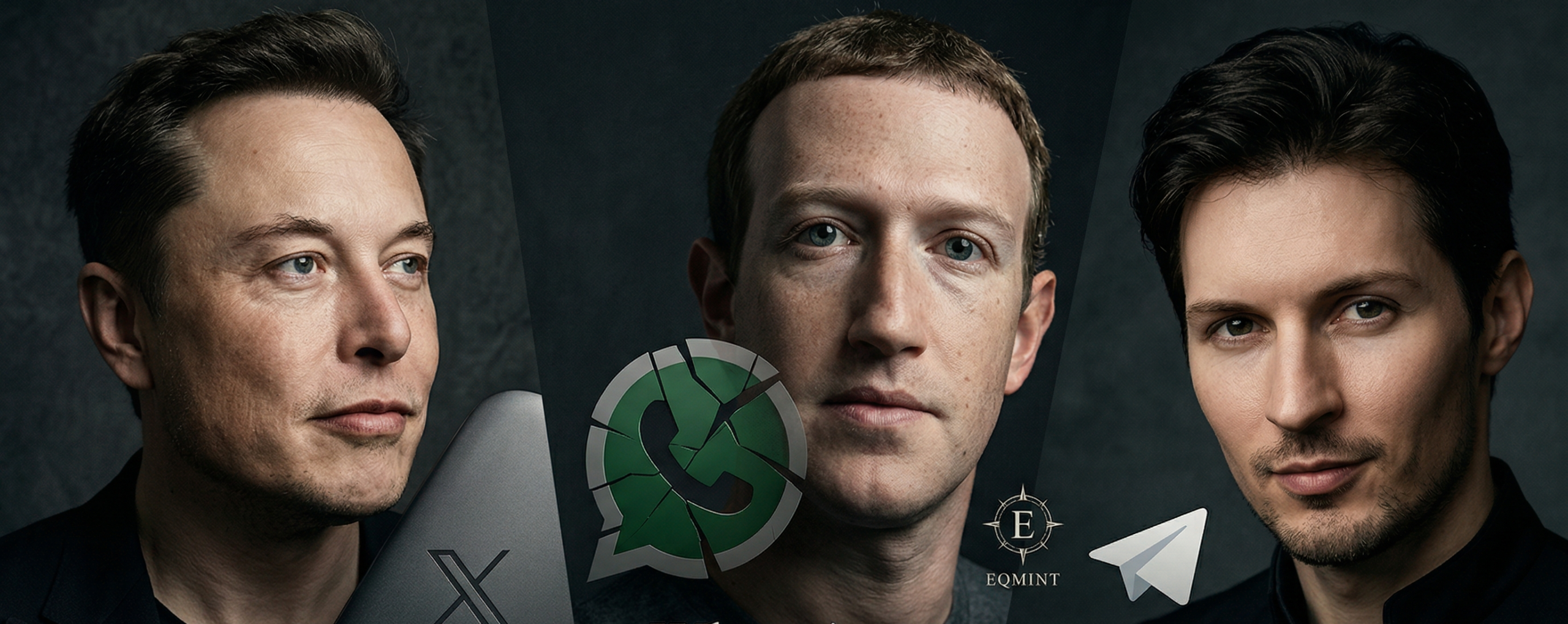
In a coordinated-yet-explosive series of statements, X-owner Elon Musk and Telegram founder Pavel Durov have publicly branded WhatsApp as a security risk, urging billions of users to reconsider where they host their private conversations. The allegations have sent shockwaves through Silicon Valley, forcing Meta to issue a rare, high-stakes defense of its encryption protocols.
“Can’t Trust WhatsApp”: The Musk Bombshell
The firestorm began when Elon Musk responded to a technical report alleging that WhatsApp’s microphone access and background data tracking were more invasive than disclosed. Musk, who has a long-standing rivalry with Meta CEO Mark Zuckerberg, was blunt: “Can’t trust WhatsApp.”
Musk didn’t stop there. He used the momentum to pivot the conversation toward X Chat, claiming that the integration of private messaging into the X ecosystem offers “actual privacy” compared to Meta’s data-hungry advertising machine. For many users, Musk’s words carry weight, especially following his acquisition of X and his push for “everything app” functionality.
Durov’s ‘Fraud’ Allegation: Is Encryption a Lie?
While Musk’s critique was brief, Telegram’s Pavel Durov delivered a detailed manifesto against his primary competitor. Durov described WhatsApp’s marketing of end-to-end encryption (E2EE) as “the biggest consumer fraud in history.”
According to Durov, while the messages might be encrypted in transit, “backdoors” and metadata sharing mean that your privacy is an illusion. He alleged that:
- WhatsApp metadata reveals exactly who you talk to and when.
- Cloud backups often bypass encryption, leaving chats vulnerable to law enforcement and hackers.
- Telegram’s architecture is fundamentally more transparent than Meta’s “closed-box” system.
“Deceiving billions of users is not a feature; it’s a business model. Despite its claims, WhatsApp shares data with third parties—something Telegram has never done and never will.”
— Pavel Durov, Telegram CEO
Meta Fires Back: “Absurd and Categorically False”
Meta was quick to mobilize its PR machinery. A spokesperson for WhatsApp dismissed the claims as a desperate attempt by rivals to gain market share through misinformation. Meta reiterated that WhatsApp has utilized the Signal Protocol for over a decade- the industry gold standard for privacy.
“The claims are categorically false,” Meta stated.
“End-to-end encryption means exactly that. No one, not even Meta, can read your messages. These allegations are not based on technical reality but on corporate rivalry.”
| Feature | WhatsApp (Meta) | X Chat (Musk) | Telegram (Durov) |
|---|---|---|---|
| Encryption | Signal Protocol (E2EE) | Proprietary / Peer-to-Peer | MTProto (Optional E2EE) |
| Data Linkage | High (Linked to FB/IG) | Linked to X Profile | Minimal / Independent |
Ashish Pareek’s Take: Who Should You Believe?
At Eqmint, we’ve analyzed the technical frameworks of all three platforms. While Meta’s encryption is robust on paper, the metadata (the data about your data) remains their most valuable asset. Musk and Durov aren’t just fighting for your privacy – they are fighting for your attention and trust.
If you prioritize absolute anonymity, the Signal app remains the expert choice. However, for the average user, the choice between WhatsApp, X, and Telegram is increasingly becoming a question of which billionaire’s ecosystem you trust more with your digital life.