

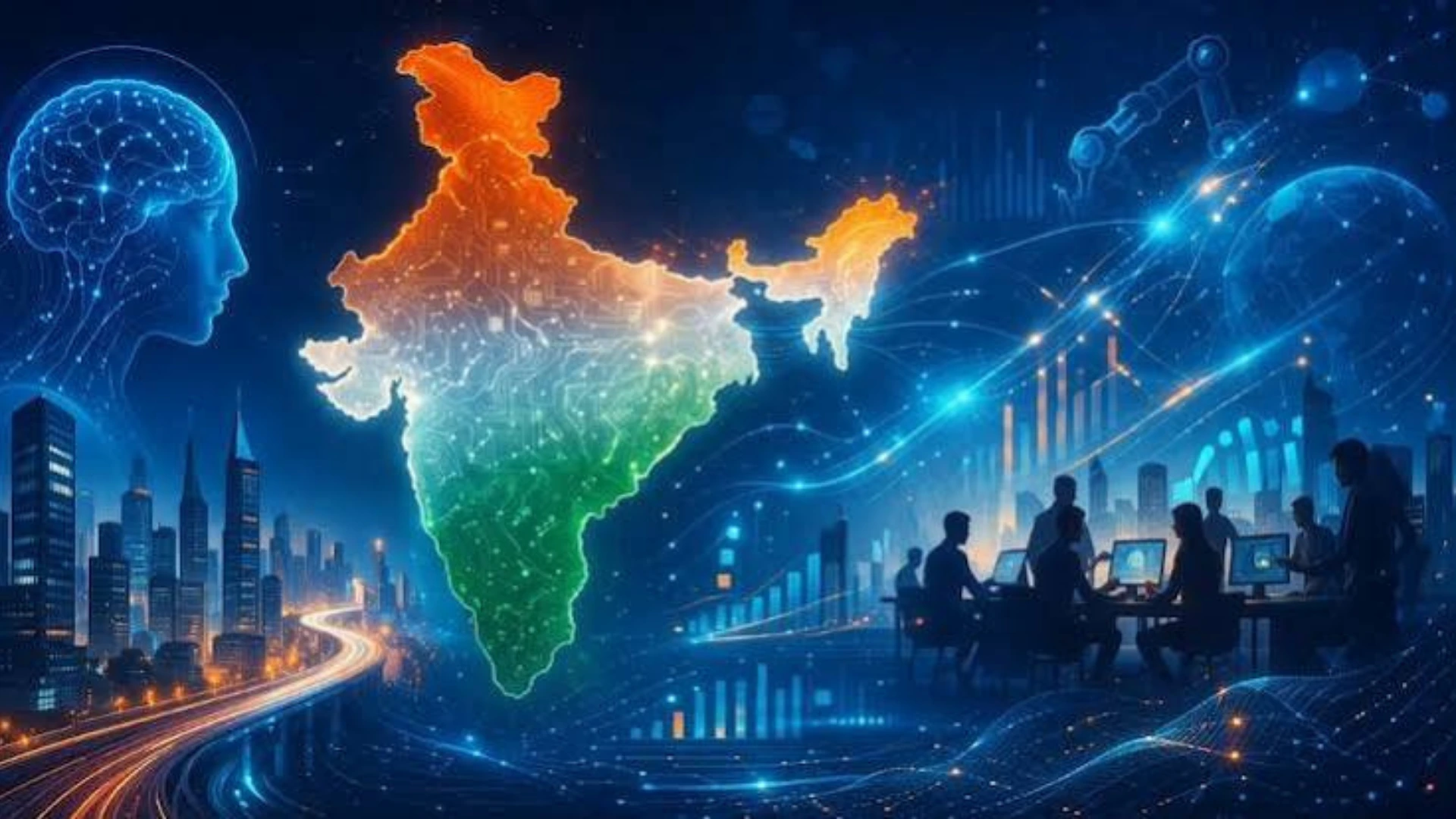
Synopsis: Artificial Intelligence (AI) is no longer limited to research departments or technology companies. It has become a strategic tool, that transform industries around India—from banking and healthcare to manufacturing, agriculture, and small businesses. Aided by government initiatives, such as the IndiaAI Mission and increasing private investment, AI addition is accelerating across sectors. However, the question does not go around whether India will adopt AI, but whether industries are using it effectively and what it means for the country’s economic future.
July 1, 2026: India’s AI Story Has Moved Beyond Big Tech
For years, Artificial Intelligence was seen primarily as a technology associated with Silicon Valley or global software giants. Today, the landscape looks significantly different. India is positioning itself as one of the world’s fastest-growing AI markets, with businesses applying AI into everyday operations rather than thinking it as a futuristic concept.
Author: Tavisha Kanodia | EQMint | Technology
According to NASSCOM, India’s AI market is expected to bloom over the upcoming years, driven by increasing enterprise adoption, digital infrastructure, cloud computing, and government-backed initiatives. The launch of the IndiaAI Mission, approved with an outlay of over ₹10,000 crore, shows the government’s plan to strengthen AI computing infrastructure, research, startups, and skill development.
Banking and Healthcare Lead India’s AI Transformation
Among all industries, banking has emerged as one of the fastest users of Artificial Intelligence. Banks are using AI for fraud detection, customer support through virtual assistants, credit risk assessment, anti-money laundering systems, and personalised financial products. As digital payments continue to expand through UPI and mobile banking, AI has become an inseparable tool for managing large volumes of transactions securely and efficiently.
Healthcare is experiencing a similar transfiguration. Hospitals and diagnostic centres are deploying AI to help doctors in analysing medical images, detecting diseases at earlier stages, improving patient management, and streamlining administrative processes. AI is also helping in drug discovery and supporting telemedicine services, making quality healthcare more accessible, mainly in underserved regions.
These developments are supported by India’s growing digital public infrastructure and increasing availability of healthcare data, although experts continue to stress the importance of strong data privacy safeguards and ethical AI deployment.
Manufacturing, Agriculture, and MSMEs Are Catching Up
Manufacturing is entering a new level through AI-powered automation and predictive maintenance. Smart factories use sensors and machine learning algorithms to monitor equipment performance, reduce downtime, improve quality control, and optimise supply chains. As India seeks to strengthen domestic manufacturing under initiatives such as Make in India, AI is expected to play an important part in enhancing productivity and global competitiveness.
Agriculture, traditionally known as less technology-intensive, is also now adopting AI. Farmers now have access to AI-based advisory platforms that provide weather forecasting, pest detection, crop health monitoring through satellite imagery, and precision farming recommendations. These technologies help optimise resource usage while improving crop yields and reducing production risks.
Perhaps the most significant shift is occurring among Micro, Small and Medium Enterprises (MSMEs). Historically constrained by limited financial and technological resources, many small businesses are now leveraging affordable AI tools for customer service, inventory management, accounting, digital marketing, and business analytics. The growing availability of cloud-based AI solutions has lowered entry barriers, allowing even smaller enterprises to participate in India’s digital economy without substantial capital investment.
The Real Challenge Is Not Adoption—It’s Readiness
While AI adoption is accelerating across industries, experts believe India’s long-term success will depend less on technology itself and more on the ecosystem supporting it. High-quality datasets, skilled professionals, responsible regulation, cybersecurity, and computing infrastructure remain essential for scaling AI applications sustainably.
The government has taken several steps through the IndiaAI Mission to strengthen AI research, semiconductor capabilities, startup funding, and talent development. Industry bodies, including NASSCOM, have also emphasised the importance of reskilling the workforce as AI becomes embedded across business functions.
At the same time, concerns around job displacement, algorithmic bias, data privacy, and ethical governance continue to shape discussions around AI deployment. Rather than replacing human expertise entirely, many organisations are increasingly adopting AI as a collaborative tool that enhances productivity while allowing employees to focus on higher-value work.
India’s AI journey, therefore, is entering a more mature phase. The conversation is no longer centred on whether businesses should adopt Artificial Intelligence but on how responsibly, efficiently, and inclusively they can integrate it into their operations. As AI becomes a foundational layer of economic activity, the industries that successfully combine technology with human capability are likely to emerge as the country’s next engines of growth.
For more such information visit EQMint
Join our Whatsapp channel for timely updates: Whatsapp
Disclaimer: This article is not an investment advice and is for educational purpose only.