
Author: Aadarsh Patel | EQMint | Sustainability News
Every day, India generates thousands of tonnes of plastic waste. For years, much of it ended up in landfills, rivers, and open dumping sites, creating an environmental challenge that continues to grow.
One professor from Madurai looked at the same problem and saw an opportunity.
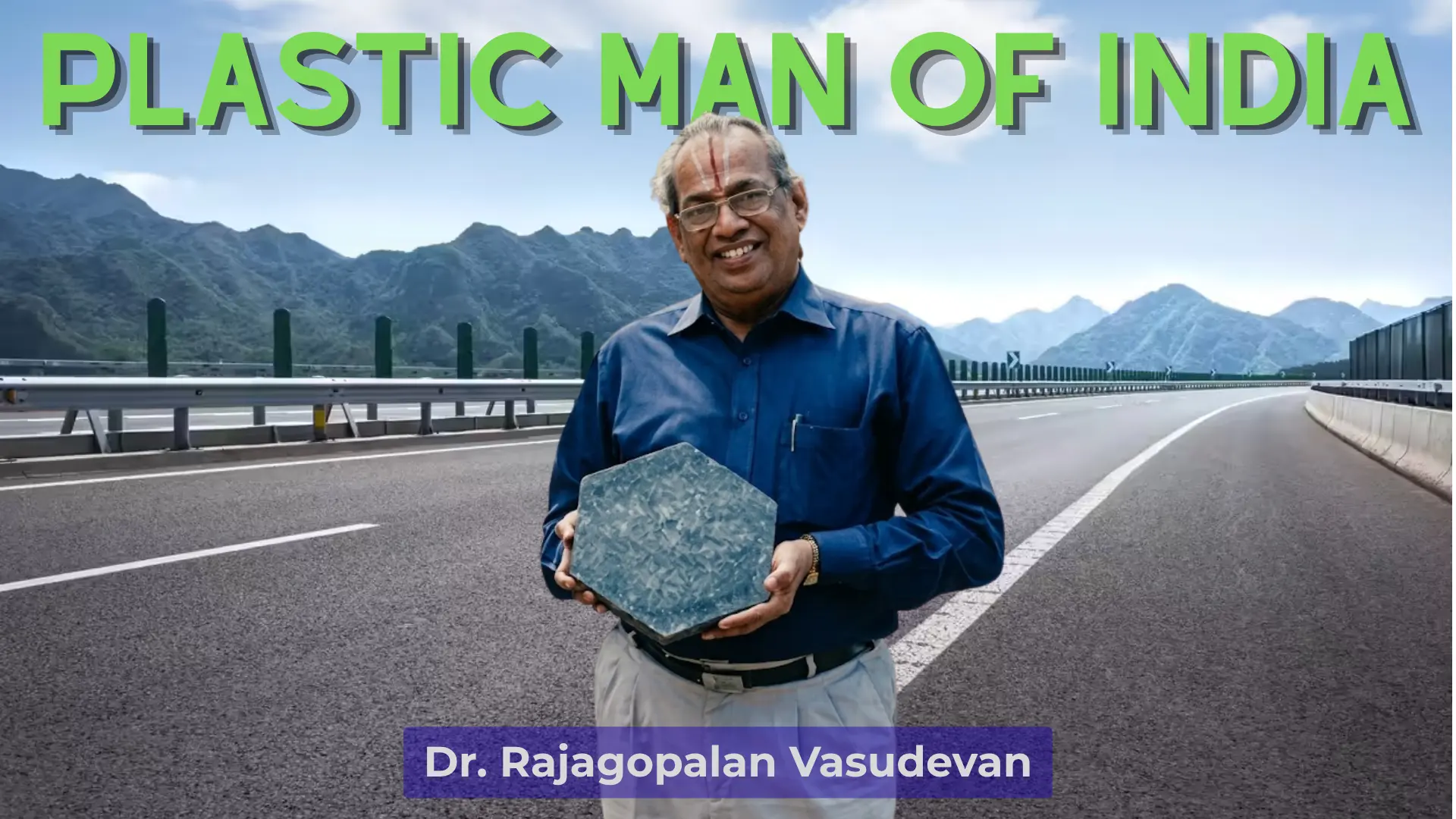
Dr. Rajagopalan Vasudevan, often called the “Plastic Man of India,” developed a simple yet effective method to use waste plastic in road construction. His idea has changed how roads are built across the country, turning discarded plastic into stronger, more durable highways.
Today, more than 10,000 km of roads have been built using this technology, proving that a local innovation can deliver national impact.
A Classroom Experiment That Changed Road Construction
Dr. Rajagopalan Vasudevan was a chemistry professor at Thiagarajar College of Engineering in Madurai, Tamil Nadu.
While researching ways to manage increasing plastic waste, he experimented with shredded plastic mixed into hot aggregates used for road construction. The results surprised even experienced engineers.
The plastic coated the stone aggregates before bitumen was added. This improved the bonding between materials, making the final road surface stronger and more resistant to water damage.
What began as an academic experiment soon attracted the attention of engineers and government agencies looking for practical waste management solutions.
How Plastic Roads Are Built
The process is straightforward and can be integrated into existing road construction methods.
Collected plastic waste such as:
- Carry bags
- Food packaging
- Disposable cups
- Plastic wrappers
- Multi-layer plastic packaging
is cleaned, shredded into small pieces, and heated with aggregates at around 170°C.
The plastic melts and forms a thin coating around the aggregates before hot bitumen is mixed in. This creates a stronger bond compared to conventional road construction.
The process does not require entirely new machinery, making it easier for contractors to adopt.
Why Plastic Makes Roads Better
Several studies and field projects have shown that roads built using waste plastic perform better than conventional asphalt roads under many conditions.
Some of the key advantages include:
- Better resistance to water seepage
- Reduced formation of potholes
- Improved flexibility during temperature changes
- Higher durability under heavy traffic
- Lower maintenance requirements
- Productive use of plastic waste that would otherwise become pollution
In regions that experience heavy monsoon rains, improved water resistance helps extend the lifespan of road surfaces.
From Madurai to Thousands of Kilometres Across India
The success of the initial projects encouraged wider adoption.
Over the years, multiple state governments, municipal bodies, and national agencies began using plastic waste in road construction.
The technology gained further momentum after the Ministry of Road Transport and Highways encouraged the use of waste plastic in road projects, particularly for roads located within a specified distance of urban areas where plastic waste is readily available.
Plastic roads have since been constructed in states including:
- Tamil Nadu
- Karnataka
- Maharashtra
- Kerala
- Himachal Pradesh
- Uttar Pradesh
- Rajasthan
- Delhi
- Gujarat
Together, these projects account for more than 10,000 km of plastic roads across India.
One of the earliest roads built using Dr. Rajagopalan Vasudevan’s technology has reportedly remained in excellent condition for over two decades, demonstrating the long-term performance of the innovation.
Solving Two Problems With One Solution
India faces two significant infrastructure challenges.
The first is managing millions of tonnes of plastic waste generated every year.
The second is maintaining road networks that frequently suffer damage from water, heat, and heavy traffic.
Plastic road technology addresses both issues at once by giving low-value plastic waste a productive use while improving road quality.
Although this approach is not a complete solution to plastic pollution, it creates an additional recycling pathway for certain plastic materials that are otherwise difficult to recover.
Global Recognition for an Indian Innovation
Dr. Rajagopalan Vasudevan’s work has earned recognition from scientific institutions, policymakers, and environmental organisations.
He has received several national honours, including the Padma Shri, for his contribution to sustainable infrastructure and waste management.
His research has inspired engineers and governments beyond India to study similar methods of incorporating recycled plastic into road construction.
The innovation continues to demonstrate how scientific research can deliver practical solutions with measurable environmental and economic benefits.
The Road Ahead
As India expands its highway and urban road networks, sustainable construction practices are becoming increasingly important.
Using recycled materials wherever technically feasible can reduce pressure on natural resources while helping cities manage growing volumes of waste.
Plastic roads are one example of how circular economy principles can be applied to public infrastructure. They show that materials once considered waste can become part of long-lasting public assets.
For Dr. Rajagopalan Vasudevan, the journey started inside a college laboratory. Today, his idea supports roads that connect cities, towns, and villages across the country while giving discarded plastic a second life.
Innovation sometimes begins with asking a simple question: Can waste become a resource? In this case, the answer has already been paved across thousands of kilometres of Indian roads.
Frequently Asked Questions
Who is Dr. Rajagopalan Vasudevan?
Dr. Rajagopalan Vasudevan is an Indian scientist and former professor at Thiagarajar College of Engineering in Madurai. He is widely known as the “Plastic Man of India” for developing plastic road technology.
How are plastic roads made?
Waste plastic is cleaned, shredded, and mixed with hot stone aggregates before bitumen is added. The melted plastic coats the aggregates, improving the strength and durability of the road.
What are the benefits of plastic roads?
Plastic roads are more resistant to water damage, develop fewer potholes, last longer, require less maintenance, and help recycle plastic waste.
Are plastic roads used in India?
Yes. Plastic road technology has been adopted across several Indian states, with more than 10,000 km of roads reportedly constructed using waste plastic.
For more such information visit EQMint
Join our Whatsapp channel for timely updates: Whatsapp