
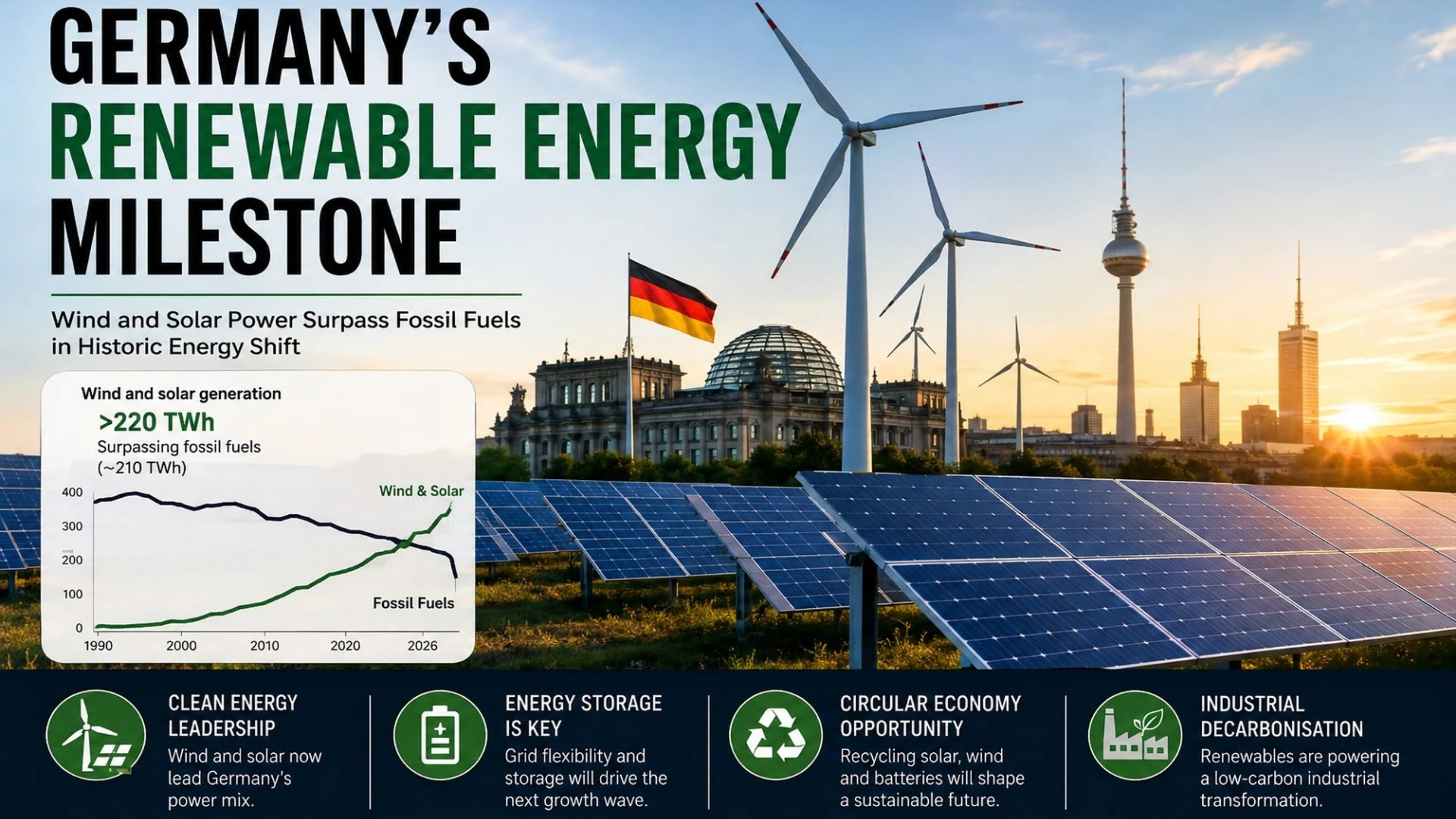
August 03, 2026: Germany Renewable Energy has reached a defining moment in its energy transition. For the first time in modern history, electricity generated from wind and solar has surpassed power generated from fossil fuels, marking a structural shift in one of the world’s largest industrial economies.
Author: Aditya Pareek | EQMint
This is more than just another energy statistic—it signals that renewable energy has moved from being an alternative to becoming the backbone of a modern power system.
A Historic Turning Point
For decades, coal and natural gas powered Germany’s economic growth. Today, that narrative has changed.
According to the Energy Institute Statistical Review of World Energy 2026, wind and solar together generated more than 220 TWh of electricity, overtaking fossil fuels, which declined to approximately 210 TWh. At the same time, Germany has completed its nuclear phase-out under its long-term Energiewende (Energy Transition) strategy.
The milestone demonstrates that a major industrial economy can significantly reduce its dependence on conventional energy sources while continuing to operate one of Europe’s largest manufacturing sectors.
What Drove This Transformation?
Germany’s renewable energy success is the result of decades of policy consistency, technological innovation, and private investment.
Key drivers include:
• Large-scale deployment of wind and solar capacity
• Continuous improvements in grid infrastructure
• Rapid adoption of battery storage technologies
• Digital energy management systems
• Strong policy support encouraging renewable investments
The result is an electricity system increasingly powered by clean energy rather than fossil fuels.
Why the World Should Pay Attention
Energy Storage Becomes the Next Growth Engine
Germany renewable energy produce electricity when the sun shines and the wind blows. Managing this variability requires advanced battery storage, smart grids, and demand-response technologies.
Circular Economy Will Define the Next Decade
Every solar panel, battery, and wind turbine will eventually reach the end of its useful life. This creates enormous opportunities in solar panel recycling, wind turbine blade recycling, battery recycling, critical mineral recovery, and sustainable materials supply chains.
Industrial Decarbonisation Is Accelerating
As renewable electricity becomes more affordable, industries are transitioning away from fossil fuels to reduce emissions and meet ESG commitments.
What This Means for India
India is already one of the fastest-growing renewable energy markets in the world. With ambitious solar targets, expanding battery manufacturing, and a rapidly developing recycling ecosystem, India has the opportunity to become not only a renewable energy powerhouse but also a global leader in the circular economy.
Companies involved in recycling, resource recovery, battery materials, waste management, and sustainable manufacturing are likely to play an increasingly important role in supporting this transition.
Challenges Remain
Important challenges still need to be addressed:
• Maintaining grid stability with variable renewable generation
• Expanding battery storage capacity
• Upgrading transmission infrastructure
• Ensuring affordable electricity prices
• Building efficient recycling systems for renewable energy assets
EQMINT Perspective on Germany Renewable Energy
Germany renewable energy milestone is more than a national success—it is evidence that the global energy transition is accelerating.
The next phase of this transformation will not be defined solely by generating clean electricity. It will be shaped by energy storage, smart grids, recycling, circular economy solutions, and sustainable supply chains.
For businesses, investors, and policymakers, the message is clear: the future of energy extends beyond power generation. It lies in building the ecosystem that enables clean energy to scale sustainably.
As countries around the world pursue net-zero goals, Germany renewable energy experience offers valuable lessons—and significant opportunities—for emerging economies like India.
For more such information visit EQMint
Join our Whatsapp channel for timely updates: Whatsapp