
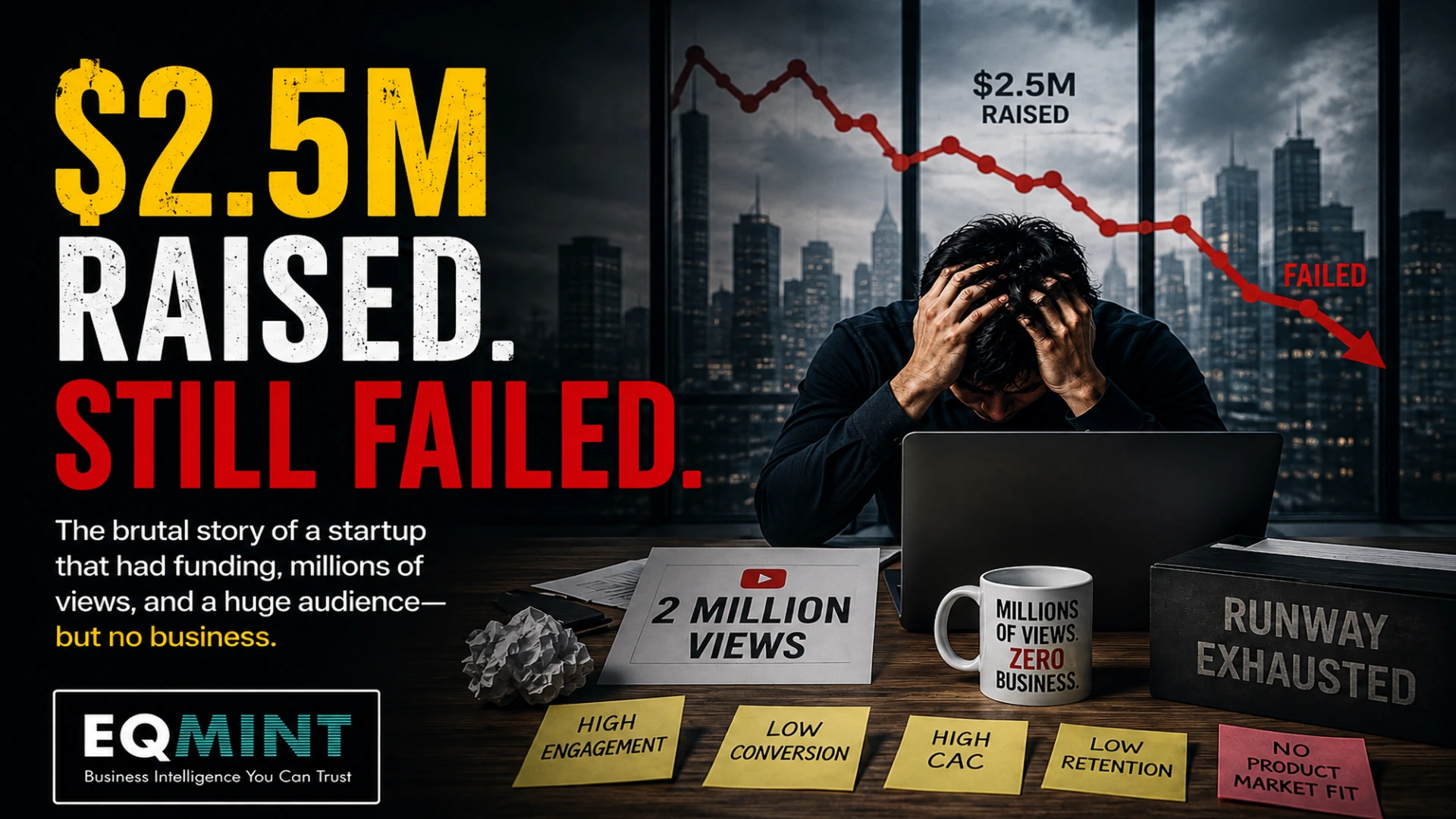
August 21, 2026: They had funding. They had millions of views. They had an audience Startup Lesson. And they still ran out of money. Back in 2015, a startup in China raised $2.5 million to build a home-decoration community. The early numbers looked impressive: tens of thousands of followers on Zhihu, hundreds of thousands on WeChat, millions of content views, and one article crossing 2 million reads.
Author: Aditya Pareek | EQMint | EQ Exclusive
Users were even sending products for reviews. It looked like product-market fit. The business eventually showed why audience size and funding can be very different from a sustainable revenue model.
The Audience Wasn’t the Customer
People loved the startup’s renovation guides. The content helped users understand home decoration, compare products and make decisions.
But many users then did the work themselves or searched for cheaper alternatives.
The company had built an engaged audience, yet converting that attention into paying customers proved difficult.
That distinction matters for founders and investors. A community can grow rapidly while the underlying business struggles to make money from it.
When Funding Starts Disappearing
The company had raised $2.5 million Startup Lesson , giving the team capital to build products, acquire users and experiment with monetisation.
The pressure came from turning that capital into a repeatable business.
Investors wanted app numbers, so the company pushed its social-media audience toward a standalone app.
The result was poor conversion, high acquisition costs and weak retention.
There was another problem: home renovation is a low-frequency activity.
A customer might spend heavily on renovation once every few years. That makes it difficult to build a business that depends on daily engagement and frequent app usage.
The $15,000 Signal
Then came China’s Singles’ Day. The company generated around $15,000 in affiliate commissions in a single day.
The interesting part was where that revenue came from. Users weren’t buying the expensive renovation products the company had Startup Lesson spent months creating content around. They were buying decorative items, soft furnishings and simpler home products.
That revenue revealed something the company’s engagement numbers couldn’t:
Customers were already showing the company what they were willing to buy.
The opportunity was there. The challenge was turning that signal into a clear business decision.
The Strategy Debate
The team eventually split over what to do next. One side wanted to raise another round and build a full marketplace. The other Startup Lesson wanted to monetise the audience already established on platforms such as WeChat and social media.
The disagreement consumed time while the company continued burning cash. The runway disappeared before the team settled on a strategy.Eventually, the startup failed.
5 Lessons for Founders and Investors
1. Funding Doesn’t Prove the Business Model
Raising capital gives a startup resources to test its assumptions. It doesn’t prove that customers will pay.
A successful fundraising round can buy time. Revenue determines how long the business can keep operating once that capital starts running down.
2. Millions of Views Don’t Equal Revenue
Content can generate enormous reach without creating meaningful commercial value.
Founders should track the path from attention to action to revenue.
If millions of people consume your content but very few buy anything, the audience may be impressive while the economics remain weak.
3. Follow Existing Customer Behaviour
Customers often reveal the strongest business opportunities through their actual behaviour.
The Singles’ Day affiliate revenue showed demand for smaller home products, decorative items and soft furnishings.
That signal deserved serious attention because it came from customers spending real money.
4. Match the Business Model to Purchase Frequency
A business built around an occasional purchase needs a model that reflects that behaviour.
Home renovation can generate significant transaction value, but the customer may not need the service again for years.
That changes how you think about retention, acquisition costs, repeat purchases and customer lifetime value.
5. Cash Runway Makes Decisions More Important
When a Startup Lesson is burning cash, strategic disagreement becomes expensive. Every month spent debating a business model consumes runway.
Testing 2 possible revenue paths with real customers can produce an answer faster than spending months arguing over which strategy looks better on paper.
The EQMint Take on Startup Lesson
The startup had money, attention and users. The missing piece was a business model that consistently converted those assets into revenue. That’s a lesson worth remembering when evaluating any startup.
A large audience can attract investors. A successful funding round can create headlines. Millions of views can create the appearance of momentum. But eventually, the business has to answer a much simpler question:
What will customers actually pay for, and can the company make that transaction work repeatedly?
For founders, that’s the test.For investors, it’s the number worth watching.
For more such information visit EQMint
Join our Whatsapp channel for timely updates: Whatsapp