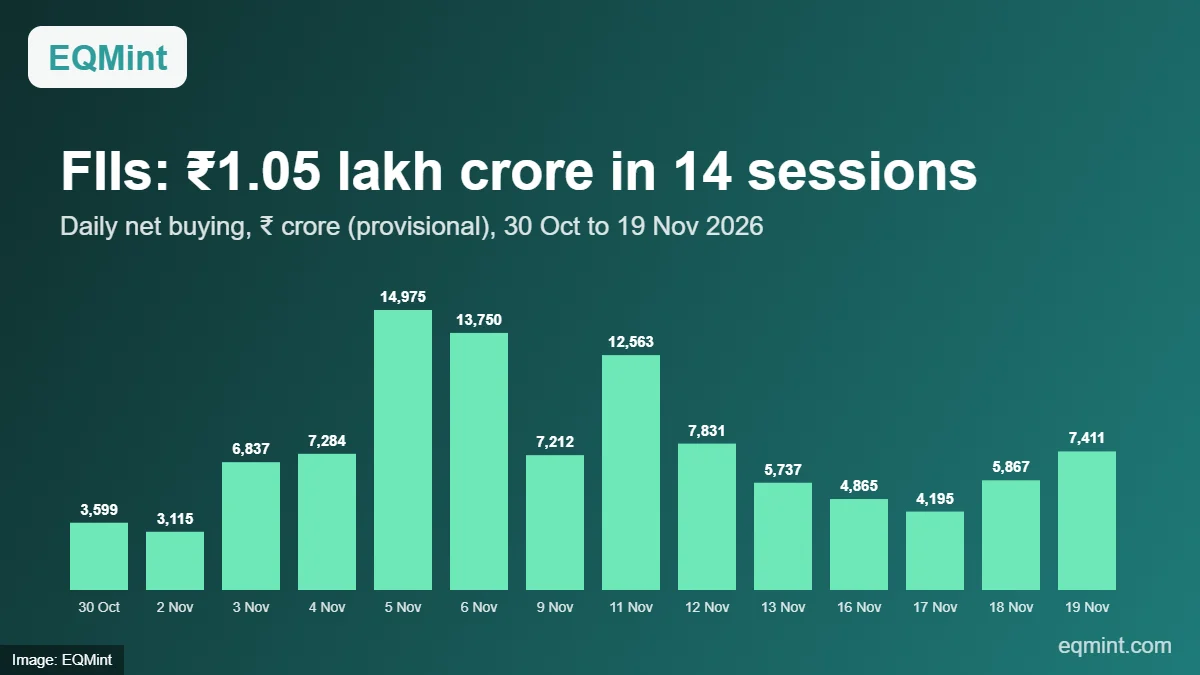
Synopsis: Foreign institutional investors bought Indian shares worth about ₹1.05 lakh crore in 14 straight sessions to 19 November, exchange data shows. EQMint’s day-by-day tally finds domestic institutions sold ₹57,047 crore into that buying, the daily pace has slowed by a third, and the run has already reversed all of September and October’s selling.
Foreign institutional investors (FIIs) were net buyers of Indian equities for the 14th session in a row on Thursday, 19 November 2026. Provisional exchange data showed net purchases of ₹7,411.41 crore in the cash market, while domestic institutional investors (DIIs) were net sellers of ₹1,356.57 crore.
That took the buying since 30 October to about ₹1,05,241 crore. For November alone, the cumulative figure stands at ₹1,01,640.72 crore, according to Business Today, the first time this month’s exchange tally has crossed ₹1 lakh crore. The buying came on a day when the Sensex rose 990 points to 83,022 and the Nifty 50 gained 286 points to 25,514, as covered in EQMint’s post-market analysis for 19 November.
EQMint analysis: domestic funds sold more than half of what FIIs bought
EQMint added up the daily provisional figures for all 14 sessions. Three things stand out.
1. DIIs were on the other side. Across the same 14 sessions, domestic institutions were net sellers of ₹57,047 crore. That is 54% of the ₹1,05,241 crore that FIIs bought. DIIs were net sellers in 13 of the 14 sessions; the only exception was 17 November, when they bought a net ₹197 crore. The combined institutional inflow was therefore about ₹48,194 crore, less than half the headline FII number.
2. Two days did over a quarter of the work. The average was ₹7,517 crore a session, but 5 November (₹14,975 crore) and 6 November (₹13,750 crore) together account for 27% of the total.
3. The pace has cooled. FIIs averaged ₹8,260 crore a session in the first six sessions (30 October to 6 November) and ₹8,336 crore in the next four (9 to 13 November). In the latest four sessions (16 to 19 November) the average fell to ₹5,585 crore, about a third lower.
| Session (2026) | FII net (₹ crore) | DII net (₹ crore) |
|---|---|---|
| 30 Oct | +₹3,599 | −₹818 |
| 2 Nov | +₹3,115 | −₹392 |
| 3 Nov | +₹6,837 | −₹3,679 |
| 4 Nov | +₹7,284 | −₹3,712 |
| 5 Nov | +₹14,975 | −₹10,445 |
| 6 Nov | +₹13,750 | −₹5,969 |
| 9 Nov | +₹7,212 | −₹7,173 |
| 11 Nov | +₹12,563 | −₹8,435 |
| 12 Nov | +₹7,831 | −₹6,331 |
| 13 Nov | +₹5,737 | −₹2,254 |
| 16 Nov | +₹4,865 | −₹3,519 |
| 17 Nov | +₹4,195 | +₹197 |
| 18 Nov | +₹5,867 | −₹3,160 |
| 19 Nov | +₹7,411 | −₹1,357 |
| 14 sessions | +₹1,05,241 | −₹57,047 |
Provisional cash-market figures published by the exchanges, rounded to the nearest crore, as compiled by Tapetide and ScanX and checked against Business Today on 19 November 2026. Totals are EQMint calculations. A special session listed for 8 November showed no net FII figure and is not counted.
How it compares with the selling before it
Business Today reported that FIIs had been net sellers for six straight months, from May to October, with outflows of ₹44,012.82 crore in September and ₹45,161.71 crore in October. Those two months add up to ₹89,174.53 crore. The 14-session buying is 118% of that, so the last two months of selling have been fully reversed in under three weeks.
The longer picture is less complete. The same report put withdrawals before this streak at more than $60 billion, against buying of over $13 billion during it. On those numbers, roughly a fifth of the earlier selling has come back.
Is it a record?
On depository data, yes for a single month. The previous record for monthly foreign portfolio buying of Indian equities was ₹66,135 crore, set in December 2023, according to National Securities Depository Ltd (NSDL) data reported at the time. Kotak Neo reported that November’s purchases crossed that mark by 12 November, and put the month’s tally at ₹1,12,095.78 crore on 19 November, citing NSDL and NSE data. Since the earlier record was ₹66,135 crore, no previous month had reached ₹1 lakh crore on that measure.
The two datasets are not the same. The exchange figures are provisional and cover the cash market each day. NSDL figures are final settled numbers and include primary-market purchases such as IPOs, which is why the totals differ. EQMint could not verify the claim circulating on social media that a 14-session run of this size is the first in the market’s history, so this article does not make it.
What moved alongside
The Nifty Bank index closed at a record 63,063 on 19 November, crossing 63,000 for the first time, and the rupee strengthened to 93.3340 per US dollar from 93.4175, Business Today reported. EQMint looked at what is drawing overseas money in Indian stocks rally as AI sell-off draws foreign funds, and at the risk from US interest rates in Fed rate bets, the dollar and the rupee.
What happens next
Three numbers are worth tracking. First, whether the daily FII figure stays positive; a single day of net selling would end the streak. Second, whether DIIs keep selling at the current rate, because the net institutional flow, not the FII figure alone, shows how much new money is entering the market. Third, NSDL’s settled data for the full month, which will confirm how far November 2026 finishes above the December 2023 record. Provisional figures can be revised, so the final count may differ slightly from the totals above.
Image credit: EQMint (chart of daily FII net buying, 30 October to 19 November 2026).
Sources
- Source: NSE India, FII/FPI and DII trading activity (provisional), 19 November 2026
- Source: Business Today, FIIs pump over ₹1 lakh crore into Indian equities in November, 19 November 2026
- Source: Tapetide, FII DII data, daily net flows
- Source: ScanX, FII/DII data, daily cash-market activity
- Source: Kotak Neo, market rebound and foreign inflows in November, 19 November 2026
- Source: Kotak Neo, FIIs return with record buying in November, 12 November 2026
- Source: Business Standard (Reuters), record monthly FPI buying in December 2023
Disclaimer: This article is for information purposes only and is not investment advice.
For more such information, visit EQMint
Join our WhatsApp channel for timely updates: Whatsapp