Synopsis: Knight Frank India counts 80 data centre facilities in India’s pipeline in Q3 2026, up 14.3% from 70 in 2025. EQMint’s lower-bound capacity calculation, using each size band’s minimum, shows the pipeline’s floor rising 48% to 3,800 MW, because sites above 100 MW jumped from 15 to 27.
India’s data centre build-out is getting bigger per site, not just more numerous. A Knight Frank India study released on 28 November 2026 says the national pipeline across seven key markets stood at 80 facilities in the third quarter of 2026, against 70 in 2025. The sharper change sits in the largest size band: facilities above 100 MW rose 80% to 27, and now make up 33.8% of the pipeline, up from 21.4%.
For founders building AI and cloud products, and for investors tracking power and equipment suppliers, the shift matters because large campuses draw far more electricity and land than small server halls.
EQMint analysis: count up 14%, capacity floor up 48%
Knight Frank reports facility counts by size band but, in the coverage reviewed, no total megawatt figure. EQMint therefore estimated a conservative floor: each facility is assigned the lowest value of its band (100 MW for the above-100 MW band, 50 MW for 50 to 100 MW, 10 MW for 10 to 50 MW and zero for below 10 MW). The real pipeline capacity is higher than this floor, but the floor shows the direction of the mix.
| Size band | 2025 facilities | Q3 2026 facilities | Change | Floor MW 2025 | Floor MW Q3 2026 |
|---|---|---|---|---|---|
| Above 100 MW | 15 | 27 | +80.0% | 1,500 | 2,700 |
| 50 to 100 MW | 16 | 17 | +6.3% | 800 | 850 |
| 10 to 50 MW | 26 | 25 | -3.8% | 260 | 250 |
| Below 10 MW | 13 | 11 | -15.4% | 0 | 0 |
| Total | 70 | 80 | +14.3% | 2,560 | 3,800 |
Source: Knight Frank India data via Business Standard and ANI (28 Nov 2026). EQMint calculations.
On this basis the capacity floor grew 48.4%, more than three times the 14.3% rise in facility count. The two smaller bands actually shrank, from 39 to 36 facilities, which means all of the net growth came from sites of 50 MW and above. Facilities above 50 MW rose from 31 to 44 and now account for 55% of the pipeline, up from 44.3%.
Mumbai and Hyderabad account for most of it, but large sites are spreading
Mumbai remains the anchor market with 34 of the 80 facilities, or 42.5%, up from 31. Fifteen of its pipeline facilities are above 100 MW, up from 10. Hyderabad is the fastest-growing major hub, rising from 11 to 15 facilities, with its above-100 MW count doubling from four to eight. According to the ANI report, 93.3% of Hyderabad’s pipeline is above 50 MW.
| Market | 2025 | Q3 2026 | Change |
|---|---|---|---|
| Mumbai | 31 | 34 | +9.7% |
| Hyderabad | 11 | 15 | +36.4% |
| Chennai | 9 | 9 | 0% |
| Pune | 9 | 9 | 0% |
| Bengaluru | 4 | 5 | +25% |
| New Delhi | 4 | 5 | +25% |
| Kolkata | 2 | 3 | +50% |
| Mumbai + Hyderabad share | 60.0% | 61.3% | +1.3 pts |
Source: Knight Frank India data via ANI and Business Standard (28 Nov 2026). EQMint calculations.
EQMint’s calculation adds one less obvious point. Mumbai and Hyderabad together held 14 of the 15 above-100 MW facilities in 2025, or 93.3%. In Q3 2026 they account for 23 of 27, or 85.2%. So while the two cities still dominate overall, four of the largest projects now sit in other markets, against one a year earlier. The reports do not say which cities host them.
Why power, not just land, is the constraint
Joseph Thilak, who heads the data centre business at Knight Frank India, said the market is changing “not just in terms of the number of facilities being developed”. He also pointed to “the ability to align development with infrastructure readiness, particularly power availability”.
That links the data centre story to India’s grid build-out, since a 100 MW campus needs dedicated substations and long-term power contracts. EQMint has tracked related demand drivers, including the pace of AI startup funding in India in 2026 and the government-backed Chariot-1 foundation model under the IndiaAI Mission, both of which add to compute requirements.
A caution on the comparison: the published coverage compares Q3 2026 with “2025” without stating whether the base is the full year or a single quarter, and it does not give total megawatts or investment figures. The floor estimate above should be read only as a minimum.
What it means
The pipeline mix has moved decisively towards 50 MW-plus campuses, with the above-100 MW band now the largest single category. For listed and unlisted firms that supply power equipment, cooling, construction and land, demand is concentrating in fewer but much larger projects. Knight Frank publishes its data centre tracking periodically; its next update is the next data point on where large sites are being located. Grid-side developments such as large battery storage orders remain relevant context for power availability.
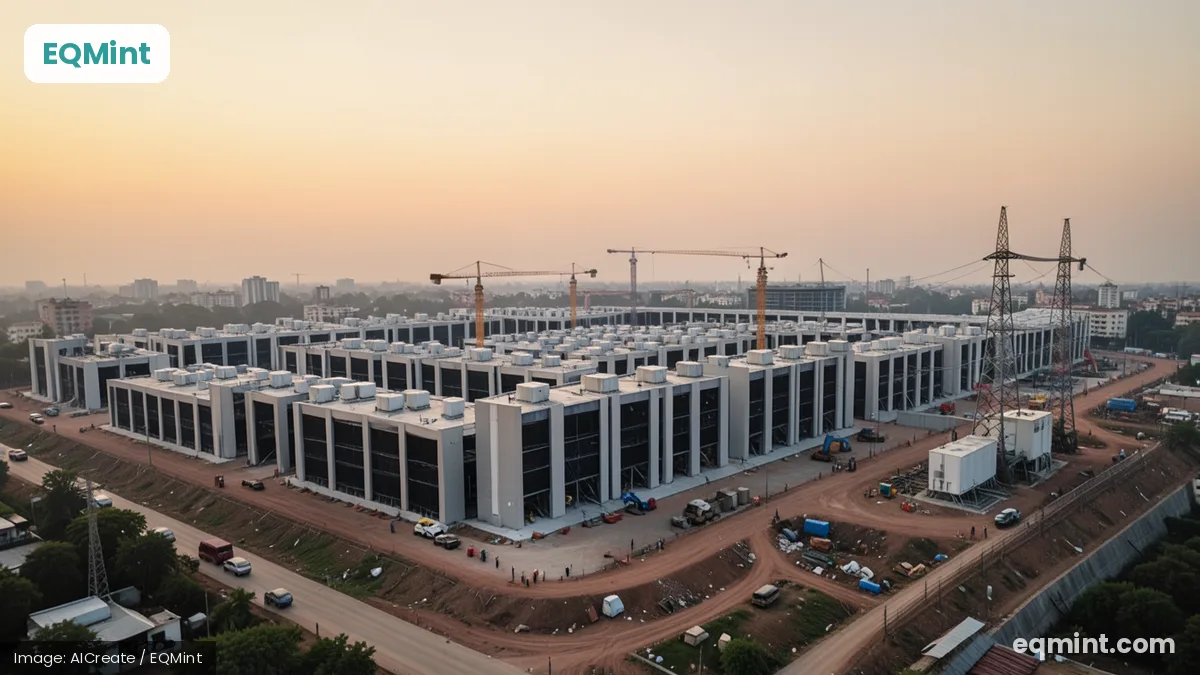
Image credit: AICreate / EQMint (representational).
Sources
- Source: Business Standard – India’s data centre expansion shifts to larger facilities: Knight Frank (28 Nov 2026)
- Source: ANI via Daily Prabhat – India’s data centre pipeline rises 14.3% to 80 facilities in Q3 2026 (28 Nov 2026)
- Source: IANS – India’s data centre pipeline shifts towards larger facilities: Report (28 Nov 2026)
Disclaimer: This article is for information purposes only and is not investment advice.
For more such information, visit EQMint
Join our WhatsApp channel for timely updates: Whatsapp
Support EQMint: tap below to add us as a preferred source on Google.
Get the EQMint Daily
Market moves, IPOs and startup funding news in your inbox every morning.