
Author : Ashish Pareek | EQMint | EQMint originals
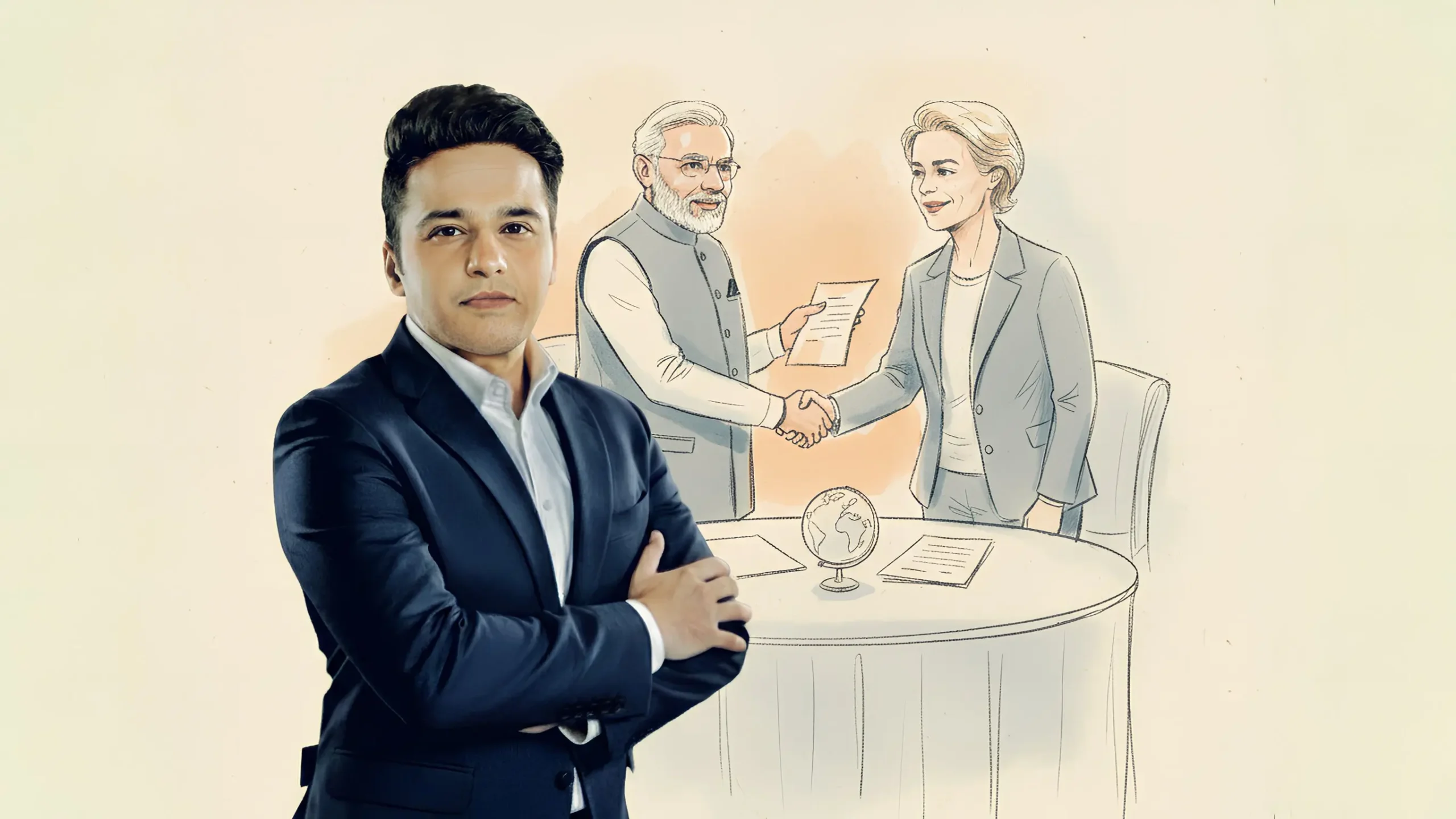
The headlines in India and the EU over the last few days, since the World Economic Forum, have revolved around ‘the mother of all deals’. While monstrous hyperbole isn’t a rarity in the Trump era, a closer look at this new deal between India and the European Union does give one insight into why it could send a tremor through global trade corridors.
For starters, this FTA will bring on board two of the world’s most influential markets, which together account for roughly 25% of global GDP and a combined population of nearly 2 billion people.
So essentially, one in every four people on the planet will be affected by this landmark Free Trade Agreement.
Great things take time
One can’t escape the timeless adage about the Chinese Bamboo. A plant that shows seemingly no growth in the first five years suddenly shoots up to the height of 80–90 feet within just six weeks.
On similar lines, the FTA between India and the EU has been in the making for nearly two decades, though marred by inconsistencies and roadblocks. The NDA government – realising the need to create a buffer against growing trade volatility – revived talks in 2022, and the developments ever since have been fast-tracked with uncharacteristic speed.
A Closer Look
This FTA is not just a simple reduction in taxes. It is a deep integration of two vastly varying economic ecosystems. The FTA is as diverse as it is complex: covering everything from traditional goods and services related trade to modern obstacles like intellectual property, sustainability, labour standards, and regulatory cooperation.
It is a major win for India as over 90% of Indian goods will now enjoy duty-free access to the 27-member EU market. Not only does this open up new markets, but it also provides a much-needed level playing field for Indian exporters who previously struggled to compete with duty-free rivals from nations like Bangladesh.
The Numbers Behind the Handshake
Beyond the reach, the sheer economic scale and depth of this partnership is staggering. Here’s an overview:
- Goods Trade: Topped $135 bn in 2024, doubling over the last decade.
- Services: Exploded by 243% in ten years, now exceeding €66 billion across IT, telecom, and consulting.
- Investment: The EU has solidified its position as India’s premier investor bloc, with Foreign Direct Investment (FDI) hitting €132 billion in 2024.
Who Wins What?
| Feature | India’s Gains | EU’s Gains |
| Market Access | Duty-free entry for over 90% of goods. | Massive market entry for autos, machinery, and luxury items. |
| Key Sectors | Push for Textiles, Pharma, IT, and Renewables. | Boost for Chemicals, Green Tech, and Spirits. |
| Investment | Surge in FDI for infrastructure and manufacturing. | Reinforced status as India’s top investment partner. |
| Strategic | Solidifies “Supply Chain Hub” status. | Deepens footprint in the Indo-Pacific region. |
Strategic Buffer in a Volatile World
While the deal looked inevitable given the intent and speed over the last few years, the timing of its announcement is no coincidence. As the world comes to terms with choppy US trade policies and geopolitical friction – largely induced by Donald Trump, both New Delhi and Brussels are more than happy to make compromises for stability.
While the deal has drawn some side-eye from Washington – specifically regarding India’s energy trade with Russia – the overarching sentiment is one of “derisking.” Through this deal, India and the EU are creating a buffer against global supply chain disruptions and unilateral trade tensions.
PM Narendra Modi hailed the deal as a “partnership of two major democracies,” while EU Commission President Ursula von der Leyen put the spotlight on the “complementary strengths” that will build mutual resilience.
What’s Next?
While the heavy lifting of negotiation is over, the path to implementation involves formal ratification by the EU Member States and the European Parliament. Once active, the deal is expected to spark a new era of “green tech” collaboration and digital alignment.
For more such information : EQmint