
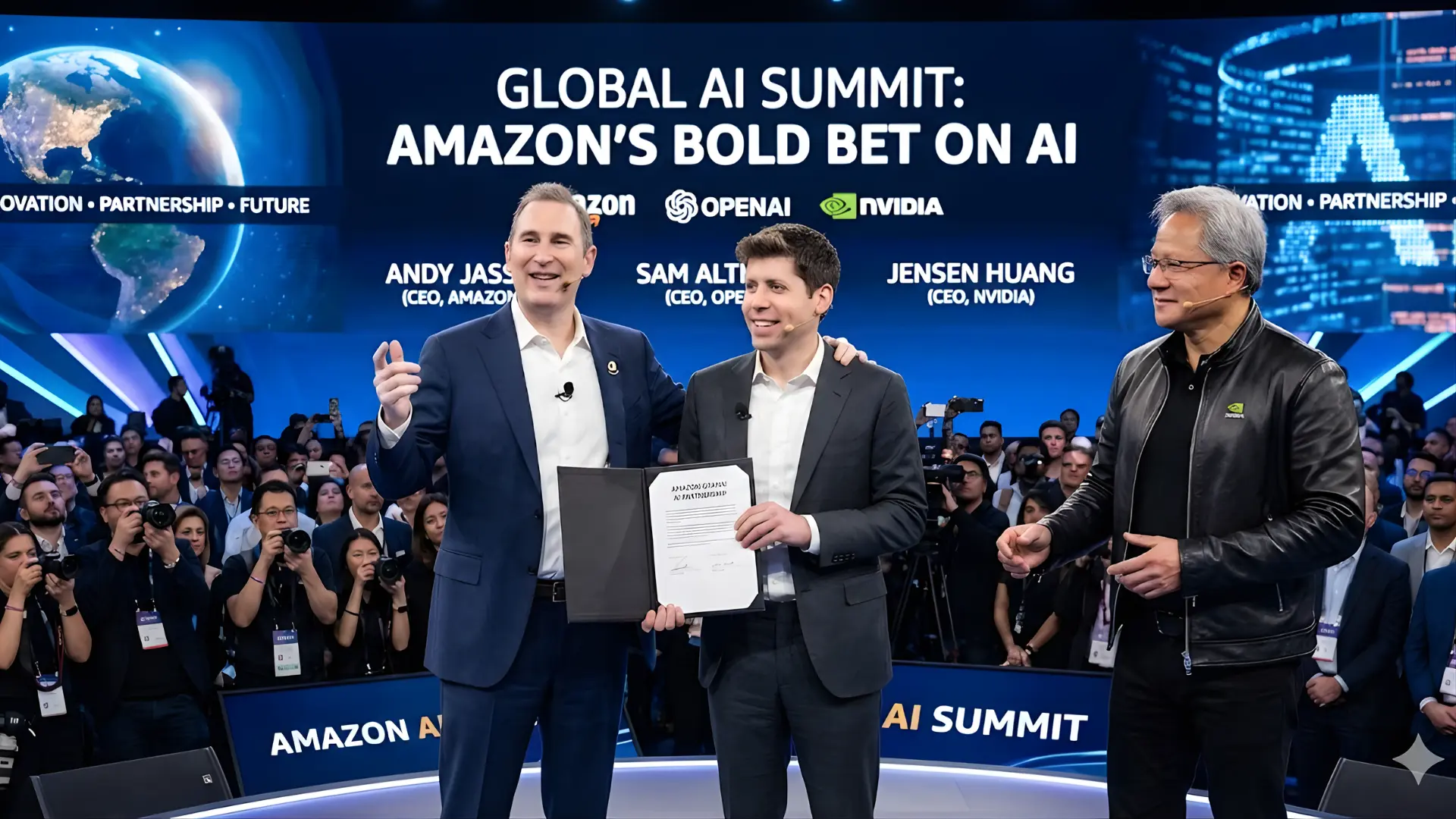
In a striking shift within the artificial intelligence landscape, Amazon CEO Andy Jassy has emerged as a major supporter of Sam Altman’s OpenAI, pledging a $50 billion investment that underscores Amazon’s confidence in AI’s future. This commitment comes as Nvidia CEO Jensen Huang scales back his company’s earlier enthusiasm for an even larger investment, highlighting contrasting strategies by two of the world’s top tech leaders. The divergence reveals how companies are positioning themselves in a rapidly evolving and intensely competitive AI race.
Author : Aashiya Jain | EQmint | FinTech News
Artificial intelligence has become one of the most transformative technologies of our era, and the strategies of corporate giants are shaping the industry’s trajectory. In recent developments, Amazon, under the leadership of CEO Andy Jassy, has made waves with a major financial commitment to OpenAI, the creator of ChatGPT and one of the most influential AI organisations globally.
The announcement marks a significant moment in the AI ecosystem especially as Nvidia, a key player in AI hardware, appears to be recalibrating its own level of investment.
Amazon’s $50 Billion Vote of Confidence in OpenAI
Amazon’s $50 billion investment in OpenAI is more than just a big funding deal. It shows how serious both companies are about shaping the future of AI. The partnership is getting deeper and could change how AI is built used and sold across different industries.
This comes after a $110 billion funding round led by Amazon Nvidia and Japan’s SoftBank. Amazon was the biggest single investor. With OpenAI valued at around $730 billion before the deal the size of this investment shows how much is riding on AI’s commercial future. Andy Jassy said OpenAI has “incredible talent vision and products.”
It shows Amazon sees real value in working closely with a company leading the AI revolution. They’re not just betting on returns. They’re betting on influence. The deal reflects confidence in OpenAI’s ability to lead in generative AI and next-gen computing. It’s a long-term play. One that could reshape how businesses use AI in the years ahead.
Contrast with Nvidia’s Strategy
On the other side of the funding equation Nvidia CEO Jensen Huang long recognized as one of the architects of the AI hardware boom due to Nvidia’s dominant GPU business appears to be reining in earlier ambitions. Nvidia had previously signalled interest in a massive $100 billion investment in OpenAI infrastructure intended to lock in long-term compute demand and deepen Nvidia’s hardware relationship with OpenAI.
However recent shifts in the funding landscape suggest that Nvidia’s role in the current round has been scaled back to around $30 billion. This pivot reflects a more pragmatic approach by Nvidia as it balances capital allocation competitive pressures and broader strategic priorities. While the company still remains a core AI hardware provider its appetite for tying up capital in large funding commitments appears more measured at this stage.
This contrast Amazon’s aggressive investment stance versus Nvidia’s more cautious recalibration illustrates how tech leaders are interpreting risk and opportunity differently within the same industry.
Why This Matters for the AI Ecosystem
These strategic decisions reverberate beyond boardrooms. They influence everything from technology standards and platform choices to global compute infrastructure, developer ecosystems, enterprise adoption, and even geopolitical AI leadership. For example:
- Amazon’s multi-year collaboration with OpenAI and its cloud division AWS could integrate advanced models into mainstream enterprise applications and customer products at scale.
- Nvidia’s continued investment in AI hardware and related technologies ensures that the underlying infrastructure for AI workloads remains cutting edge.
- Combined, these moves reflect a maturing ecosystem where capital deployment, technology partnerships, and strategic alignment will determine competitive advantage.
As OpenAI pushes toward highly scaled compute needs, partnerships like these and the visions behind them could influence how quickly and broadly AI capabilities evolve.
Humanizing the High-Stakes Chess Game
At first glance these stories might seem like dry financial manoeuvres but they are human decisions shaped by vision conviction risk tolerance competition and leadership styles. Andy Jassy’s bold endorsement of OpenAI can be seen as a leadership bet a deliberate choice to back disruptive innovation despite uncertainties.
It echoes the early days of cloud computing when AWS invested heavily before the returns were clear. On the other hand Jensen Huang’s recalibration might reflect a more cautious read of market conditions and financial discipline not a retreat from AI but an adaptation to it. Nvidia’s strong growth and future forecasts still make it a powerhouse the company is simply choosing to allocate capital with greater focus.
Conclusion
The contrasting strategies between Amazon and Nvidia underscore a broader narrative: AI’s future is being shaped by varied visions of leadership and investment. While Jassy’s bold bet on Sam Altman’s OpenAI highlights the transformative potential of AI when capital and talent align, Huang’s careful adjustment suggests a conscious effort to balance ambition with sustainability.
In this evolving landscape, what ultimately matters for users, developers and enterprises is not just who bets the most but who builds technology that is responsible, scalable and truly transformative.
For more such information: EQmint