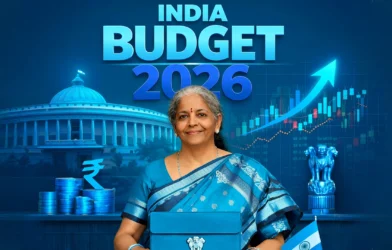

Finance Minister Nirmala Sitharaman said the government’s “Reform Express” will continue at full momentum as she presented Union Budget 2026 in Parliament. The Budget focuses on structural reforms, manufacturing, MSMEs, infrastructure push, and technology-led governance.
Author: Samir Jain | EQMint
Nirmala Sitharaman on Sunday reaffirmed the government’s commitment to reforms, stating that the “Reform Express” is well on its way and will continue to help the government fulfil its kartavya (duty). Delivering her ninth consecutive Union Budget speech in Parliament on February 1, 2026, the Finance Minister underlined that sustained and forward-looking reforms remain central to India’s economic strategy.
“The Reform Express is well on its way and will maintain its momentum to help us fulfil our kartavya,” Sitharaman said, setting the tone for Budget 2026, which places strong emphasis on growth, productivity, and governance reforms.
Over 350 Reforms Rolled Out Since Independence Day 2025
Highlighting the scale of reform activity undertaken by the government, the Finance Minister noted that over 350 reforms have been rolled out following the Prime Minister’s announcement on Independence Day 2025.
These reforms include:
- GST simplification
- Notification of labour codes
- Registration of mandatory Quality Control Orders (QCOs)
She added that high-level committees have been constituted to drive reforms, while the Centre continues to work closely with State governments on deregulation and reduction of compliance requirements. This collaborative approach, she said, is essential to improving ease of doing business and unlocking productivity across sectors.
Three Pillars of the Reform Strategy
Outlining the philosophical framework guiding Budget 2026, Sitharaman highlighted three core requirements for India’s growth journey:
1. Sustaining Structural Reforms
The Finance Minister stressed that reforms must be continuous, adaptive, and forward-looking, rather than one-time initiatives. Sustaining reform momentum is critical to ensuring long-term competitiveness and economic resilience.
2. Strengthening the Financial Sector
A robust and resilient financial sector, she said, is vital for:
- Mobilising household savings
- Efficient allocation of capital
- Effective risk management
This pillar underlines the importance of financial stability in supporting investment-led growth.
3. Leveraging Cutting-Edge Technologies
Sitharaman emphasised that cutting-edge technologies, including artificial intelligence (AI), can act as force multipliers for better governance, improving service delivery, transparency, and policy execution.
Six Focus Areas to Accelerate Economic Growth
As part of Budget 2026, the Finance Minister announced targeted interventions across six key areas aimed at accelerating and sustaining economic growth:
- Scaling up manufacturing in seven strategic and frontier sectors
- Rejuvenating legacy industrial sectors to enhance productivity
- Creating champion MSMEs capable of competing globally
- Delivering a powerful push for infrastructure development
- Ensuring long-term security and stability
- Developing city economic regions as growth engines
These focus areas signal the government’s intent to combine industrial expansion, urban development, and infrastructure creation with reform-led governance.
Manufacturing, MSMEs and Infrastructure at the Core
The emphasis on manufacturing and MSMEs aligns with India’s broader goal of strengthening domestic value chains and generating employment. By scaling up manufacturing in strategic sectors and nurturing champion MSMEs, the government aims to enhance India’s role in global supply chains while supporting entrepreneurship and job creation.
Infrastructure continues to remain a cornerstone of the growth strategy, with Budget 2026 promising a strong push to logistics, connectivity, and urban infrastructure, critical for sustaining long-term economic momentum.
Technology and AI as Governance Enablers
The Finance Minister’s remarks on AI and advanced technologies underscore a growing policy focus on technology-led governance. AI applications are increasingly being seen as tools to:
- Improve regulatory efficiency
- Strengthen public service delivery
- Enhance data-driven decision-making
This approach aligns with global trends where governments are leveraging digital tools to improve governance outcomes.
16th Finance Commission Report Tabled in Lok Sabha
In addition to the Budget speech, Sitharaman also tabled the 16th Finance Commission report in the Lok Sabha. The Commission is chaired by Arvind Panagariya and includes members such as:
- Annie George Mathew, former bureaucrat
- Economist Manoj Panda
- Soumya Kanti Ghosh
- T Rabi Sankar
The tabling of the report is a significant fiscal development, as Finance Commission recommendations shape Centre–State fiscal relations and resource distribution.
Why Budget 2026 Matters
Budget 2026 comes at a time when India is balancing strong domestic growth prospects with global uncertainties. The focus on reforms, financial sector resilience, manufacturing, and technology-led governance reflects a strategy aimed at long-term stability rather than short-term stimulus.
The continued emphasis on the Reform Express suggests policy continuity, which is often viewed positively by investors and industry stakeholders.
Conclusion
Finance Minister Nirmala Sitharaman’s Budget 2026 speech reinforced the government’s commitment to sustained reforms through the Reform Express, aimed at fulfilling its kartavya toward citizens and the economy. With over 350 reforms already implemented, a clear six-point growth agenda, and a strong focus on manufacturing, MSMEs, infrastructure, and technology, Budget 2026 outlines a reform-driven roadmap for India’s economic future.
For more such budget updates visit EQMint
Disclaimer: This article is for informational and educational purposes only. Budget proposals and policy announcements are subject to parliamentary approval and subsequent notifications. Readers are advised to consult professional advisors for financial, tax, or business decisions.