
As of September 9, 2025
1. Executive Summary
This report summarizes the Waste Management industry globally and in India, covering market size, segmentation, drivers, challenges, technologies, regulations, and profiles of major players. Charts illustrate market growth, segmentation, and regional distribution.
Source: Grand View Research, IMARC Group, Mordor Intelligence
2. Market Size & Growth Trends
Waste management encompasses collection, transportation, treatment, and disposal of waste materials. Historically, the industry relied on landfills, but it has expanded to include recycling, composting, and waste-to-energy solutions. India generates over 62 million tonnes of municipal solid waste annually, and this figure is expected to rise to 165 million tonnes by 2030.
- Global waste management market: USD 1.16 trillion (2024), projected to USD 1.81 trillion by 2032 at 5.7% CAGR.
- India: USD 13.5 billion (2025), projected to USD 17.9 billion by 2030 at 5.8% CAGR. Alternate estimates suggest USD 64.5 billion by 2033.
Source: Grand View Research; Mordor Intelligence; IMARC Group

Source: Grand View Research, Mordor Intelligence

Source: IMARC Group, Mordor Intelligence
3. Market Segmentation
By Waste Type:
-
- Municipal solid waste
-
- Industrial waste
-
- Hazardous waste
-
- E-waste
-
- Construction & Demolition waste.
By Service:
-
- Collection
-
- Transportation
-
- Recycling & Sorting
-
- Landfill,
-
- Incineration
-
- Waste-to-Energy.
By End User:
-
- Municipal corporations
-
- Industrial clients
-
- Commercial establishments
-
- Households.
By Geography:
-
- North America,
-
- Europe
-
- Asia-Pacific
-
- Middle East & Africa
-
- Latin America.
Sources: Grand View Research; IMARC Group; Mordor Intelligence.

Source: Grand View Research, Precedence Research (estimates)

Source: Grand View Research, Mordor Intelligence
4. Key Drivers & Barriers
Drivers:
- Rising urbanization and industrialization.
- Strong ESG focus and circular economy initiatives.
- Regulatory push for segregation, EPR frameworks.
- Technological advancements (AI, IoT, robotics).
Barriers:
- Low segregation efficiency in India (<25%).
- Financing and infrastructure challenges.
- Informal sector dominance.
- Public awareness gaps.
Sources: IMARC; Mordor Intelligence; CPCB India.
5. Major Players: Short Introductions
- Veolia Environnement: A global leader providing integrated waste management services across 40+ countries.
- Source: Veolia official site.
- Suez SA: Offers recycling, resource recovery, and water-waste integration services worldwide.
- Source: Suez official site.
- Waste Management Inc. (WM): US-based waste management leader with strong landfill and recycling operations.
- Source: WM official site.
- Ramky Enviro Engineers: India’s largest private waste management company with hazardous and municipal waste operations.
- Source: Ramky Enviro official site.
- BVG India: Provides municipal solid waste collection and transportation across Indian cities.
Source: BVG India official site.
SWOT:
- Strengths: Policy tailwinds.
- Weaknesses: Informal dominance.
- Opportunities: WtE, e-waste.
- Threats: High capex, policy risk.
Source: Company annual reports; Wikipedia; Ramky Enviro official site
6. Technological Advancements
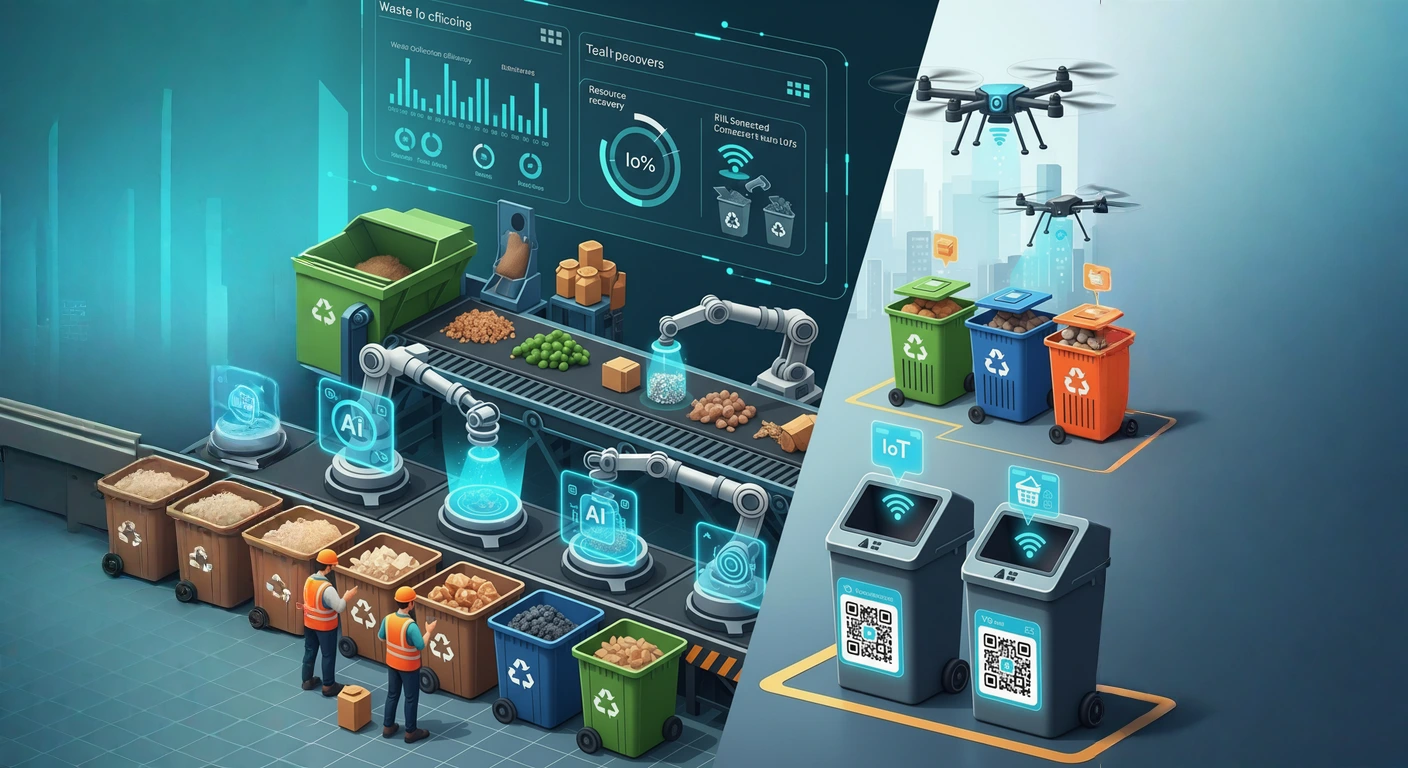
IoT bins, AI route optimization, RFID tracking, waste-to-energy, plasma arc recycling.
Source: Grand View Research, Mordor Intelligence
7. Regulatory Environment
- India: SWM Rules 2016, Plastic & E-waste Rules, SBM.
- Global: EU Directives, US EPA standards, China bans.
Source: CPCB; MoEFCC; EU Commission; US EPA
8. Consumer Trends and Regulatory Impacts
Rising ESG awareness, brand take-back programs, composting adoption.
- India: Solid Waste Management Rules 2016, Plastic Waste Management Rules 2021 (EPR), E-waste Management Rules 2022, Swachh Bharat Mission.
- Global: EU Waste Framework Directive, US EPA landfill regulations, China’s import bans on waste.
Sources: MoEFCC; CPCB; EU Commission; US EPA; IMARC; GlobalData.
9. Supply Chain & Collection Models
Collection models include municipal collection systems, informal sector waste pickers, PPP-led operations, and brand-led take-back programs. Source segregation is critical but remains a challenge in India.
- Collection → segregation → treatment (recycling, landfill, incineration).
- Challenges: logistics, contamination, landfill scarcity.
Source: CPCB; IMARC
10. Future Outlook & Recommendations
The waste management sector is expanding rapidly, supported by strong policy frameworks and ESG mandates. Stakeholders should invest in recycling, waste-to-energy, and segregation infrastructure while leveraging AI/IoT for efficiency. Integration of the informal sector in India will be critical to improving efficiency and transparency. Global market to surpass USD 1.8 trillion by 2032. India doubling by 2033.
Recommendations: invest in segregation infra, PPPs, AI/IoT, integrate informal sector.
Source: Grand View Research; IMARC; Mordor
Disclaimer: This article is based on information available from public sources. It has not been reported by EQMint journalists. EQMint has compiled and presented the content for informational purposes only and does not guarantee its accuracy or completeness. Readers are advised to verify details independently before relying on them.
11. Glossary
-
- CAGR (Compound Annual Growth Rate): The mean annual growth rate of an investment, market, or industry over a specified period longer than one year.
-
- MSW (Municipal Solid Waste): Common household and commercial waste generated by urban and rural populations, including biodegradable, recyclable, and inert waste.
-
- SWM (Solid Waste Management): The process of collecting, transporting, treating, and disposing of solid waste in an environmentally sound manner.
-
- Hazardous Waste: Waste that poses substantial threats to public health or the environment due to its toxic, corrosive, reactive, or ignitable properties.
-
- E-waste (Electronic Waste): Discarded electrical and electronic equipment such as computers, mobile phones, and televisions, often containing valuable but hazardous components.
-
- C&D Waste (Construction & Demolition Waste): Waste generated from construction, renovation, repair, and demolition activities, including concrete, wood, metals, and debris.
-
- WtE (Waste-to-Energy): Technologies that convert waste into usable forms of energy, such as electricity, heat, or fuel, typically through incineration, gasification, or anaerobic digestion.
-
- Composting: A biological process in which organic waste (e.g., food scraps, garden waste) is decomposed into nutrient-rich soil conditioner under controlled aerobic conditions.
-
- Landfill: A site designated for the disposal of solid waste by burial; often engineered to reduce environmental and health impacts.
-
- Incineration: A thermal treatment process where waste is combusted at high temperatures, significantly reducing its volume and sometimes producing energy.
-
- Circular Economy: An economic system aimed at eliminating waste and continually using resources by reusing, repairing, refurbishing, and recycling existing materials.
-
- EPR (Extended Producer Responsibility): A regulatory framework requiring manufacturers and producers to take responsibility for the end-of-life management of their products, including collection, recycling, or disposal.
-
- PPP (Public-Private Partnership): A cooperative arrangement between government bodies and private companies to finance, build, and operate projects, often used for waste management infrastructure.
-
- ESG (Environmental, Social, and Governance): A set of non-financial performance indicators that assess the sustainability and ethical impact of an organization’s operations.
-
- IoT (Internet of Things): A network of interconnected devices that collect and share data, applied in waste management through smart bins, route optimization, and tracking systems.
-
- MRF (Material Recovery Facility): A specialized plant where collected recyclables are sorted, processed, and prepared for sale to manufacturers.
-
- Segregation at Source: The practice of separating waste at the point of generation into categories (biodegradable, recyclable, hazardous) to improve recycling efficiency.
-
- Biodegradable Waste: Organic waste that can be decomposed naturally by microorganisms, such as food scraps, paper, and garden waste.
-
- Non-biodegradable Waste: Waste that does not break down easily, including plastics, metals, and glass, which require recycling or specialized disposal methods.
-
- Resource Recovery: The extraction of useful materials or energy from waste through recycling, composting, or waste-to-energy processes.
12. References
Grand View Research – Waste Management Market
IMARC Group – India Waste Management Market
Mordor Intelligence – Waste Management
Precedence Research – Waste Management Market
CPCB Reports: https://cpcb.nic.in/
MoEFCC Notifications: https://moef.gov.in/
EU Waste Framework Directive: https://environment.ec.europa.eu/
US EPA Waste Regulations: https://www.epa.gov/
Ramky Enviro Engineers: https://ramkyenviroengineers.com/
Veolia: https://www.veolia.com/
Suez: https://www.suez.com/
Waste Management Inc.: https://www.wm.com/
BVG India: https://bvgindia.com/