

Author: Aditya Pareek | EQMint | General News
Political temperatures rose sharply on Saturday, December 20, 2025, as PM Modi launched a fresh attack on the West Bengal government, calling for the people of the state to free themselves from what he described as “mahajungle-raj”. On the same day, Congress Parliamentary Party chairperson Sonia Gandhi accused the Modi government of “bulldozing” the Mahatma Gandhi National Rural Employment Guarantee Act (MGNREGA), vowing resistance against what she termed a “black law”.
The twin statements, coming from the country’s top political leadership, underscored the sharpening political divide ahead of key electoral battles and amid sweeping changes to India’s rural employment framework.
PM Modi Invokes Bihar Mandate, Takes Aim at Bengal
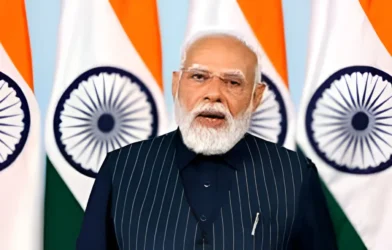
Addressing a public rally at Taherpur in West Bengal via video link, PM Modi drew parallels between Bihar’s recent Assembly election results and the political situation in West Bengal. The rally, which saw thousands in attendance, was held virtually as dense fog prevented the Prime Minister’s helicopter from landing at the venue.
Referring to the National Democratic Alliance’s (NDA) victory in Bihar, PM Modi said the result reflected people’s rejection of misgovernance and lawlessness. “Last month the people of Bihar gave a huge mandate to the NDA. After the victory in Bihar, I had said that Ganga flows from Bihar to Bengal,” he said.
Invoking the phrase “jungle-raj”, commonly used to criticise past regimes in Bihar, PM Modi extended the analogy to West Bengal. “Bihar rejected jungle-raj for 20 years. Now the people of West Bengal need freedom from the mahajungle-raj prevailing here,” he said, alleging deterioration in governance and law and order in the state.
Although the PM Modi did not directly name the ruling Trinamool Congress or Chief Minister Mamata Banerjee in his speech, the remarks were widely interpreted as a direct political challenge to the Bengal government ahead of upcoming electoral contests.
BJP Pushes Narrative of Governance and Law and Order
The Prime Minister’s comments align with the BJP’s broader strategy of projecting itself as a party of governance and development, while accusing regional parties of corruption and administrative failure. By linking Bihar’s electoral outcome with West Bengal’s political future, Modi signalled that the BJP intends to intensify its campaign in the state.
Party leaders later said the Prime Minister’s remarks reflected public sentiment and growing dissatisfaction in Bengal, particularly among youth and first-time voters. Opposition parties, however, dismissed the statements as politically motivated rhetoric.
Sonia Gandhi Attacks Centre Over MGNREGA Changes
Even as the PM Modi was addressing the Bengal rally, Sonia Gandhi released a strong video message accusing the Modi government of dismantling MGNREGA, one of India’s largest social welfare programmes.
“The PM Modi government has bulldozed MGNREGA,” she alleged, referring to the recent legislation that replaces the Mahatma Gandhi National Rural Employment Guarantee Act with a new rural employment framework. Gandhi described the move as an attack on the livelihoods of millions of rural Indians.
By weakening MGNREGA, she said, the Centre had targeted the interests of farmers, labourers, and landless workers. “Over the last 11 years, the government has consistently ignored the concerns of the rural poor,” she alleged.
‘A Revolutionary Step Being Undermined’
Sonia Gandhi described MGNREGA as a “revolutionary step” that transformed rural India by guaranteeing livelihood security to the poorest sections of society. “It became a means of survival for the deprived, the exploited, and the poorest of the poor,” she said.
She accused the government of diluting the spirit of the Act through funding cuts, administrative hurdles, and now, legislative replacement. Calling the new law a “black law”, Gandhi vowed that lakhs of Congress workers would defy it and continue to fight for the rights of rural workers.
Her remarks come at a time when the Congress and other opposition parties have stepped up protests against changes to rural employment schemes, arguing that they weaken the legal guarantee of work and shift the financial burden onto states.
Political Reactions and Wider Implications
The Congress’s sharp response highlights how rural welfare has once again become a central political fault line. While the government argues that reforms are necessary to modernise employment schemes and improve efficiency, the Opposition maintains that such changes erode hard-won social protections.
Political analysts say the contrasting statements by PM Modi and Gandhi reflect two competing narratives: one centred on governance, law and order, and electoral mandates; the other on social justice, welfare, and rural livelihoods.
The timing of these remarks is also significant. With municipal, Assembly, and national elections on the horizon, both the BJP and the Congress are seeking to consolidate their core voter bases—urban and aspirational voters on one side, and rural and marginalised communities on the other.
A Sharpening Political Battle
As debates over governance in West Bengal and the future of rural employment schemes intensify, the political discourse is expected to grow more confrontational. Prime Minister Modi’s call for “freedom from mahajungle-raj” and Sonia Gandhi’s pledge to fight what she calls an unjust law signal that welfare, federalism, and governance will dominate the national conversation in the months ahead.
With rallies, protests, and legislative battles likely to follow, the clash of narratives is set to shape India’s political landscape well beyond December 2025.
For more such information visit EQMint
Source: The Hindu