Synopsis: Guru Nanak Jayanti, celebrated on 24 November 2026, marks the 557th birth anniversary of Guru Nanak Dev Ji, the founder of Sikhism. His teachings on honest work, sharing, equality and truthful living also offer clear rules for founders, traders and business owners. Here is what the day represents and the lessons it holds.
Guru Nanak Jayanti, also called Gurpurab or Prakash Purab, falls on Tuesday, 24 November 2026, on Kartik Purnima. It marks the 557th birth anniversary of Guru Nanak Dev Ji (1469 to 1539), the first of the ten Sikh Gurus. Gurdwaras hold Akhand Path recitations, early-morning Prabhat Pheris, Nagar Kirtan processions and langar, the free community kitchen open to everyone.
Guru Nanak Ji’s life had a lot to do with work and trade. As a young man he was given money to start a business, he later ran the government stores at Sultanpur Lodhi, and he spent his last years farming at Kartarpur. That is why his teachings still read well for anyone who runs a business today.
What Guru Nanak Jayanti represents
Sikh tradition sums up Guru Nanak Ji’s teaching in three duties, often called the three pillars of Sikhism:
- Kirat Karo: earn a living through honest work, without fraud or exploitation.
- Vand Chhako: share what you earn with others, especially those in need.
- Naam Japo: remember God and live with awareness of the divine.
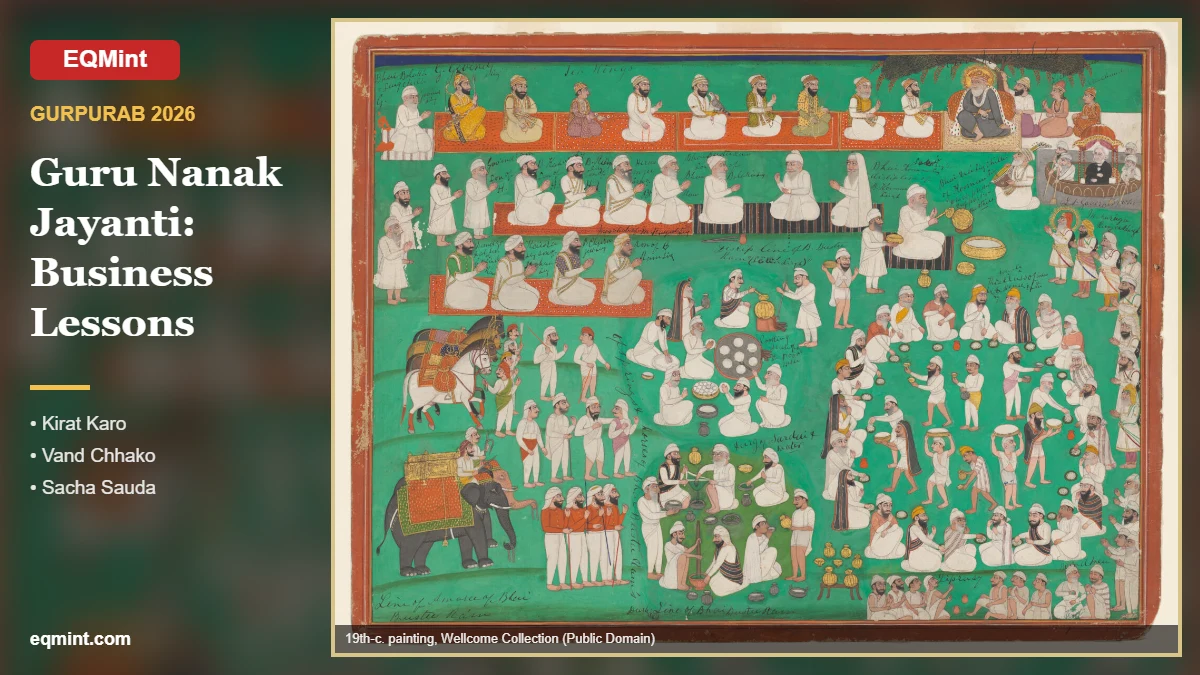
At Kartarpur, Guru Nanak Ji also set up the traditions of sangat (the congregation) and pangat (sitting together in a row to eat). Everyone ate the same food at the same level, whatever their caste, religion or wealth. For many people, Gurpurab is a reminder of equality, service and honest living.
Two quotes from Guru Nanak Ji on work and truth
“Ghaal khaae kichh hathahu dey, Nanak raahu pachhaanahi sey.”
One who works for what he eats, and gives some of what he has, O Nanak, knows the true path.
Guru Nanak Dev Ji, Sri Guru Granth Sahib, Ang 1245
“Sachahu orai sabh ko upar sach aachaar.”
Truth is high, but higher still is truthful living.
Guru Nanak Dev Ji, Sri Rag, Sri Guru Granth Sahib, Ang 62
7 business rules we can learn from Guru Nanak Ji
1. Earn honestly, or the profit is not worth it (Kirat Karo). Guru Nanak Ji’s idea of honest work rules out money made through cheating or exploiting others. For a business, this means correct billing, honest product claims and fair dealing with suppliers. Short-term gains from cutting corners usually cost far more later in lost trust, penalties or customers.
2. Make the “true bargain” (Sacha Sauda). According to the Janamsakhi tradition, his father gave young Nanak twenty rupees to buy goods and sell them at a profit. On the way he met hungry people and spent the money feeding them, calling it a “sacha sauda”, a true bargain. Gurdwara Sacha Sauda now stands at the spot, in Farooqabad in present-day Pakistan. The lesson for a founder is not to give away working capital. It is to ask what real value a deal creates, and for whom.
3. Share what you earn (Vand Chhako). Many Sikhs give dasvandh, a tenth of their income, to the community and to people in need. Businesses can apply the same idea through profit-sharing with employees, fair pay and community programmes. Indian companies above certain size limits already have to spend on CSR under the Companies Act. Guru Nanak Ji’s teaching asks for sharing as a habit, not only as a rule to follow.
4. Keep honest books and serve customers fairly. At Sultanpur Lodhi, Guru Nanak Ji worked as the modi, the person in charge of the stores of Nawab Daulat Khan Lodi. Gurdwara Sri Hatt Sahib marks the place. Tradition says that when he reached the count of thirteen (“tera”, which also means “yours” in Punjabi), he kept saying “tera, tera” and gave customers more than they asked for. Whatever one takes from the story, the job itself was about weighing, recording and serving people correctly. Accurate accounts and fair measures are still the base of any business that wants to last.
5. Treat every customer and employee as equal (Sangat and Pangat). In langar, the person who funds the kitchen and the person who walks in hungry sit on the same floor and eat the same food. For a company, this means the same service standards for a small customer and a large one, and respect for every role in the team.
6. Build systems that scale through service (Seva and Langar). Langar runs mostly on volunteer service and community contributions, and the largest gurdwara kitchens serve huge numbers of people every day. It is a working model of process, supply chain and teamwork driven by purpose. Founders building operations-heavy businesses can learn from how simple, repeatable systems and a shared mission keep such kitchens running.
7. Live the values you preach. “Truth is high, but higher still is truthful living.” A mission statement on a website is not enough. What counts is how the company acts when no one is watching: how it treats a complaint, an unpaid invoice or a mistake in its own product. For listed companies, the same idea shows up as honest disclosure to shareholders.
EQMint analysis: an old model of ethical enterprise
Guru Nanak Ji was a householder, not an ascetic. He worked as a storekeeper and a farmer and did not ask his followers to give up work or wealth. He asked them to earn it honestly and share it. That makes his teaching closer to what modern business writing calls stakeholder thinking: a business serves its customers, workers and community, not only its owners. For Indian founders and traders, Gurpurab is a good day to check three things. Is our income earned honestly? Are we sharing fairly with the people who help create it? And do our actions match what we say?
EQMint wishes all its readers a happy Guru Nanak Jayanti. For more on Indian founders, see our Bombay Shaving Company case study.
Image: “Kings and other devotees paying homage to Guru Nanak Ji, as food and drinks are organised and served”, gouache painting by an Indian painter, 19th century. Wellcome Collection, Public Domain Mark.
Sources
- Source: Sri Guru Granth Sahib, Ang 1245 (SikhNet)
- Source: SikhiWiki, “Truth is high but higher still is truthful living” (Ang 62)
- Source: Drik Panchang, Guru Nanak Jayanti 2026 date
- Source: Harvard Pluralism Project, Guru Nanak Ji’s message
- Source: The Tribune, Life lessons by Guru Nanak Ji
- Source: The Week, In the Guru’s footsteps (Kartarpur, sangat and pangat)
- Source: Encyclopaedia of Sikhism (Punjabi University), Sachcha Sauda
- Source: Discover Sikhism, Guru Nanak Ji at Sultanpur Modikhana
- Source: Wellcome Collection, painting of Guru Nanak Ji (public domain)
Disclaimer: This article is for information purposes only and is not investment advice.
For more such information, visit EQMint
Join our WhatsApp channel for timely updates: Whatsapp
Get the EQMint Daily
Market moves, IPOs and startup funding news in your inbox every morning.