Synopsis: India’s astrology apps make most of their money from paid consultations, and winning users is costly: Astrotalk spent ₹823 crore on marketing in FY26, about 45% of its ₹1,823 crore revenue. Jio’s JioAstro, reported in late November 2026 as a test app, starts from a different place: an AI astrologer and an existing user base.
Last updated on 28 November 2026.
Astrology has become one of the more profitable corners of India’s consumer internet. Users pay by the minute to chat or speak with astrologers, buy gemstones and puja items, and come back for repeat readings. In late November 2026, several outlets reported that Jio Platforms has built JioAstro, an AI-powered Vedic astrology app. This explainer looks at how the business makes money, what it costs to grow, and where an AI-first product like JioAstro fits. Figures are dated, and claims made by companies about their own products are marked as such.
EQMint analysis: 75 paise of extra marketing for every extra rupee of revenue
Astrotalk, one of the biggest players in the segment, gives the clearest picture because its audited FY26 numbers have been reported in detail. Its operating revenue rose by ₹647 crore in FY26, from ₹1,176 crore to ₹1,823 crore. Over the same year its marketing spend rose by ₹486 crore, from ₹337 crore to ₹823 crore. In other words, for every additional ₹100 of revenue, Astrotalk spent about ₹75 more on marketing (EQMint calculation from reported figures).
| Astrotalk (consolidated) | FY25 | FY26 | Change |
|---|---|---|---|
| Operating revenue | ₹1,176 crore | ₹1,823 crore | +55% |
| Marketing spend | ₹337 crore | ₹823 crore | +144% |
| Marketing as % of revenue | 28.7% | 45.1% | EQMint calculation |
| Revenue from consultations | ₹1,139 crore | ₹1,657 crore | +45% |
| Revenue from outside India | ₹236 crore | ₹621 crore | about 2.6x |
| Net profit | about ₹22 crore | ₹222 crore | about 10x |
Source: Inc42 and IANS reports on Astrotalk’s FY26 audited financial statements (October 2026); percentages of revenue calculated by EQMint.
The company still made money: net profit rose to ₹222 crore in FY26 and profit before tax to ₹296 crore, according to the same reports, and the marketing was funded from its own cash. But the table shows the shape of the model. Consultations brought in about 91% of revenue, and a growing share of the extra marketing went into overseas markets, which supplied 34% of revenue in FY26 against 20% a year earlier.
How astrology apps make money
Most large platforms work as marketplaces. Astrologers sign up, users top up a wallet, and the app charges per minute of chat, call or video, keeping a share. Three things drive revenue:
- Consultations: the bulk of revenue at Astrotalk, at ₹1,657 crore in FY26.
- Commerce: gemstones, rudraksha, crystals and Vastu products. Astrotalk Store revenue was reported at ₹166 crore in FY26, up from ₹37 crore.
- Repeat use: daily horoscopes, Panchang and festival content bring users back, which lowers the cost of each later consultation.
Other players follow versions of the same model. InstaAstro’s FY26 revenue was reported at ₹111.26 crore, up from ₹52 crore. AstroSage, in a company release in February 2026, said its app had more than 80 million downloads and that its AI consultations run at close to 90% margins; that is the company’s own claim. For founders, the lesson from these numbers is that demand is proven, but customer acquisition is the largest cost line.
What JioAstro is, according to reports
TelecomTalk reported on 25 November 2026 that Jio Platforms has an AI Vedic astrology app called JioAstro on Google Play. Based on the app’s description as reported, it offers:
- Kundali analysis from birth date, time and place, with Lagna (D1) and Navamsa (D9) charts in North and South Indian formats
- Identification of 40-plus Yogas and checks for Doshas such as Manglik and Kaal Sarpa
- Vimshottari Dasha timelines, transits and Sade Sati analysis
- An AI astrologer that answers in English, Hindi, Marathi and Gujarati
- Daily horoscopes, Muhurat suggestions, a yearly Varshaphal report, Panchang and up to four family profiles
The app signs users in with JioID. Jio’s stated privacy terms, as reported, are that birth data is encrypted, is not sold or used for advertising, and that the app does not push paid remedies. These are the company’s claims and have not been independently checked.
Its status is not settled. Marketing Mind and Kotak Neo reported that JioAstro is in invite-only internal testing on Google Play and is not yet available to the general public, with no pricing or launch date announced. EQMint could not find a public Google Play listing for the app or an official Jio press release as of 28 November 2026.
Why the model matters more than the app
JioAstro’s reported design differs from the marketplace model in two ways. First, readings come from an AI working on calculated charts rather than from paid human astrologers, so the cost of each reading is mainly computing, not a revenue share. Second, it sits inside Jio’s own app ecosystem and sign-in, so it does not start from zero users the way a standalone startup does. Those two lines, consultation payouts and marketing, are the largest costs in the table above.
The open questions are just as clear. Jio has not said whether JioAstro will be free, paid or bundled; whether it will sell remedies or products; or when it will open to the public. Existing players also have a head start in AI: AstroSage has run AI consultations since 2024 by its own account, and Astrotalk earns a third of its revenue abroad, where Jio’s user base does not reach.
What founders and investors can take from this
- Watch the marketing ratio. In consumer apps with proven demand, the growth story is often a customer-acquisition story. Astrotalk’s marketing went from 29% to 45% of revenue in one year.
- Distribution is an asset. A product launched inside an app many people already use can skip part of that cost; this is why telecom and payments companies keep adding services.
- AI changes the cost of supply. Where a human expert is the product, AI can replace part of the payout, but users have to trust it.
For more on the companies involved, see EQMint’s coverage of the Jio Platforms IPO, its list of Indian unicorns, and the faith-tech platform Samskara’s expansion into Hyderabad.
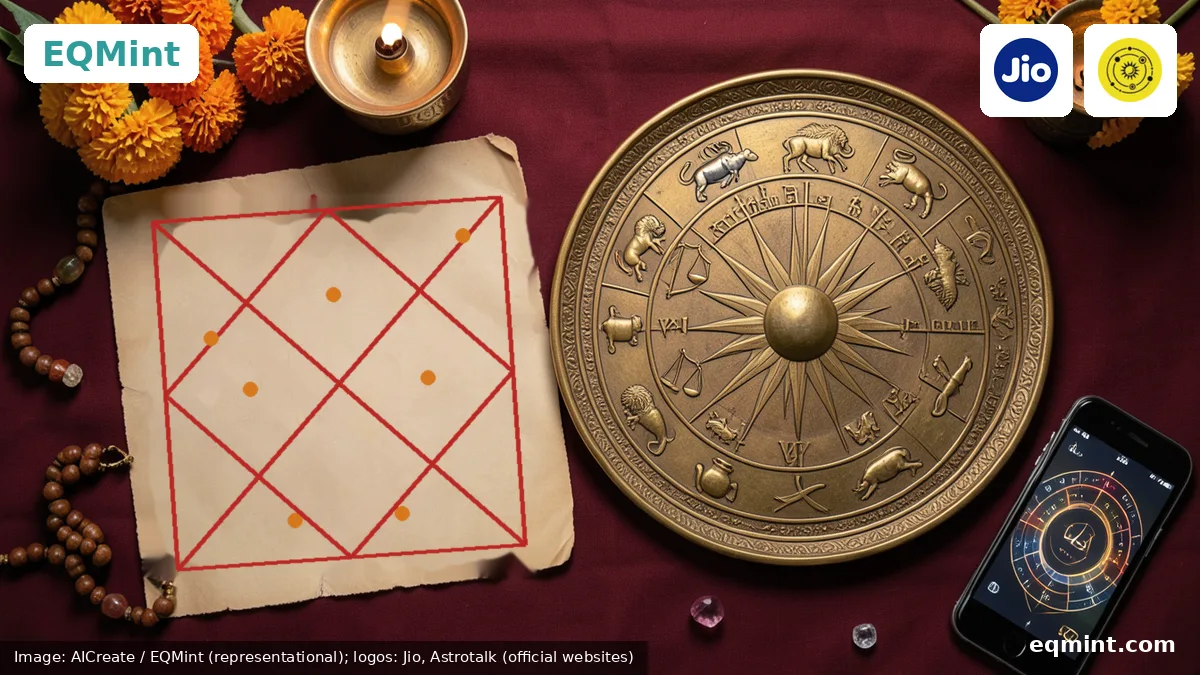
Image: AICreate / EQMint (representational); logos: Jio and Astrotalk (official websites).
Sources
- Source: Inc42, Astrotalk’s FY26 profit and revenue (October 2026)
- Source: IANS via NewKerala, Astrotalk FY26 results (28 October 2026)
- Source: TelecomTalk, Reliance Jio enters the AI astrology space with JioAstro (25 November 2026)
- Source: Marketing Mind, JioAstro invite-only testing (November 2026)
- Source: Kotak Neo, JioAstro availability (November 2026)
- Source: Open magazine, Astrotalk Store and InstaAstro revenue
- Source: AstroSage company release via ANI/PNN (16 February 2026)
Disclaimer: This article is for information purposes only and is not investment advice.
For more such information, visit EQMint
Join our WhatsApp channel for timely updates: Whatsapp
Support EQMint: tap below to add us as a preferred source on Google.
Get the EQMint Daily
Market moves, IPOs and startup funding news in your inbox every morning.