

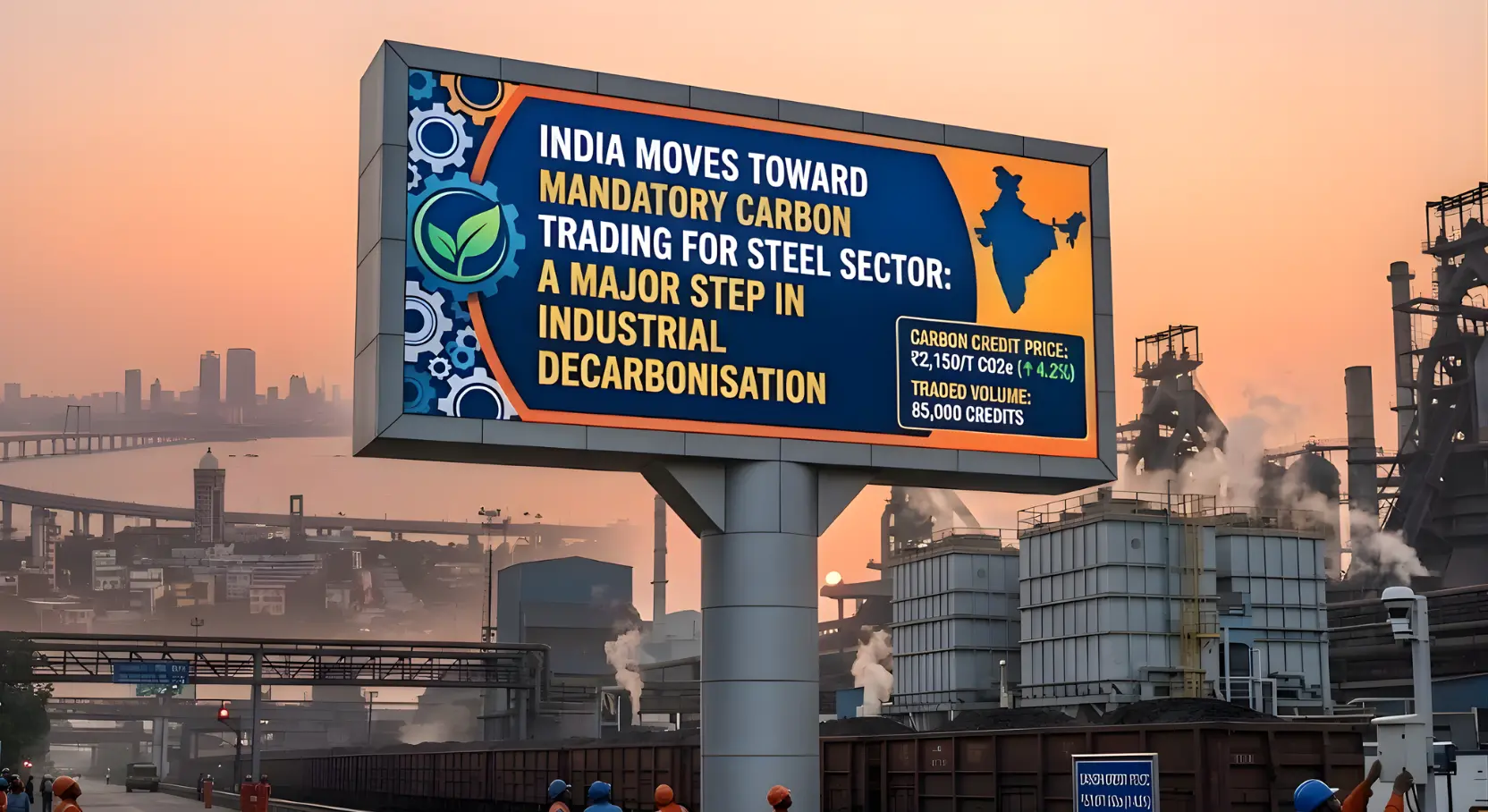
India is preparing to make carbon trading compliance mandatory for the steel sector as part of its broader climate strategy. The policy will fall under the Carbon Credit Trading Scheme (CCTS), which aims to reduce industrial emissions by setting emission intensity targets and allowing companies to trade carbon credits. The move is expected to push steel manufacturers to adopt cleaner technologies, improve energy efficiency, and align with global climate regulations. At the same time, it could reshape how one of India’s most important industries manages production, costs, and sustainability.
Author : Aashiya Jain | EQmint | Market News
India’s Push Toward a Carbon Market
India is building a structured carbon market and steel is probably next in line to be pulled in. Government folks have hinted that the Carbon Credit Trading Scheme will soon be mandatory for steel producers. This is part of a bigger push to speed up decarbonisation. The carbon trading system is pretty simple. Companies that emit less than their target get carbon credit certificates.
They can then sell those to companies that go over their limits. It’s like a financial nudge for industries to pollute less and invest in cleaner tech. This fits into India’s climate roadmap. The plan includes a regulated emissions trading system and pushing for low carbon industrial practices. The carbon market was made possible by changes to the Energy Conservation Act and the launch of the Carbon Credit Trading Scheme.
Why the Steel Sector Matters
Steel production is one of the most energy-intensive industries in the world. In India the sector plays a critical role in infrastructure construction automobile manufacturing and economic development. However it is also a significant contributor to greenhouse gas emissions.
Studies suggest that the steel industry accounts for around 10% of India’s total emissions largely due to the heavy reliance on coal-based production processes. Because of its high emissions footprint the government sees the steel industry as a key area for emission reductions.
By bringing steel companies under mandatory carbon trading policymakers hope to encourage large manufacturers to adopt cleaner fuels energy-efficient equipment and emerging technologies such as green hydrogen-based steel production.
How the Carbon Credit Trading Scheme Works
Under the Carbon Credit Trading Scheme (CCTS), industrial facilities will be assigned specific emissions-intensity targets. These targets are measured as carbon emissions per unit of output rather than an absolute emissions cap.
If a company successfully lowers its emissions below the benchmark level, it earns Carbon Credit Certificates (CCCs). These certificates can then be traded on designated platforms, allowing companies that struggle to meet targets to purchase credits instead of facing penalties.
Key features of the scheme include:
- Emission targets for energy-intensive industries
- Carbon credit certificates issued for outperforming targets
- Trading of credits through regulated exchanges
- Monitoring, reporting, and verification of emissions data
The program is expected to initially cover around 800 industrial facilities across nine sectors, including cement, petrochemicals, iron and steel, textiles, aluminium, and fertilisers.
Global Pressures Driving the Move
India’s push into carbon trading is also shaped by what’s happening globally. You know, like how the European Union’s Carbon Border Adjustment Mechanism (CBAM) is basically making it more expensive to import stuff from countries that don’t have strong emission rules.
For Indian steel exporters, if they don’t cut emissions, their products could end up costing more than competitors in Europe. Anyway, adopting carbon pricing and trading systems helps Indian industries stay competitive while meeting global climate standards. It’s kind of a win win they protect their market share and show they’re serious about emissions.
Opportunities and Challenges for Steel Companies
For steel manufacturers, the new policy could bring both challenges and opportunities.
On one hand, companies may face higher costs as they invest in cleaner technologies, upgrade equipment, and monitor emissions more closely. Smaller producers, in particular, might find compliance expensive in the short term.
On the other hand, companies that innovate quickly could gain a competitive advantage. Efficient plants that reduce emissions faster than required could earn additional revenue by selling surplus carbon credits.
Over time, the carbon market could also stimulate investments in energy efficiency, renewable power, and new steel-making technologies.
A Key Step Toward India’s Climate Goals
India has set ambitious climate targets including reducing emissions intensity by 45% from 2005 levels by 2030 and achieving net-zero emissions by 2070. Introducing mandatory carbon trading for the steel sector is a crucial step toward achieving these goals.
It signals a shift from voluntary sustainability initiatives to structured regulatory frameworks that hold industries accountable for their environmental impact. As India’s carbon market evolves sectors like steel will likely play a central role in determining how successfully the country balances industrial growth with environmental responsibility.
For more such information visit EQMint
Disclaimer: This article is not an investment advice and is for educational purpose only