
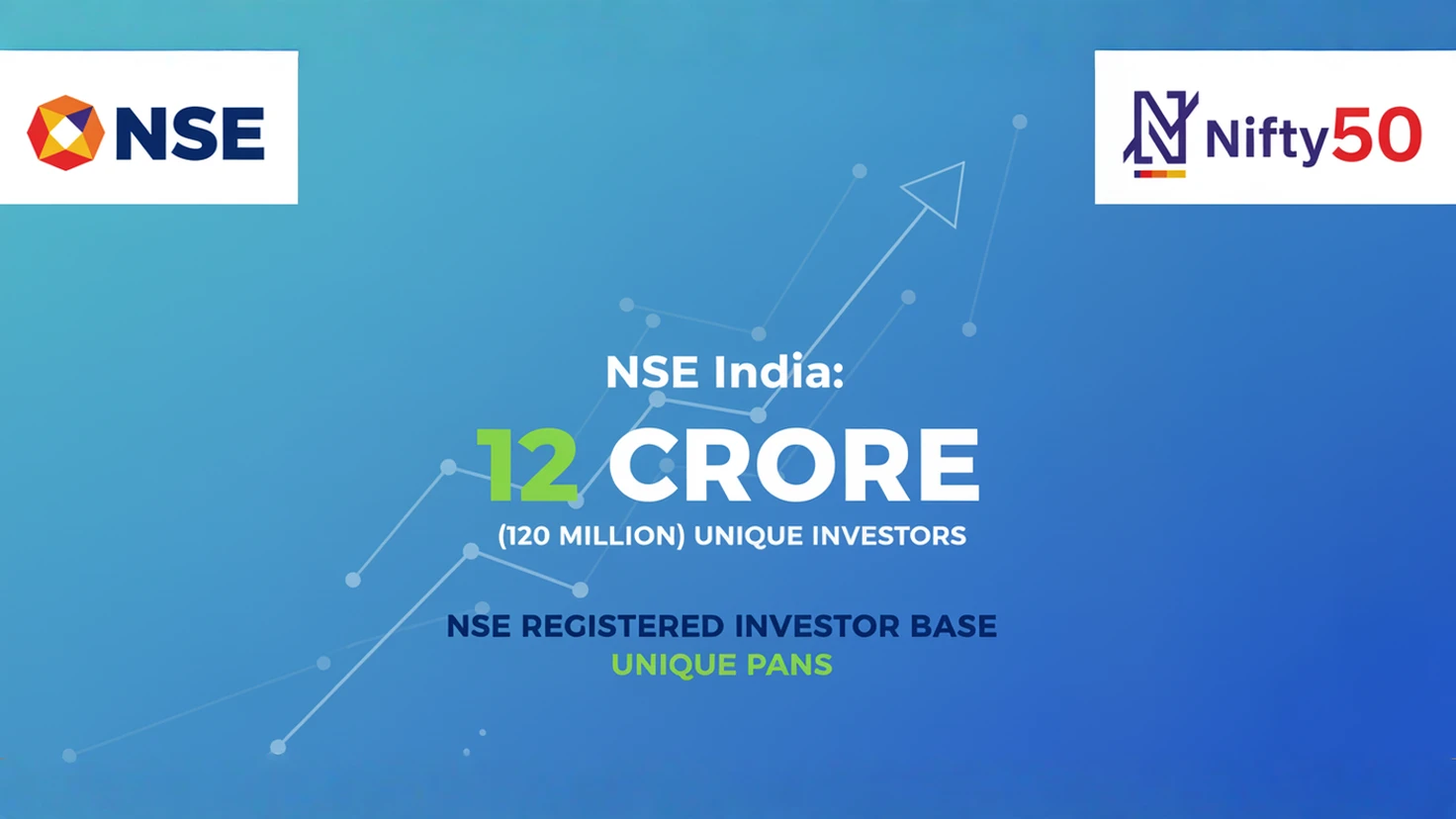
The unique registered investor base on the National Stock Exchange of India crossed the 12-crore (120 million) mark on September 23rd, 2025. The total number of Investor Accounts (Unique Client Codes) registered with NSE stands at 23.5 crore (as of September 23rd, 2025), having crossed the 23-crore mark in July 2025. (Includes all client registrations done to date; clients can register with
more than one trading member.)
The structural expansion of the investor base has accelerated meaningfully over time. The registered
Investor base hit the 1 crore mark 14 years after NSE started operations, the next 1 crore additions took about seven years, the subsequent 1 crore addition took about three-and-a-half years, and the next one a little over a year. In other words, it took over 25 years for the registered investor base to hit the 4-crore mark in March 2021, with the subsequent 1 crore investors being added in about 6-7 months.
India’s rapid rise in investor participation is driven by digitization, greater fintech access, an expanding middle class, and supportive policy measures under the leadership of Hon’ble Prime Minister Shri Narendra Modi.
In this fiscal year thus far (as of September 23rd, 2025), the benchmark Nifty 50 index has generated
returns of 7.0%, while the Nifty 500 index has delivered a strong 9.3% gain during this period. Annualised returns over the five-year period ending September 23rd, 2025, have been 17.7% and 20.5% for Nifty 50 and Nifty 500, respectively, higher than returns generated by broader emerging market and developed market packs. The market capitalization of NSE-listed companies has increased at an annualized rate of 25.1% during this five-year period to Rs 460 lakh crore as of September 23rd, 2025, leading to a significant accretion to the household wealth. Notably, the individual investors, directly and indirectly via mutual funds, own 18.5% of the market (NSE-listed companies), as of June 30th, 2025.
One in four investors today is a woman. Further, we have seen rising interest in financial markets and stock ownership among the country’s youth in recent years – a testament to the trust placed by these investors in the capital market ecosystem. The 12 crore registered investors in India today have a median age of about 33 years, down from 38 years just five years ago, with nearly 40% of them being less than 30 years old.
This has been accompanied by widening participation across the country. The investor base today spans covering 99.85% of India’s pin codes. As of August 31st, 2025, there were three states with the count of unique registered investors more than a crore, with Maharashtra leading the pack with 1.9 crore (19 million) investors, followed by Uttar Pradesh with 1.4 crore (14 million) investors and Gujarat, the latest entrant in this set, with 1.03 crore (10.3 million) investors. Indirect participation has also continued to rise steadily during the current fiscal, as evidenced by almost 2.9 crore (29 million) new SIP accounts opened between Apr 25- Aug’25. During this period, average monthly SIP inflows stood at Rs 27,464 crores (~US$3.2 bn), compared to Rs 21,883 crores (~ US$2.5 bn) in the corresponding months of last year.
India’s vibrant influx of new investors—many of them young, first-time participants—makes broadening financial awareness a priority. Over the past five years, NSE has significantly intensified its work in this area. Investor Awareness Programs (IAPs) by NSE have quadrupled—from 3,504 in FY20 to 14,679 in FY25—reaching more than 8 lakh participants across all states and union territories. Meanwhile, NSE’s Investor Protection Fund (IPF) has grown by nearly 21% YoY to Rs 2,644 crore as of August 31st, 2025.
Shri Sriram Krishnan, Chief Business Development Officer, NSE, said: “This year, we have crossed another significant yardstick in terms of our investor base. After crossing the 11-crore mark in January, it is commendable that the investors onboarded by NSE have increased by an additional crore in about eight months, despite persistent concerns regarding the contours of global trade and geopolitics. This steady growth is supported by several key drivers: a streamlined Know Your Customer (KYC) process, enhanced financial literacy through stakeholder-led investor awareness programs, and sustained positive market sentiment. The rise in participation across Exchange-Traded instruments—including Equities, Exchange-Traded Funds (ETFs), Real Estate Investment Trusts (REITs), Infrastructure Investment Trusts (InvITs), Government Bonds, and Corporate Bonds—underscores these factors.”
About National Stock Exchange of India Limited (NSE):
National Stock Exchange of India (NSE) was the first exchange in India to implement electronic or screen-based trading. It began operations in 1994 and is ranked as the largest stock exchange in India in terms of total and average daily turnover for equity shares every year since 1995, based on SEBI data.
NSE has a fully integrated business model comprising exchange listings, trading services, clearing and settlement services, indices, market data feeds, technology solutions, and financial education offerings. NSE also oversees compliance by trading, clearing members, and listed companies with the rules and regulations of SEBI and the exchange. NSE is a pioneer in technology and ensures the reliability and performance of its systems through a culture of innovation and investment in technology.
NSE is the world’s largest derivatives exchange by trading volume (contracts) as per the statistics maintained by the Futures Industry Association (FIA) for the calendar year 2024. NSE is ranked 2nd in the world in the equity segment by the number of trades (electronic order book) in 2024, as per the statistics maintained by the World Federation of Exchanges (WFE).
For more information, please visit: NSE
Disclaimer: This article is based on information available from public sources. It has not been reported by EQMint journalists. EQMint has compiled and presented the content for informational purposes only and does not guarantee its accuracy or completeness. Readers are advised to verify details independently before relying on them.