Synopsis: An ISMA and P3C study says perovskite solar could add about Rs 74,000 crore of domestic value in 15 years by skipping imported wafer stages. EQMint’s math puts that near Rs 4,900 crore a year and shows the claimed CUF gain means 25% more power per megawatt, pending field data.
India’s solar manufacturers have a new pitch for the next stage of the industry. A study by the Indian Solar Manufacturers Association (ISMA) and P3C Technology and Solutions, released on 18 November 2026, argues that perovskite solar cells could help India sidestep the parts of the supply chain where it depends most on imports. The report is titled “Perovskite Solar: India’s Atmanirbharta Opportunity in Next Generation PV”.
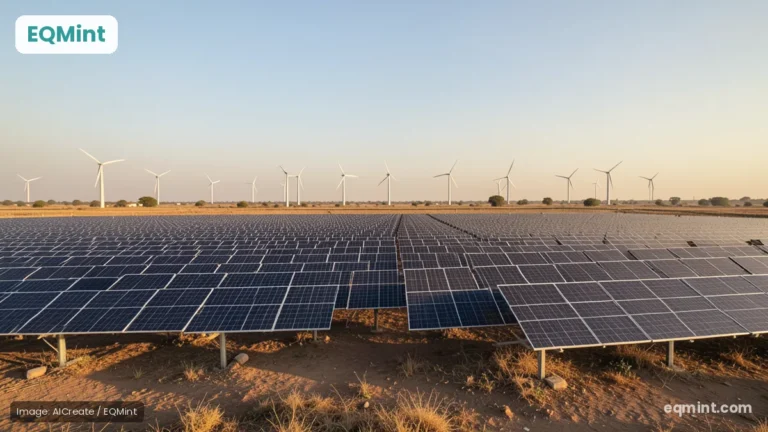
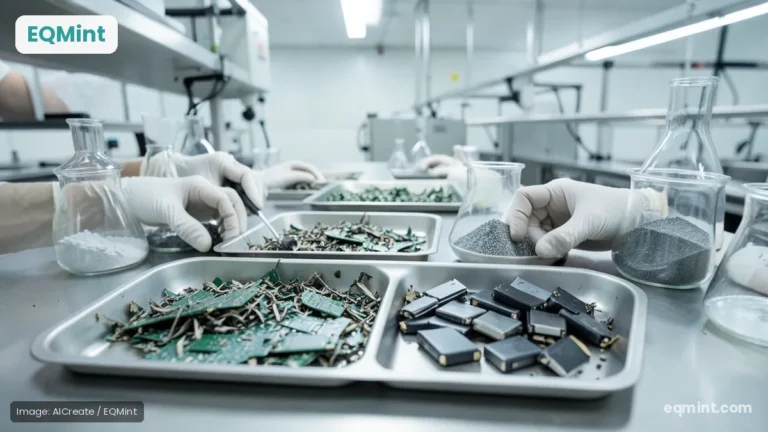
Perovskites are a family of crystal materials that can absorb sunlight and be deposited as thin layers, instead of being cut from silicon wafers. The business case: a perovskite line skips polysilicon, ingots and wafers, where the study says India’s import dependence is highest.
What the ISMA-P3C study claims
The study estimates about Rs 74,000 crore in domestic value addition over 15 years. It says the capital cost of a perovskite factory could be roughly 70% to 80% lower than a conventional crystalline silicon line. With lower heat losses, it projects a plant’s capacity utilisation factor (CUF) could rise from about 20% to about 25%, and the levelised cost of energy could fall by 30% to 40%. The study itself says these performance gains need validation through long-term field data.
Its recommended route is phased: start with single-junction perovskite modules, then move to silicon-perovskite tandem cells that build on the TOPCon cell lines Indian makers are already installing. It also asks for a provisional two-tier category under the Approved List of Models and Manufacturers (ALMM) with clear stability milestones, R&D and pilot funding through the Ministry of New and Renewable Energy and the Anusandhan National Research Foundation, and independent techno-economic modelling.
EQMint analysis: putting the claims in numbers
With no year-by-year build-up published, only a simple average of the Rs 74,000 crore is possible. CUF converts to output using 8,760 hours a year.
| Item | Study figure | EQMint calculation |
|---|---|---|
| Domestic value addition | About Rs 74,000 crore over 15 years | About Rs 4,933 crore a year (simple average) |
| Output of 1 MW at 20% CUF | Current baseline in study | 1,752 MWh a year |
| Output of 1 MW at 25% CUF | Projected for perovskite | 2,190 MWh a year |
| Extra energy per MW | 5 percentage points of CUF | 438 MWh a year, or 25% more |
| Factory capex vs silicon line | 70% to 80% lower | Capex of 20% to 30% of a silicon line |
Source: ISMA-P3C study as reported by Energetica India and Saur Energy, figures as of 18-19 November 2026; EQMint calculations.
The 25% output gain is the claim that most depends on how perovskites hold up outdoors over many years, the technology’s known weak point, which is why the study ties its ALMM request to stability milestones.
Why the timing matters: the cell shortage
The study lands while Indian developers are short of domestically made cells. ALMM List-II, which took effect for solar cells on 1 June 2026, has tightened supply and pushed module prices up, Mercom India reported on 12 November. Mercom also reported that large-scale solar installations fell 24% quarter-on-quarter in the July-September quarter, and its managing director has said significant new ALMM-compliant cell supply may not arrive until June 2027 or later.
Margin pressure is visible among listed makers, as in Vikram Solar’s Q2 FY27 profit decline. Investors are also backing deep-tech hardware such as Bharat Semi’s $24 million round for AI image sensors and the Oister Global deep-tech fund.
Who is P3C and what it is testing
P3C Technology and Solutions is developing its own absorber chemistry, assembly line and intellectual property in India, according to co-founder and CEO Sooraj Kumar. Its modules are in reliability testing at the National Institute of Solar Energy (NISE). Kumar said the company’s priority is to build the field data needed to make the technology bankable. ISMA secretary general Amit Manohar described perovskite as a promising next step that builds on manufacturers’ existing investments in cells, wafers and ingots.
What happens next
The study’s proposals need action from MNRE, which runs ALMM, and from ANRF for research funding. The practical test is field data: until perovskite modules show years of stable output in Indian conditions, lenders are unlikely to treat them like silicon. A provisional ALMM tier would be the first signal of support for commercial perovskite lines, not just pilots.
Image credit: EQMint.
Sources
- Source: Energetica India (via Solar Now) – Perovskite solar could unlock INR 74,000 crore for India: ISMA-P3C study (18 Nov 2026)
- Source: Saur Energy (via Solar Now) – India’s perovskite solar push could unlock Rs 74,000 crore (19 Nov 2026)
- Source: Perovskite-Info – Indian study sees perovskites as a way around silicon wafer imports (19 Nov 2026)
- Source: Mercom India – India’s solar capacity rises 21% YoY in 9M despite cell shortages (12 Nov 2026)
Disclaimer: This article is for information purposes only and is not investment advice.
For more such information, visit EQMint
Join our WhatsApp channel for timely updates: Whatsapp