
Indian stock markets witnessed a volatile trading session as the Sensex and Nifty50 fluctuated sharply, reflecting global uncertainty and rising crude oil prices. While markets attempted a recovery with modest gains during the day, concerns over geopolitical tensions, foreign investor outflows, and a weakening rupee continued to weigh on sentiment. The overall mood remains cautious, with investors closely tracking oil prices and global developments.
Author : Aashiya Jain | EQmint | Market News
A Day of Swings on Dalal Street
The Indian stock market opened on a cautious note, reflecting the prevailing global market uncertainty and weak market cues. During the early hours of trade, the market remained flat, with the benchmark indices struggling to find direction. However, as the day progressed, the market indicated signs of revival, driven by selective buying in the heavyweight stocks.
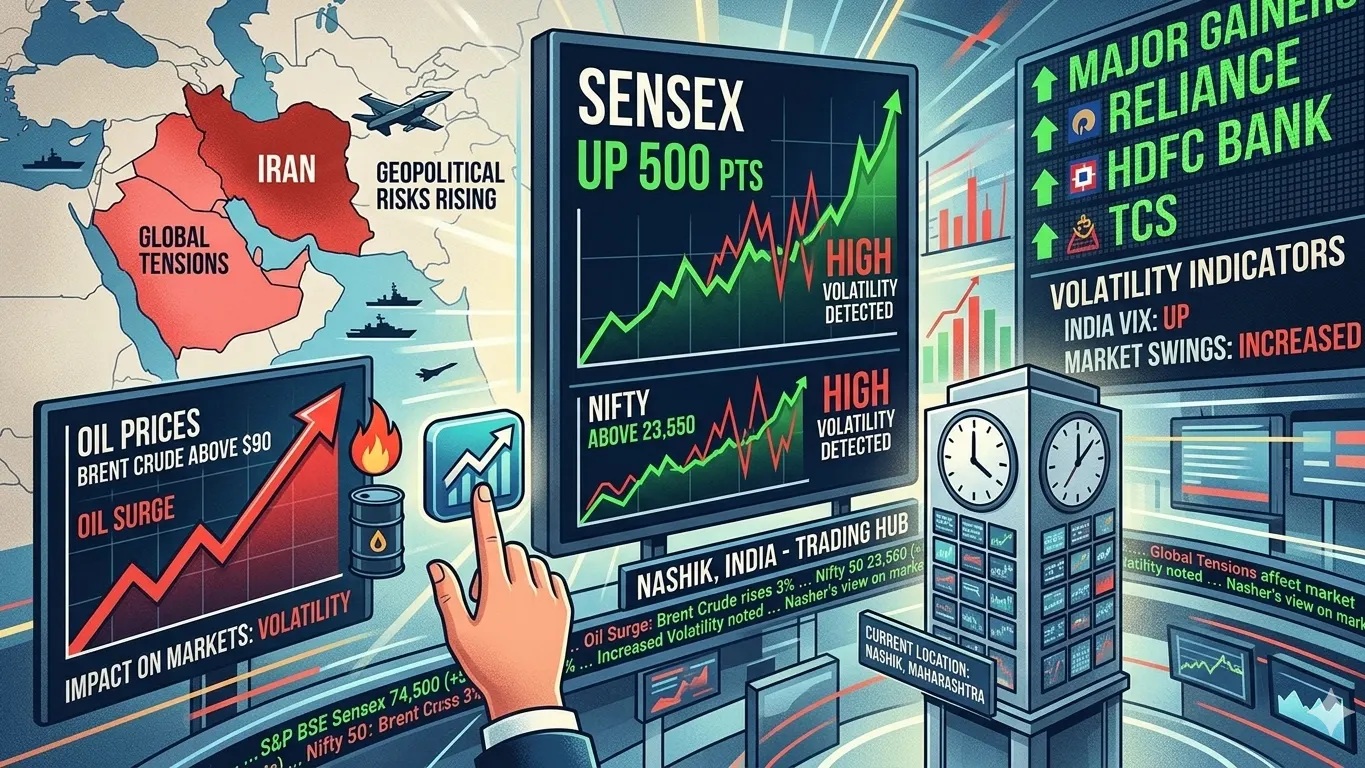
During the mid session, the Sensex and Nifty managed to inch higher, reflecting the revival in the market sentiment. The Nifty traded around the level of 23,500, while the Sensex traded around the level of 76,000, indicating a revival in the market after witnessing sharp declines in recent times.
However, the market sentiment remained fragile, as investors were still not fully convinced about the revival in the market.
Crude Oil: The Biggest Market Trigger
One of the biggest factors influencing the market right now is crude oil prices, which have surged past the $100 per barrel mark due to ongoing geopolitical tensions in the Middle East.
For India, this is a major concern. As a country heavily dependent on oil imports, rising crude prices directly impact inflation, corporate margins, and overall economic growth.
Higher oil prices also increase the cost of transportation and manufacturing, which eventually affects company earnings. This is why sectors like aviation, logistics, and paint companies often come under pressure during such phases.
Foreign Investors and Market Sentiment
Another key factor shaping the market trend is the behavior of Foreign Institutional Investors (FIIs). In recent weeks, FIIs have been pulling money out of Indian equities, adding to market pressure.
Reports suggest that nearly $6.9 billion has been withdrawn this month, marking one of the highest outflows in recent times.
When foreign investors sell heavily, it creates additional volatility and often drags indices lower. Domestic investors have tried to balance this with selective buying, but global cues still dominate the trend.
Rupee Weakness Adds to Concerns
The Indian rupee remains under pressure, trading close to its all-time low near 92.4 against the US dollar.
A weaker rupee makes imports more expensive, especially crude oil, further increasing inflationary risks. While the Reserve Bank of India has intervened at times to stabilize the currency, the broader trend continues to reflect global uncertainty.
This combination of rising oil prices and currency weakness is a double challenge for the Indian economy and markets.
Sectoral Movements and Market Breadth
Despite the challenges, the market wasn’t entirely negative. Several sectors showed resilience, with 13 out of 16 major sectors posting gains during the session.
Banking and financial stocks, along with select large-cap companies, provided support to the indices. There was also some value buying after the recent correction, as investors looked to pick fundamentally strong stocks at lower levels.
However, mid-cap and small-cap stocks remained more volatile, reflecting cautious participation from retail investors.
What Lies Ahead
The current market situation highlights one thing clearly uncertainty is the dominant theme. From global conflicts to oil price fluctuations, multiple factors are influencing investor sentiment simultaneously.
In the short term, markets are likely to remain range bound with high volatility. Any significant movement in crude oil prices or geopolitical developments could quickly shift the direction.
For investors, this phase calls for patience and careful decision-making rather than aggressive moves.
A Market Caught Between Hope and Risk
The Indian stock market is currently balancing between recovery and risk. While there are signs of resilience and buying interest, external pressures continue to limit upside.
Until global stability improves, Dalal Street is expected to move cautiously reacting quickly to every major development across the world.
For more such information visit EQMint
Disclaimer: This article is not an investment advice and is for educational purpose only