Synopsis: Skyroot Aerospace’s Raman-2 upper-stage engine has passed its acceptance test for the second flight of the Vikram-1 rocket. EQMint’s timeline analysis shows Flight 2 would come 4.5 to 6.5 months after the maiden orbital launch, with commercial missions due from Flight 3 and the company’s valuation up 2.2 times since 2023.
Hyderabad-based Skyroot Aerospace has said that its Raman-2 engine has cleared the acceptance test for the second flight of its Vikram-1 rocket, according to a company release carried by idrw.org on 25 November 2026 and reports on 26 November 2026. The engine powers the rocket’s Orbital Adjustment Module (OAM), the final stage that manoeuvres in space and places satellites into their intended orbits.
The milestone matters because Vikram-1 is India’s first privately developed orbital rocket. Its maiden mission, Mission Aagaman, reached orbit from Sriharikota on 18 July 2026, making India the third country after the US and China with a private orbital launch capability. A second successful flight would show that the vehicle can be repeated, which is what commercial customers look for before booking launches.
EQMint analysis: Vikram-1’s road to commercial service
EQMint put together the key dates and figures from Skyroot’s disclosures and media reports to measure how fast the programme is moving from demonstration to business.
| Milestone | Date | EQMint calculation |
|---|---|---|
| Company founded | 12 Jun 2018 | – |
| Unicorn round ($60 Mn) | 7 May 2026 | 72 days before first orbital flight |
| Flight 1 reaches orbit | 18 Jul 2026 | About 8.1 years after founding |
| Raman-2 acceptance test for Flight 2 | Reported 25 Nov 2026 | 130 days after Flight 1 |
| Flight 2 (reported window) | Dec 2026 to early Jan 2027 | About 4.5 to 6.5 months after Flight 1 |
| Flight 3 | Not announced | First fully commercial mission |
Source: idrw.org (25 Nov 2026), Indian Masterminds (26 Nov 2026), TechCrunch (7 May 2026), Wikipedia company profile. The Flight 2 window uses 1 Dec 2026 to 31 Jan 2027 as bounds. EQMint calculations.
Two points stand out. If Flight 2 flies in the reported window, the gap between the first and second launches would be well under a year, a short turnaround for a new rocket. And because Skyroot treats the first two flights as demonstration missions, revenue launches only begin with Flight 3, so the second flight is effectively the last test before commercial service.
What the Raman-2 engine does
Raman-2 is a liquid-fuel engine that is fully 3D-printed, regeneratively cooled and designed to restart several times in space. That restart ability lets the upper stage drop different satellites into different orbits on one mission, a selling point for small-satellite rideshare customers. Skyroot lists its design figures as 820 N of thrust at sea level and 1,460 N in vacuum, with a chamber pressure of 8.5 bar absolute. On EQMint’s calculation, vacuum thrust is about 78% higher than sea-level thrust, which reflects the engine’s role in space rather than at lift-off. It runs on mono methyl hydrazine and nitrogen tetroxide.
The next steps are integrating the engine into the OAM and completing electrical checks. First-stage hardware for Flight 2 has already moved to Sriharikota, and testing of the Raman-1 roll-control thrusters and interstage vibration tests has progressed, according to Indian Masterminds. ISRO had supported an earlier 10-second Raman-II test at its Mahendragiri Propulsion Complex in July 2023.
The business behind the rocket
Skyroot raised $60 million in May 2026, about $50 million in equity co-led by Sherpalo Ventures and GIC and about $10 million in structured debt from funds affiliated with BlackRock, according to TechCrunch. The round valued the company at $1.1 billion pre-money, 2.2 times the $500 million pre-money valuation of its 2023 round, making it India’s first space-tech unicorn. Skyroot has not disclosed revenue or a launch backlog, but it said about one-third of expected demand comes from India and the rest from overseas customers.
Vikram-1 is designed to carry up to 350 kg to low Earth orbit, and Skyroot lists 260 kg to sun-synchronous orbit. A larger one-tonne-class Vikram-2 with a cryogenic stage is planned for 2027. Its Infinity Campus in Hyderabad is designed to produce one orbital rocket a month. Private space hardware has been drawing fresh capital, from Pixxel’s satellite factory plans to SatSure’s ₹60 crore Series B. The government aims for a $44 billion space economy by 2033, against about $9 billion today, as cited at the India International Space Conclave in New Delhi this week.
What happens next
Skyroot will integrate Raman-2 into the orbital adjustment module and finish electrical checks ahead of Flight 2, which reports place around December 2026 or early January 2027, subject to final readiness reviews. Separately, India’s first industry-built PSLV, made by HAL and L&T, is targeted for the first quarter of 2027, according to ISRO chairman V. Narayanan.
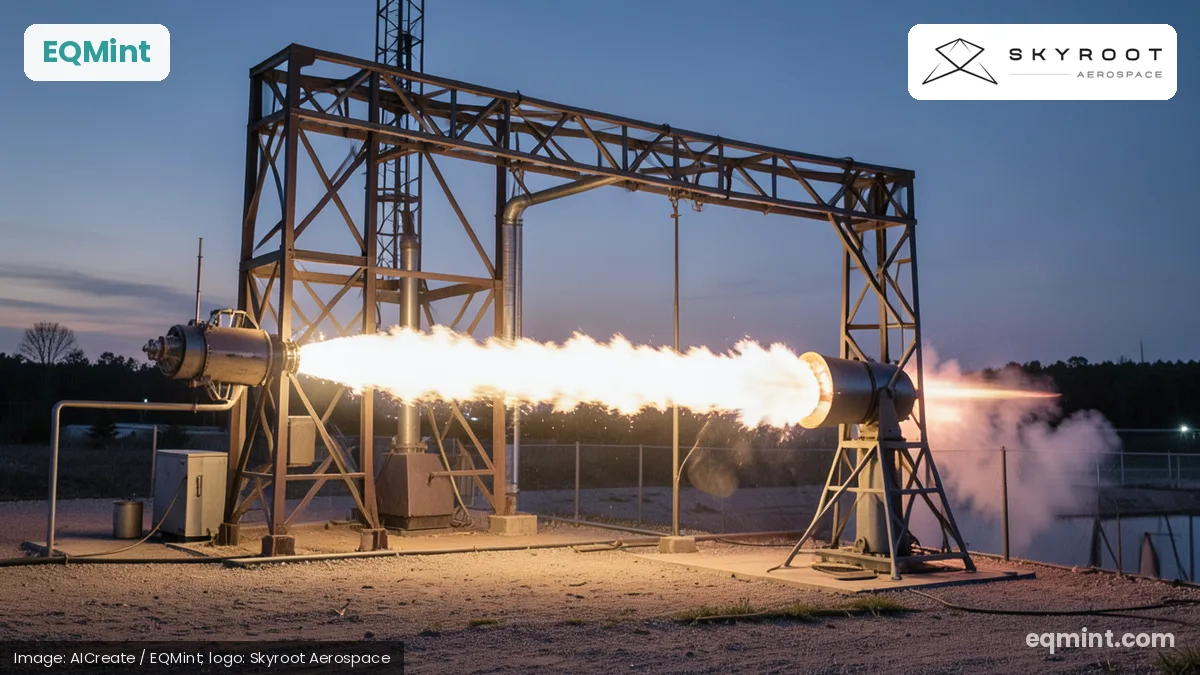
Image credit: AICreate / EQMint (representational); logo: Skyroot Aerospace (official website).
Sources
- Source: Skyroot’s Raman-2 Engine Clears Acceptance Test for Vikram-1 Flight 2 (idrw.org, company press release)
- Source: Vikram-1 Flight 2 Moves Closer, Raman-2 Engine Milestone (Indian Masterminds)
- Source: India’s first space-tech unicorn emerges as Skyroot gears up for orbital launch (TechCrunch)
- Source: Agencies, industry leaders meet in Delhi to advance India’s private space sector (Arab News)
- Source: Skyroot Aerospace company profile (Wikipedia)
Disclaimer: This article is for information purposes only and is not investment advice.
For more such information, visit EQMint
Join our WhatsApp channel for timely updates: Whatsapp
Support EQMint: tap below to add us as a preferred source on Google.
Get the EQMint Daily
Market moves, IPOs and startup funding news in your inbox every morning.