Synopsis: Tata Steel and US-based Utility Global plan a unit at Kalinganagar that would make about 10 tonnes a day of hydrogen from steel plant off-gases. EQMint’s calculation puts that at about 3,650 tonnes a year, roughly 0.07% of India’s 5 million tonne 2030 green hydrogen goal, though this process is not classed as green.
The plan
Tata Steel and Houston-based Utility Global announced on 18 November that they plan to deploy Utility’s H2Gen system at Tata Steel’s Kalinganagar plant in Odisha. The two companies will carry out a joint front-end engineering design (FEED) study to support a final investment decision by Tata Steel’s board. No timeline or project cost was disclosed.
The proposed unit would produce about 10 tonnes a day of high-purity hydrogen from water, using the energy in off-gases from the blast furnace and basic oxygen furnace. Utility says H2Gen needs no electricity and produces a separate, concentrated stream of carbon dioxide that is cheaper to capture. The hydrogen can be injected back into the blast furnace to cut the use of coke. PTI described it as India’s first such initiative.
“This planned project is our largest commercial H2Gen deployment announced globally,” said Parker Meeks, CEO of Utility Global. Subodh Pandey, Vice President for Technology and R&D at Tata Steel, said: “Technologies like H2Gen give us the opportunity to pursue emissions reduction while leveraging the existing infrastructure.”
EQMint analysis: sizing the project
| Item | Figure | Source |
|---|---|---|
| Planned hydrogen output | about 10 tonnes per day | Utility Global / Tata Steel release |
| Annual equivalent (EQMint calc.) | about 3,650 tonnes | 10 t x 365 days |
| National Green Hydrogen Mission target | at least 5 million tonnes a year by 2030 | PIB |
| Share of mission target (EQMint calc.) | about 0.07% | 3,650 t / 5 MMT |
| Kalinganagar capacity | 8 MTPA after Phase II | Tata Steel, 22 May 2025 |
Sources as listed; calculations by EQMint on 19 Nov 2026.
The scale is small next to the national goal, and an important caveat applies: hydrogen made from fossil-derived off-gases is unlikely to meet India’s green hydrogen standard, so it should not be counted against the mission target. Its value lies elsewhere. It uses waste gas that a steel plant already produces, needs no new renewable power, and creates a cleaner CO2 stream that could make carbon capture cheaper at one of India’s largest steel sites. Kalinganagar was expanded to 8 MTPA from 3 MTPA at a cost of ₹27,000 crore and houses India’s largest blast furnace at 5,870 cubic metres, according to Tata Steel.
Why it matters
Steel is one of India’s hardest sectors to decarbonise, and blast furnaces will run for decades. Tata Steel targets net zero by 2045 and aims for 40 MTPA of capacity in India. Retrofit options that work with existing furnaces, rather than replacing them, are therefore closely watched by the industry and by buyers in markets that tax carbon at the border.
The project adds to a run of large energy-transition moves in India. EQMint recently reported on Amazon’s $7 billion renewable energy commitment, Hindustan Zinc’s ₹80,000 crore expansion and a critical minerals recovery startup.
What happens next
The FEED study will set the design, cost and emissions profile of the unit. Only after that will Tata Steel’s board decide whether to invest. Disclosure of the capital cost and the expected CO2 reduction per tonne of steel will be the key numbers to watch.
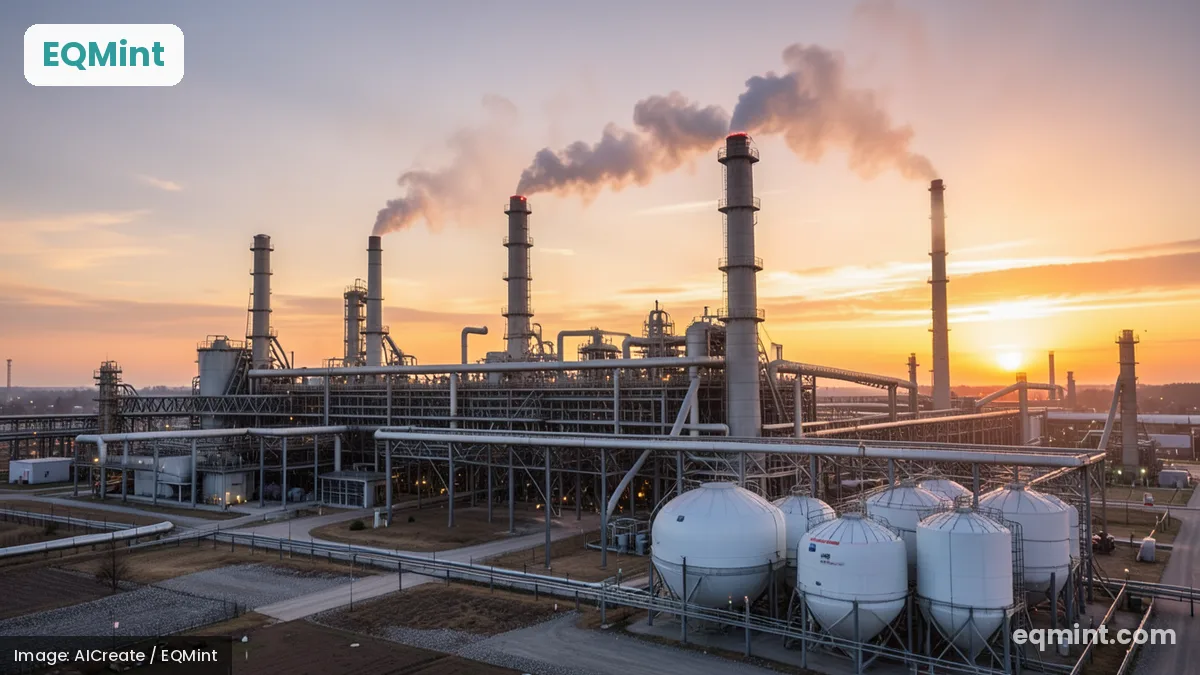
Image credit: AICreate / EQMint (representational).
Sources
- Source: PR Newswire, Utility Global and Tata Steel plan to deploy H2Gen project in India (18 Nov 2026)
- Source: Tata Steel, Kalinganagar Phase II expansion (22 May 2025)
- Source: PIB, National Green Hydrogen Mission
- Source: Business Standard/PTI, Tata Steel plans project to produce hydrogen using steel plant off-gases (18 Nov 2026)
Disclaimer: This article is for information purposes only and is not investment advice.
For more such information, visit EQMint
Join our WhatsApp channel for timely updates: Whatsapp