
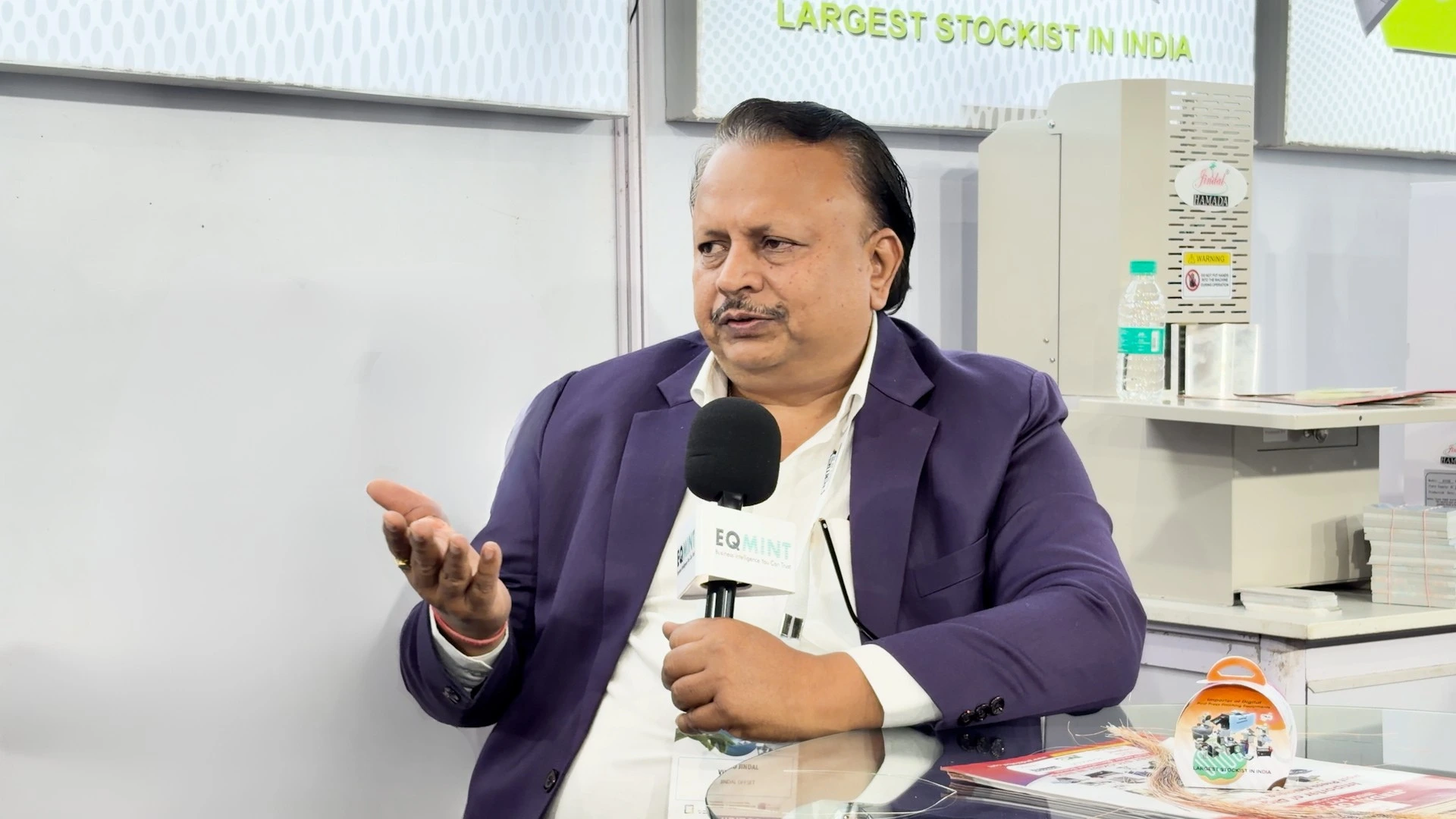
In a candid conversation as part of EQMint’s Impact Individuals series, Vinod Jindal, Director of Jindal Offset India Private Limited, reflects on his three-decade journey in the printing industry. Beginning in 1991 with a focus on offset printing, Jindal witnessed the rapid rise of digital technology and strategically shifted his company’s direction in 2010 toward finishing and post-press equipment. From launching high-precision paper cutters at PAMEX to emphasizing service reliability over quick sales, his insights offer both practical guidance for new printers and a grounded perspective on where the industry is headed.
Author : Aashiya Jain | EQmint Originals | Founder Stories
A Legacy Rooted in Printing
Jindal Offset India Private Limited has built its identity around reliability, long-term thinking, and technical expertise. Over the years, the company has earned recognition for supplying quality machinery while maintaining strong service support an area many equipment suppliers struggle to sustain.
At the helm of this evolution is Vinod Jindal, who entered the printing business in 1991. Like many industry veterans of his era, he began with offset printing a technology that has long been the backbone of commercial printing due to its cost efficiency and durability. But what distinguishes Jindal’s journey is not just longevity; it’s adaptability.
Recognizing the Digital Shift
By 2010 the printing world was changing fast. Digital printing was gaining traction especially for short-run jobs and customized prints. Many traditional offset businesses felt uncertain about this transition. Instead of resisting change Vinod Jindal read the market carefully and made a calculated pivot. He began importing high-quality finishing and post-press equipment from China recognizing that as printing technologies evolve the demand for advanced finishing solutions grows alongside them.
While printing methods may vary every printed product still needs cutting trimming folding and binding. By focusing on finishing equipment Jindal positioned his company at a critical intersection of both offset and digital workflows. Vinod Jindal didn’t just react to change he anticipated it. He saw that no matter how printing evolves the need for finishing remains constant.
That insight gave him an edge. He wasn’t betting on one technology over another he was betting on what every print job needs in the end. That kind of thinking is what separates leaders from followers. It’s not about chasing trends. It’s about finding the constant in the chaos. And for printing that constant is finishing.
Innovation at PAMEX: Launching Precision Machinery
The company recently showcased its innovations at the PAMEX exhibition, one of the most significant printing industry platforms. For Jindal, exhibitions are not merely marketing opportunities they are spaces where technology meets real customer interaction.
At PAMEX, Jindal Offset introduced new high-precision paper cutting machines in 490mm and 530mm sizes. These machines offer cutting accuracy up to 0.1mm an impressive specification that reflects the increasing demand for exactness in modern print production. Precision is no longer a luxury; it is an expectation.
In addition, the company presented advanced label cutters capable of half-cutting, full-cutting, and creasing in virtually any shape. With the explosion of packaging, branding, and customized labeling, such versatile machines address a rapidly growing segment of the market. According to Jindal, demand for these label cutters has been particularly strong, demonstrating how finishing equipment plays a crucial role in value-added printing.
Offset vs. Digital: A Balanced Perspective
Vinod Jindal believes offset printing is still going strong even as digital printing keeps growing and there’s a good reason for that. Offset machines last 15 to 20 years and cost less per unit when you’re doing big jobs.
Digital printers are flexible and great for short runs but they cost more to run and lose value faster. So it’s not really about one beating the other. Jindal sees them as working together. Offset is still the go-to for long print runs while digital handles quick jobs custom stuff and on-demand printing. And finishing equipment kind of ties both of them together anyway. Offset’s long life and lower costs make it a solid choice for big jobs. Digital’s flexibility is perfect when you need something fast and customized.
Quality Over Quick Profits
One of the most striking aspects of Jindal’s philosophy is his approach to profit margins. He openly states,
“My aim is to work on lower profit margins to provide high-quality products to the customer so they face fewer problems in the future.”
In an industry where price competition can be fierce, this mindset stands out. Instead of chasing short-term gains, Jindal focuses on durability, long-term relationships, and customer satisfaction. He believes that solving a customer’s problem once and properly builds more trust than repeatedly selling replacements or upgrades.
Advice for New Printers: Start Small, Grow Smart
For entrepreneurs entering the printing business, Jindal offers pragmatic advice: begin with small investments.
“If you invest too much initially, the risk of loss is higher. Move forward step-by-step,” he advises.
The printing industry, like many capital-intensive sectors, can overwhelm newcomers who overspend on equipment without building steady demand. Incremental growth allows businesses to adapt to market conditions without incurring unsustainable financial pressure.
He also encourages due diligence. Before buying machinery, customers should research the supplier’s track record, check online reviews, and assess how many installations the company has completed. These steps may seem basic, but in a crowded market filled with new entrants, they can prevent costly mistakes.
Service and Spare Parts: The Real Differentiator
The most powerful message from the interview revolves around service reliability. Jindal cautions buyers to ask a simple but critical question before purchasing any machine:
“Will I get service and parts in the future?”
He points out that some companies enter the market sell equipment aggressively and disappear soon after, leaving customers stranded without technical support. For businesses dependent on continuous production downtime can be devastating. Jindal Offset’s promise is straightforward: consistent service readily available spare parts and long-term commitment. “Jindal Offset always takes care of its clients” he assures reinforcing that technology alone is not enough, support infrastructure is equally vital.
Looking Ahead
The printing industry keeps changing all the time. It’s always mixing old-school methods with new digital stuff. But Vinod Jindal’s story proves that success isn’t just about using the latest tech. It’s really about knowing what the market wants. Keeping quality high. Building strong relationships that last.
Jindal Offset India Private Limited started way back in 1991 with offset printing. Now they’re bringing in precision finishing equipment to stay competitive. The company’s journey shows real adaptability. It’s built on practical wisdom not just fancy machines. This story isn’t really about equipment. It’s about seeing what’s coming. Having integrity. And committing to serve customers well after the sale is done. In an industry that’s always transforming.
Vinod Jindal’s steady approach stands out. Service-oriented. Thoughtful. His way of doing things reminds everyone that progress works best when it’s measured. When it’s customer-focused. When it’s not just chasing the next big thing.
For more such information : EQmint
Resource Link : Youtube