
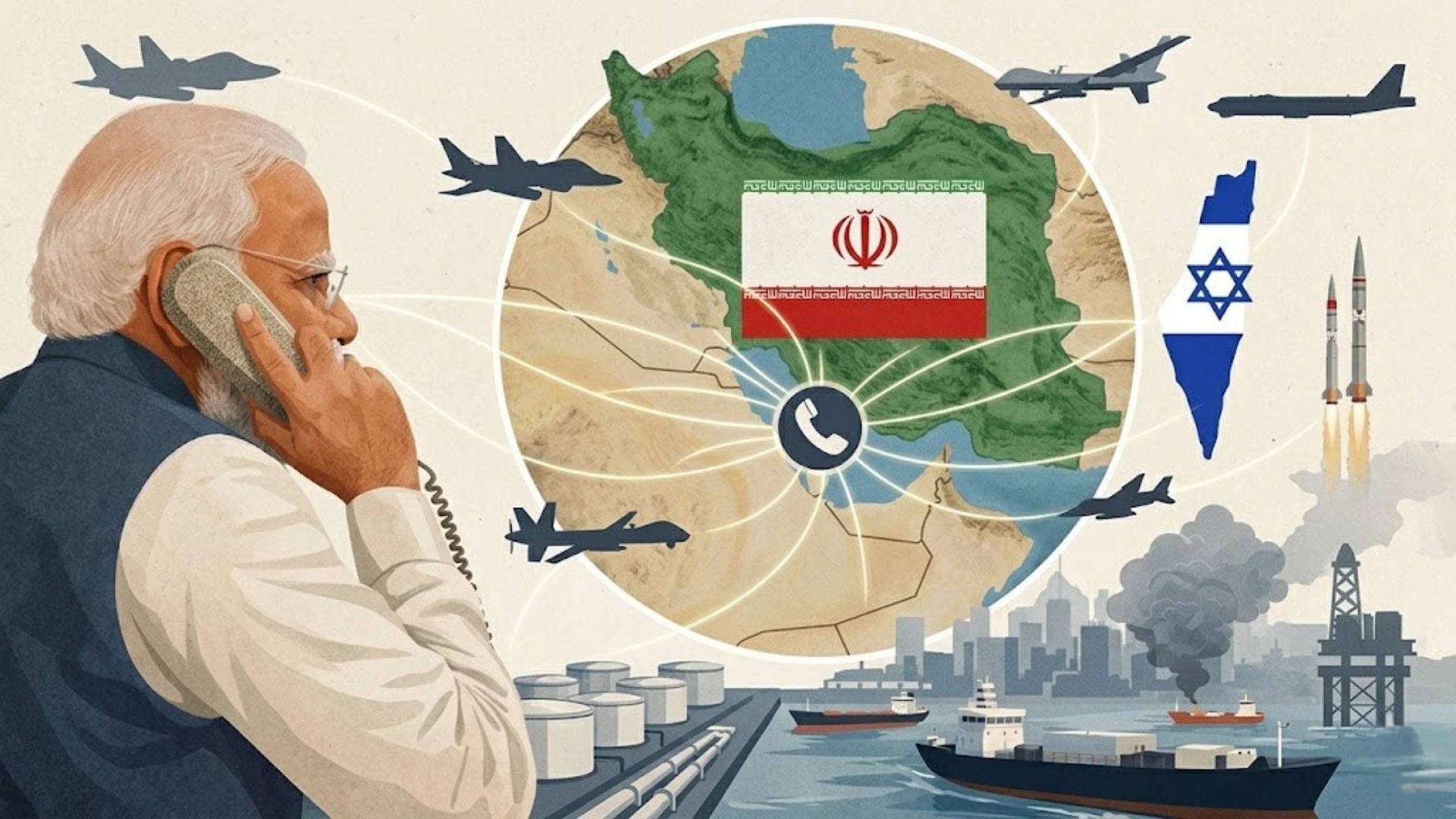
Prime Minister Narendra Modi’s delayed call to Iran after 12 days has triggered debate over India’s foreign policy stance. The timing suggests economic priorities may have outweighed diplomatic signaling.
Author: Aditya Pareek | EQMint
Modi Iran Call Delay Sparks Debate Over India’s Foreign Policy
Prime Minister Narendra Modi’s decision to call Iran’s leadership after nearly 12 days of silence has sparked intense debate across diplomatic and policy circles. The Modi Iran call delay comes at a time when the West Asia region is witnessing heightened tensions, making India’s response—or lack thereof—particularly significant.
The delay has raised critical questions about India Iran relations 2026, with analysts and observers trying to understand whether the timing reflects strategic caution or a shift in India’s foreign policy priorities.
What Happened During the 12-Day Gap?
During the nearly two-week period before the call, the geopolitical landscape in West Asia underwent rapid changes. The conflict involving Iran escalated significantly, with global powers taking positions and issuing statements.
However, India maintained a relatively muted stance. Instead of directly engaging Iran at the highest level, New Delhi limited its response to general calls for peace and diplomacy. According to the report, India reiterated that issues should be resolved through dialogue but avoided explicitly condemning any side.
This cautious approach has become central to discussions around Modi foreign policy Iran, with critics questioning whether India missed an opportunity to assert leadership.
Why Did Modi Call After 12 Days?
The most crucial question remains: why did the Prime Minister finally reach out after such a delay?
According to the analysis, the call was not primarily driven by diplomatic protocol or geopolitical positioning. Instead, it appears to have been triggered by economic and energy concerns.
India was facing disruptions in LPG supplies, which led to panic among consumers and highlighted vulnerabilities in energy logistics. The situation created urgency for the government to ensure uninterrupted access to critical energy routes.
The call to Iran was therefore aimed at securing “unhindered transit of energy and goods,” particularly through key maritime routes like the Strait of Hormuz.
This development suggests that India Iran diplomacy in this instance was driven more by practical needs than symbolic gestures.
Immediate Impact: Energy Routes Reopened
Following the call, there were tangible outcomes. Iran allowed Indian ships to pass through strategic routes, easing concerns over energy supplies.
Reports indicate that LPG tankers resumed their journey without disruption, bringing immediate relief to India’s domestic supply chain.
This outcome reinforces the idea that the Modi Iran call delay was ultimately resolved in favor of safeguarding India’s economic interests.
India’s Silence and Strategic Balancing
Another important aspect of the situation is India’s broader diplomatic posture during the crisis. While the Prime Minister did not initially reach out to Iran, India maintained communication with several other countries, including key players in the Gulf region.
This selective engagement has led to speculation about India’s strategic alignment. Some analysts argue that India’s silence may indicate a careful balancing act between competing global powers, particularly the United States, Israel, and Iran.
India has traditionally followed a policy of strategic autonomy. However, in this case, its actions have sparked debate over whether it is gradually leaning toward certain alliances.
The West Asia crisis India response reflects this delicate balancing act—one that prioritizes national interests while avoiding overt political positioning.
Criticism and Policy Debate
The delay has not gone unnoticed. Critics argue that India’s response appeared hesitant at a time when decisive diplomacy was needed.
Some believe that the Modi foreign policy Iran approach risked projecting indecisiveness, especially given India’s historical role as a voice for the Global South.
Others, however, defend the government’s stance, stating that maintaining neutrality and focusing on national interests is a pragmatic approach in a complex geopolitical environment.
This divergence of views highlights the evolving nature of India Iran relations 2026, where economic priorities, strategic partnerships, and diplomatic principles intersect.
Economic Interests vs Diplomatic Signaling
At the heart of the debate lies a fundamental question: should foreign policy prioritize economic interests over diplomatic signaling?
In this case, the Modi Iran call delay suggests that India chose a pragmatic path. By acting when its energy security was at risk, the government ensured immediate benefits for its economy.
However, this approach also raises concerns about long-term diplomatic positioning. A delayed response can sometimes be interpreted as a lack of urgency or commitment, potentially affecting bilateral relations.
The balance between economic pragmatism and diplomatic symbolism is a recurring challenge in global politics, and this episode is a clear example of that tension.
What This Means for India’s Global Role
The episode offers important insights into India’s evolving role on the global stage. As one of the world’s fastest-growing economies, India is increasingly required to navigate complex geopolitical situations.
The West Asia crisis India response shows that the country is prioritizing:
- Energy security
- Trade stability
- Strategic neutrality
At the same time, it highlights the challenges of maintaining a consistent diplomatic narrative.
Conclusion: A Calculated but Controversial Move
The Modi Iran call delay may have been a calculated decision aimed at protecting India’s immediate interests. However, it has also opened up a broader debate about the country’s foreign policy direction.
While the eventual call helped stabilize energy supplies and ensured smooth trade routes, the delay has raised questions about timing, intent, and global perception.
As India Iran diplomacy continues to evolve, such decisions will play a crucial role in shaping the country’s international image. The incident serves as a reminder that in geopolitics, timing can be just as important as action.
For more such information visit EQMint