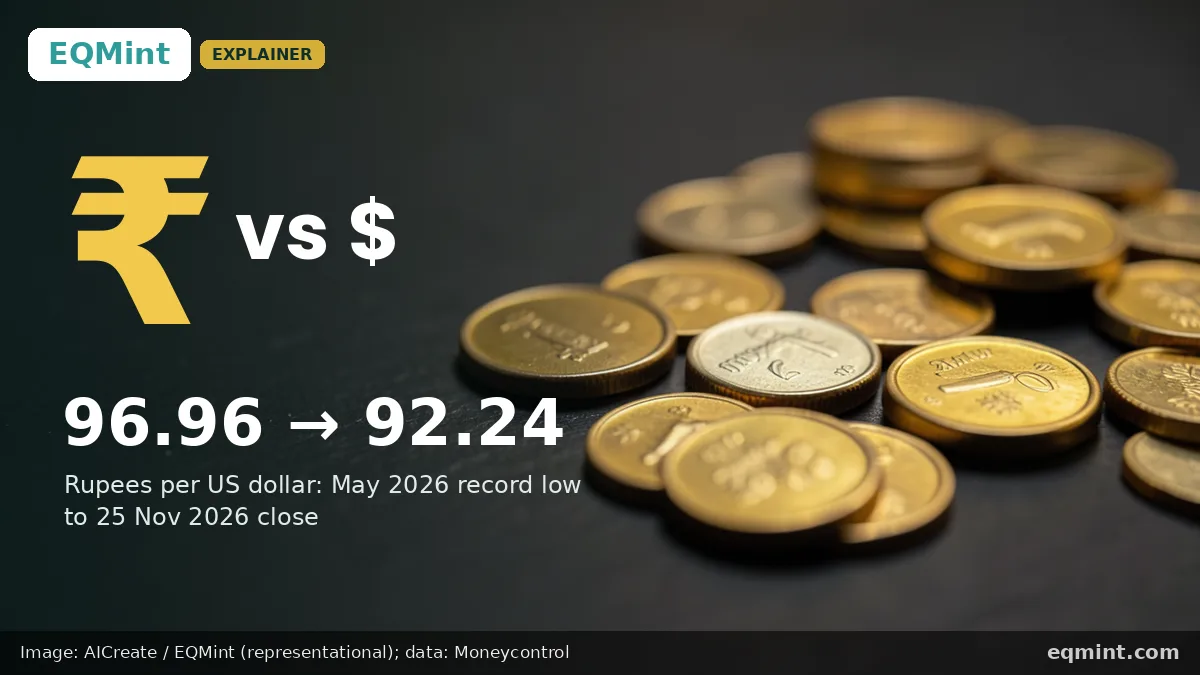
Synopsis: The rupee has climbed from a record low of 96.96 per dollar in May to 92.24 on 25 November 2026, a gain of about 5.1%. EQMint explains what drove the move, how it compares with the 2013 and 2018 recoveries, and why record foreign equity buying was the biggest single reason.
Last updated on 26 November 2026. EQMint updates this explainer regularly.
For most of 2026 the Indian rupee was Asia’s weakest major currency. It slid past 96 per US dollar in May and touched an all-time low of 96.96 during the month, according to Moneycontrol. On 9 October it was still at 96.76, a whisker away from that record. Seven weeks later, on 25 November, it closed at 92.24 per dollar, its strongest level since mid-March.
That is the “97 se 92” journey many readers have been asking about. This explainer looks at what changed, whether the rupee has made a comeback like this before, and which factor mattered most.
What a stronger rupee means
The exchange rate tells you how many rupees it takes to buy one US dollar. When the number falls, from 96.76 to 92.24 for example, each dollar costs fewer rupees, so the rupee has strengthened (appreciated). When the number rises, the rupee has weakened (depreciated).
In practical terms, a payment of $10,000 for imports, foreign fees or a child’s tuition abroad would have cost about ₹9,67,600 at the 9 October close and about ₹9,22,400 at the 25 November close, roughly ₹45,200 less before bank charges. The reverse applies to exporters and to families receiving money from abroad: each dollar they earn or receive now converts into fewer rupees.
EQMint analysis: the third sharp comeback in 13 years
The 2026 recovery is not a first. The rupee has bounced back sharply from a record low at least twice before, and each time the recovery took roughly seven weeks. EQMint compared the three episodes using closing levels reported at the time.
| Episode | Weakest point | Recovered to | Rupee gain | Days | Main triggers reported |
|---|---|---|---|---|---|
| 2013 taper tantrum | 68.85 (28 Aug 2013) | 61.55 (14 Oct 2013) | 11.9% | 47 | RBI dollar window for oil companies, FCNR(B) deposit swap, foreign inflows |
| 2018 oil shock | 74.48 (11 Oct 2018) | 69.85 (29 Nov 2018) | 6.6% | 49 | Brent fell from about $86 to about $60, foreign investors returned |
| 2026 oil and outflow shock | 96.76 (9 Oct 2026); record 96.96 in May | 92.24 (25 Nov 2026) | 4.9% (5.1% from record) | 47 | Record FPI buying, Brent below $90, RBI dollar window for oil companies |
Source: Business Standard and Domain-B (2013), Business Standard and The Quint (2018), Moneycontrol and Swarajya (2026). Rupee gain = weakest level divided by recovered level, minus one; days counted between the two dates. EQMint calculations as of 26 November 2026.
Three patterns stand out. First, every recovery started from a crisis-level low, when the currency had fallen far and fast. Second, each one followed a change in the two biggest flows that drive the rupee: dollars leaving or entering through foreign investors, and dollars paid out for crude oil imports. Third, the RBI took targeted steps each time. Notably, the special dollar window for state-run oil companies that the RBI opened in October 2026 echoes the oil-company swap window opened on 28 August 2013, the very day the rupee hit its 2013 low.
The 2026 recovery is smaller in percentage terms than 2013’s, partly because the 2013 fall had been far steeper: the rupee lost about 20% in a few months that year, according to Reuters reports at the time.
Reason 1: foreign investors came back in record size
The single biggest change in November 2026 has been the return of foreign portfolio investors (FPIs). After a 16-month selling streak from July 2025 to October 2026, in which they sold about ₹6.32 lakh crore of Indian shares, FPIs bought a net of about ₹1.08 lakh crore by 18 November, the largest monthly inflow on record, according to NSDL-based figures compiled by Finnovate. Moneycontrol put November’s foreign equity inflow at a record $14.28 billion by 25 November.
Every one of those purchases requires foreign investors to sell dollars and buy rupees. That steady supply of dollars is what pushes the exchange rate lower. Kunal Sodhani, head of treasury at Shinhan Bank, told Moneycontrol the appreciation was driven by strong FPI inflows, softer crude oil and improved domestic dollar supply and demand.
Reason 2: cheaper crude oil
India imports most of its crude oil, and pays for it in dollars, so oil prices are the other big lever on the rupee. Brent crude (January futures) fell from $113.43 a barrel on 30 October to $91.95 on 18 November, a drop of about 19%, and later slipped below $90. India’s crude and petroleum product imports had reached $22.82 billion in October 2026, up from $14.79 billion a year earlier, so the fall in prices directly reduces the dollars the country must buy.
Reason 3: the RBI’s oil-company dollar window and curbs on speculation
On 10 October 2026, with the rupee near its record low, the Reserve Bank of India announced a special window to meet the entire daily dollar requirements of three public sector oil marketing companies, Indian Oil, Bharat Petroleum and Hindustan Petroleum, from 12 October until further notice. The RBI sells dollars to them through designated banks, so their large daily purchases no longer hit the open market.
The same package tightened rules on foreign exchange derivatives, barred rebooking of cancelled contracts and cut the limit for exchange-traded currency positions without underlying exposure to $5 million from $100 million, according to reports on the announcement. These steps reduced bets against the rupee. Moneycontrol also reported that the RBI has been buying dollars to stop the rupee from rising too fast, which can slow the gains.
So what was the most important reason?
Based on the timing and size of the flows, the return of foreign investors has been the biggest single driver. The RBI’s oil window, which began in mid-October, steadied the rupee and stopped it from breaking 97, but the sharpest gains came in November, when foreign equity buying hit a record. The rupee rose about 2.9% in November alone, making it Asia’s best-performing major currency that month, according to Moneycontrol.
Cheaper oil amplified the effect, and it also explains why the rupee strengthened even as the US dollar was firm globally: the US Dollar Index rose about 2% between 30 October and 18 November, yet the rupee gained about 1.6% over the same period. In short, the rupee’s fall in 2026 was largely an oil-and-outflow story, and its recovery has been the same story in reverse.
What to track next
The events that will shape the next phase are the monthly FPI flow data, crude oil prices, the RBI’s December monetary policy review, and the US Federal Reserve’s meeting on 8 and 9 December. The RBI’s special oil window stays in place until the central bank says otherwise. For daily moves, see EQMint’s coverage of Brent near a 3-month low and the rupee, FIIs buying ₹1.05 lakh crore in 14 sessions and why the rupee climbed even as the dollar firmed.
Frequently asked questions
What was the rupee’s record low against the dollar?
The rupee touched an all-time low of 96.96 per dollar in May 2026, according to Moneycontrol.
Where is the rupee now?
It closed at 92.24 per dollar on 25 November 2026, its strongest level since mid-March.
Has the rupee recovered like this before?
Yes. It rose about 11.9% from its August 2013 low of 68.85 by mid-October 2013, and about 6.6% from its October 2018 low of 74.48 by end-November 2018.
Is a stronger rupee good or bad?
It lowers the cost of imports, foreign travel and overseas education, and eases fuel costs. It reduces the rupee value of export earnings and money sent home from abroad.
Why did the RBI open a dollar window for oil companies?
Oil companies are among the largest daily buyers of dollars. Supplying them directly takes that demand out of the open market and reduces pressure on the rupee.
Image credit: AICreate / EQMint (representational); rupee data: Moneycontrol.
Sources
- Source: RBI, special window for public sector oil marketing companies (10 October 2026)
- Source: Moneycontrol, rupee closes at eight-month high of 92.24 on record FPI inflows (25 November 2026)
- Source: Swarajya, rupee closed at 96.76 on 9 October 2026
- Source: Swarajya, RBI’s two-pronged plan to support the rupee (10 October 2026)
- Source: Finnovate, FPI flows, Brent and Dollar Index data, October to November 2026
- Source: Business Standard, rupee recovers from 2013 low of 68.83
- Source: Domain-B, rupee closes at 61.545 on 14 October 2013
- Source: India TV News, RBI swap window for oil companies on 28 August 2013
- Source: Business Standard, rupee closes at 69.85 on 29 November 2018
- Source: The Quint (IANS), rupee record low of 74.48 on 11 October 2018
- Source: Business Insider India, Brent fall from $86.80 in October 2018
Disclaimer: This article is for information purposes only and is not investment advice.
For more such information, visit EQMint
Join our WhatsApp channel for timely updates: Whatsapp
Support EQMint: tap below to add us as a preferred source on Google.
Get the EQMint Daily
Market moves, IPOs and startup funding news in your inbox every morning.