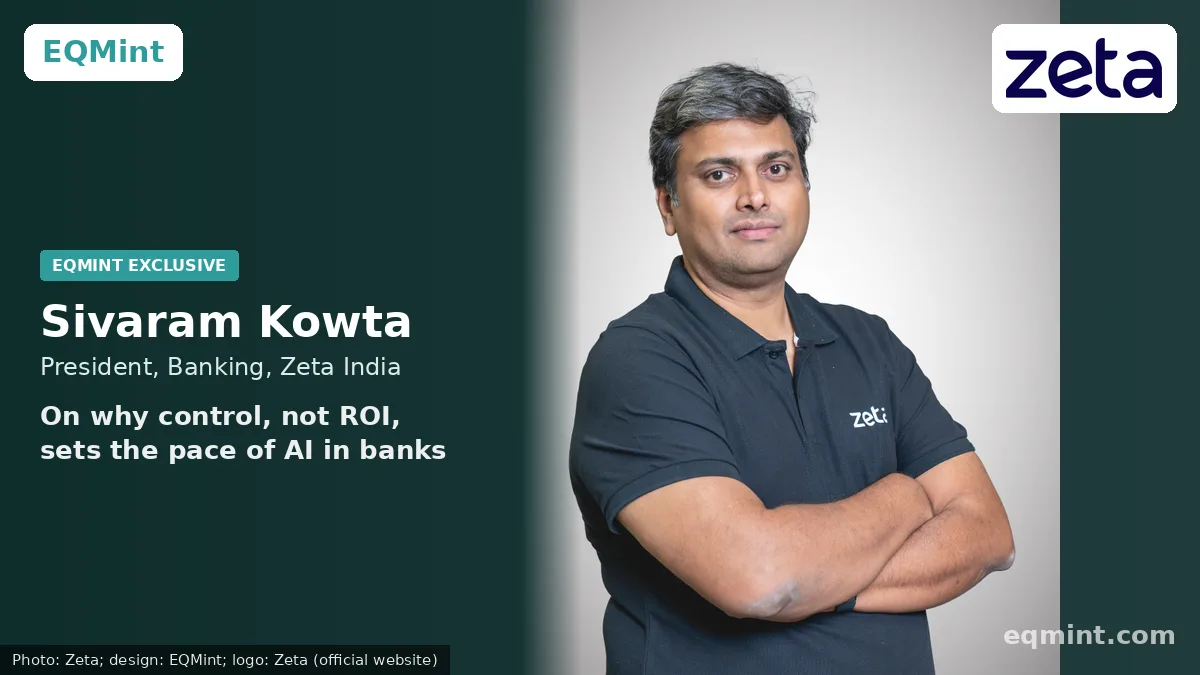
Synopsis: Sivaram Kowta, President, Banking, Zeta India, tells EQMint why security and control, not return on investment, decide how fast Indian banks scale AI. Zeta’s own survey of 40 CXOs shows AI is live in 70% of banks, yet no institution is ready to repeat deployments at scale.
EQMINT EXCLUSIVE

Sivaram Kowta is President, Banking, at Zeta India, the banking technology company whose cloud-native platform supports card processing, issuing, lending, core banking, fraud management and digital banking apps. In this interview, given exclusively to EQMint by email, he explains what Zeta’s 2026 CXO survey says about artificial intelligence in Indian banks, why controls rather than budgets set the pace, and what a bank customer may notice by 2030.
EQMint analysis: banks have proved AI works, the controls are the gap
Zeta’s survey, released on 3 September 2026, drew on responses from 40 CXOs across 18 banks and NBFCs, including CIOs, CTOs, CDOs, CROs and COOs. The company describes it as directional and not statistically representative of the whole industry. The numbers below show a clear pattern: adoption is real in reviewable tasks, while the scores for security and internal skills trail well behind.
| Finding | Result |
|---|---|
| CDOs placing their bank at selective or scaled AI deployment | 70% (30% at scaled) |
| COOs naming retail lending as an area of meaningful AI impact | 88% |
| Security and data privacy as a barrier (1 to 5 scale) | 3.89 |
| Lack of ROI clarity as a barrier (1 to 5 scale) | 2.0 |
| Building AI skills through internal development (1 to 5 scale) | 1.0, against 3.33 for specialist hiring |
Source: Zeta 2026 CXO survey on AI in Indian banking, press release dated 3 September 2026.
Two points stand out. First, the gap between a 3.89 score for security and a 2.0 score for ROI clarity suggests banks are not short of belief in AI; they are short of the permissions, audit and approval systems that let risk teams sign off. Second, the weakest score in the survey is internal skill-building, which matters because, as Kowta says below, redeploying staff only works if banks train their own teams.
The interview
EQMint: Your survey found 70% of banks have AI in production. What surprised you most in the findings?
Sivaram: The findings point to a clear gap between how far banks have progressed with selective AI deployments and how much preparation is still required for its wider adoption, faster, safer, and cheaper.
Seven in ten CDOs place their institutions at selective or scaled deployment. But when we assess the capabilities required to reproduce those successes across the institution – data, infrastructure, operations, engineering, governance and workforce – none has yet reached the threshold for repeatable deployment.
A team can make an AI application work by bringing together the data, integrations, and the oversight it needs. But the harder test is whether another team or project can build on that work and should it start all over again.
The findings of this study reinforced that banks are pursuing two tasks in parallel: establishing value through deployments and at the same time preparing the institution to support more of them.
EQMint: Security and control, not return on investment, came out as the main brake on scaling AI. Why is that?
Sivaram: This is because the constraint is control readiness, not conviction. There is a considerable difference between asking AI to summarise a document and allowing it to influence a lending decision or initiate an action. The responsibility grows as AI gets closer to customers, money and live systems.
Three-quarters of technology and risk leaders we spoke to identify security and data privacy as the leading barrier. Banks need confidence about what information AI can access, whose authority it operates under, where approval is required and how an action can be investigated afterwards.
Model validation is part of that answer, but governance extends further. Permissions, privacy rules and approval boundaries must be enforced by the surrounding systems. They cannot depend entirely on a model following instructions.
Getting these controls right gives banks the confidence to put AI to greater use.
EQMint: Most banks put less than 10% of new-project technology spend into AI. Is that caution or under-investment?
Sivaram: Our findings suggest a measured approach. Leaders see value in AI, while security, privacy and readiness remain concerns. Starting with a limited commitment can be sensible when a bank is still establishing performance and working through the controls.
The question is whether those investments leave the bank better prepared. Spending on usable data, secure access, monitoring and internal skills can support several applications over time.
I would be concerned if a bank kept funding disconnected pilots without addressing the obstacles they reveal. Caution is useful when it produces learning and better foundations. It becomes limiting when the same issues recur without being resolved.
“Caution is useful when it produces learning and better foundations. It becomes limiting when the same issues recur without being resolved.”
Sivaram Kowta, President, Banking, Zeta India
EQMint: Retail lending came out as the area of greatest impact. What is AI doing there today that a customer would notice?
Sivaram: Much of the useful work happens behind the scenes. Lending involves reading documents, extracting information, checking inconsistencies and assembling material for an assessment. AI can reduce the effort involved in those steps and help staff deal with exceptions more quickly.
For a customer, the benefit could be fewer requests to submit information again, a quicker response or less time spent waiting while a file moves between teams. Those are practical improvements, even when the final credit decision remains with a person.
Retail lending reported the strongest operational impact in our study showing where banks are already finding useful applications. The next opportunity is to connect those improvements across the journey.
EQMint: Four in ten digital leaders could not name a high-return AI use case. What separates the banks that can?
Sivaram: Being unable to name a high-return use case also does not necessarily mean that AI has delivered no value. The benefit may be early, difficult to isolate or poorly measured.
In our view, the starting point should be a business outcome with a clear baseline. Is the objective to reduce processing time, improve collections, detect more fraud or increase the quality of service? What was the performance before AI, and what has changed?
The calculation also needs to include integration, human review, exceptions and ongoing operation. A demonstration of time saved is useful, but it is only part of the business case.
Banks need that discipline to decide which applications merit further investment.
EQMint: Chief risk officers want AI in credit decisions and fraud detection within two years. What has to be in place before a regulator is comfortable?
Sivaram: A bank must be able to demonstrate that it understands the system, has tested it for its intended purpose and can control its use. Regulatory acceptance will depend on the application and the applicable requirements.
For credit, that includes the quality and permitted use of data, validation, fairness, explanations and clear responsibility for decisions. Fraud applications also need careful management of false positives and the consequences of blocking a legitimate customer.
Banks must be able to reconstruct a decision, identify the model and information involved, and intervene when performance deteriorates. Where AI can act, permissions and approval limits become essential.
Our study shows that these capabilities are still developing. Preparing them should be part of the application from the outset, alongside its business objectives.
EQMint: Half of operations leaders expect staff to be redeployed and none expect large job cuts. Do you agree?
Sivaram: That is a credible near-term expectation, though it should not be treated as a guarantee about employment across the industry. The survey captures what participating leaders expect.
Many banking roles combine routine processing with judgement, customer interaction and responsibility for exceptions. AI can take over parts of the routine work, leaving people more time for activities that need their experience.
But redeployment requires preparation. Employees need training, managers need to redesign responsibilities, and performance measures may need to change. Our research found that internal reskilling was progressing more slowly than external hiring and the use of vendor expertise.
Banks will get more from AI if they invest in helping their existing teams use it well. Buying technology and expecting that adjustment to happen on its own would be a mistake.
EQMint: How do public sector banks compare with private banks and NBFCs on AI readiness?
Sivaram: Large private banks in the sample reported the broadest use of AI. Large public-sector banks had a smaller deployment footprint, but their foundational readiness compared reasonably well.
These are directional findings from a limited sample, not a ranking of the industry. The same caution applies to drawing conclusions about NBFCs as a group.
The useful question for each institution is what constrains its next step. One may need better access to data; another may need stronger engineering controls or more internal expertise. Ownership and size provide context, but they do not replace an assessment of the institution itself.
EQMint: Where does Zeta fit in this shift, and what are banks asking you for now that they were not a year ago?
Sivaram: Our role is in the banking systems that AI needs to work with. A bank may build its own AI platform and choose its own models, but those models still need to understand banking information and interact with applications under appropriate controls.
That is closely connected to our work in banking platforms. We are developing agents for specific tasks and adapting our platform stack for the identity, security and monitoring requirements of AI deployments.
The questions we need to address with banks are practical: what can an agent access, what is it authorised to do, how is its activity monitored, and who remains responsible?
We would not claim that banks have settled on a common buying approach. Many are building internally. Our task is to demonstrate where Zeta can complement that work and solve a specific problem.
EQMint: What will an Indian bank customer experience differently by 2030 because of AI?
Sivaram: I would expect customers to spend less time navigating the bank’s internal processes.
A customer should be able to explain a problem once, receive an answer that reflects the actual account position and get help completing the next step. A loan application could involve fewer repeated document requests. A service query could be resolved without the customer moving between several teams.
AI could also help banks identify financial stress earlier and offer more relevant assistance. But relevance must come with permission, and customers need a clear way to question an outcome or reach a person.
The best changes may feel quite ordinary: fewer delays, clearer explanations and more useful service. Achieving that consistently will depend as much on the bank’s systems and operating practices as on the intelligence of the models.
What happens next
The survey frames progress through four stage gates: prove relevance, prove value and control, make it repeatable, and embed the capability. Zeta says banks are already showing the first two in selected areas, and Kowta says the company is building task-specific agents and adapting its platform for the identity, security and monitoring needs of AI. For more on how lending and payments platforms are changing, see EQMint’s coverage of PayU India’s credit-led revenue mix, Finnable’s ₹405 crore Series C and Zeta’s earlier study on co-branded credit card revenues.
About Sivaram Kowta
Sivaram Kowta is President, Banking, at Zeta India. Zeta is a banking technology company whose cloud-native, API-enabled platform supports card processing, issuing, lending, core banking, fraud management, loyalty programmes and digital banking apps. The company says it has more than 1,700 employees globally and that customers have issued over 25 million cards on its platform.
Photo: Zeta; design: EQMint; logo: Zeta (official website).
Sources
- Source: Zeta, 2026 CXO survey on AI in Indian banking (press release, 3 September 2026) and company website
- Source: EQMint, Indian Banks’ Co-Branded Credit Card Revenues to Grow 3x by FY28
Disclaimer: This article is for information purposes only and is not investment advice.
For more such information, visit EQMint
Join our WhatsApp channel for timely updates: Whatsapp
Support EQMint: tap below to add us as a preferred source on Google.
Get the EQMint Daily
Market moves, IPOs and startup funding news in your inbox every morning.