

Author : Ashish Pareek| EQMint | EQMint originals
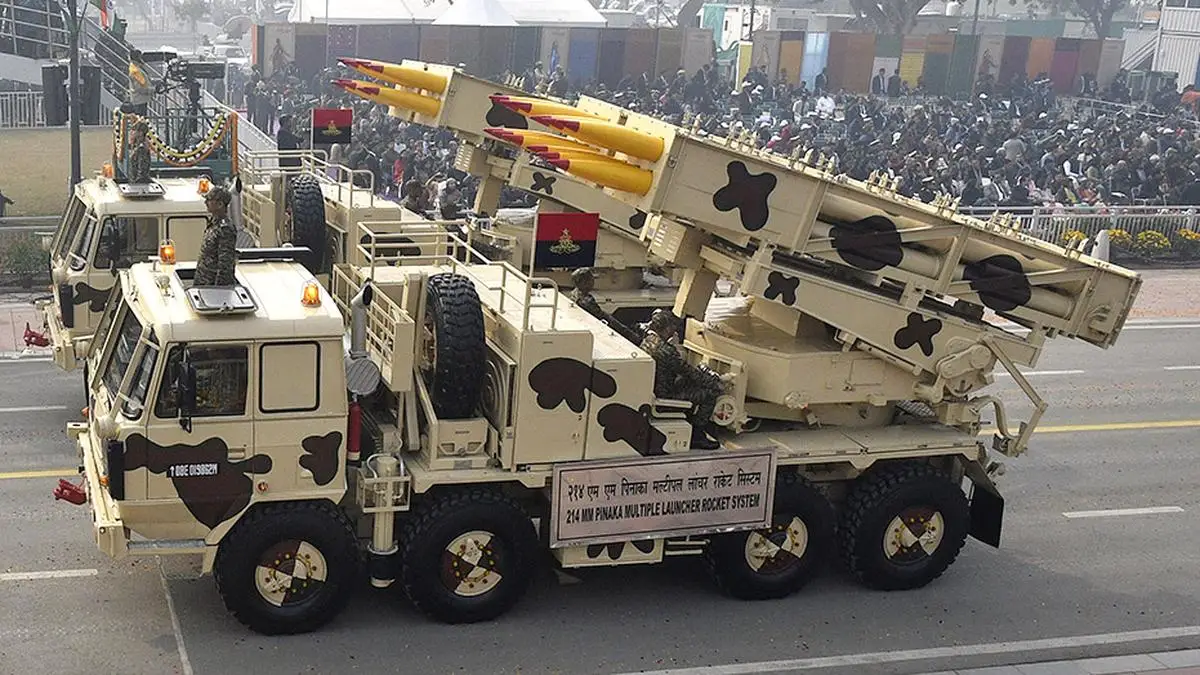
The real target of India’s 120-km range Pinaka rocket wasn’t the one it hit
At a time when much of the populace is gripped in festive fervour, holiday destinations are packed with tourists, and new year resolutions are being rehashed, India has quietly ushered in a new era in its defence strategy.
In the evening of December 29, a rocket thundered into the Odisha sky and traveled 120 kilometers before striking its target with textbook precision. To casual observers and defence correspondents, it was another weapons test but for strategists in New Delhi, Washington, Beijing, and Islamabad, it was something far more significant: a proof that India is closing the gap between aspiration and capability in advanced weaponry.
A lot has been reported since, especially about Pinaka 120’s range specifications, but a crucial aspect has been missing in India’s traditional media coverage (as with most stories these days).
Pinaka 120’s operational capabilities in the Himalayas is an unmissable attribute. There’s a peculiar issue with Conventional artillery in extreme elevations. They lose range effectiveness due to thin air. For example, a gun system that delivers 80 kilometers at sea level might only reach 60 kilometers at 12,000 feet altitude in Ladakh.
However, rocket-based systems like the Pinaka don’t face these limitations. Combined with precision guidance systems developed by DRDO, the Pinaka 120 enables deep strikes across mountainous terrain where traditional artillery becomes nearly useless. This isn’t just a marginal advantage, it’s a fundamental shift in how India can project firepower in its most challenging geographic domains and in its most strategically critical regions.
The test on December 29 wasn’t just for the Indian Army. It was a demonstration to potential international buyers: India can develop, test, and productionize advanced systems with impressive speed and reliability. For nations seeking alternatives to traditional suppliers, this is a powerful message.
India’s Range Disadvantage: A Problem Solved
For nearly a decade, despite its advancements and massive defence procurements, India faced an uncomfortable reality.
On one hand, when Pakistan deployed its A-100 rocket system with a 120-kilometer range and China fielded its PHL-03 with similar capabilities, India’s most advanced artillery – the original Pinaka – maxed out at 90 kilometers. This was a serious disadvantage, especially at extreme elevations.
The Pinaka 120 erases this disadvantage. For the first time, India possesses a domestically produced system with range parity with its neighbors’ most advanced platforms. More crucially, there’s no foreign dependency, no supply chain vulnerability, and no diplomatic complications. In an era of unpredictable geopolitics, this autonomy is worth its weight in strategic gold.
The Industrial Ecosystem Multiplier Effect
The success of this test reverberates through India’s entire defense manufacturing ecosystem. Companies like Larsen & Toubro, Solar Industries, BHEL, and Yantra India have invested heavily in production capacity for Pinaka variants. The successful test validates these investments and provides proof that private companies can develop products meeting the highest military standards.
The Quiet Export Revolution Nobody Is Talking About
While Indian media celebrates the test as a national achievement, something equally significant is happening in boardrooms across Europe and Asia. The Pinaka has already been purchased by Armenia. More importantly, France – a NATO member and a major defense power – is actively evaluating the Pinaka as a cost-effective alternative to developing indigenous systems.
This matters because NATO is in crisis mode. Years of supporting Ukraine have depleted ammunition stocks. Domestic production capacity is stretched. There’s growing skepticism about whether America will remain a reliable supplier indefinitely. Into this vacuum steps India with a proven, tested, combat-capable system that works and can be produced at a fraction of what European defense contractors demand.
The Unwritten Message to Global Powers
The Pinaka 120 test didn’t just hit its target, it carried a message far beyond our borders.
It signalled to the United States that India is building indigenous capabilities and won’t be permanently dependent on American technology. To our ally Russia, it demonstrated India’s self reliance even as it maintains strategic partnerships.
To potential allies in Europe, Asia, and Africa, it demonstrates that India is a reliable supplier of advanced defense technology.
Most importantly, to China, this test shows that India is systematically closing technological gaps and is committed to modernization.
For more such a information : EQMint
