

Author: Aditya Pareek | EQMint | Business News
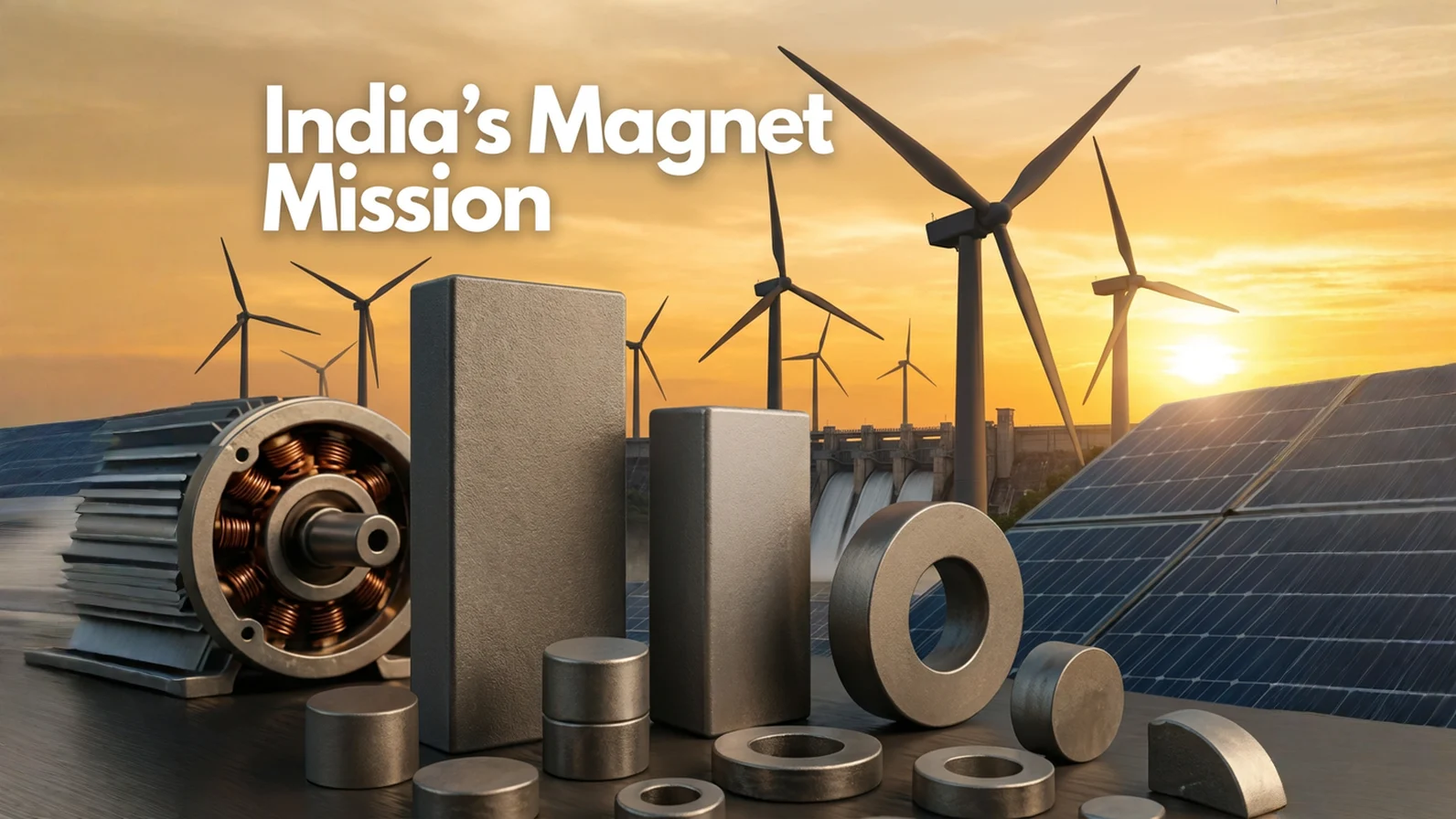
India has officially taken a historic step toward building one of the most crucial supply chains of the future: rare-earth permanent magnets. With the Union Cabinet approving a ₹7,280 crore policy, the country is preparing to manufacture these strategic magnets entirely at home — a move that could reshape India’s position in electric mobility, defence technologies, satellites, consumer electronics and renewable energy.
Rare-earth permanent magnets are among the most powerful magnets in the world. They are essential for high-efficiency motors, precision electronic systems, modern fighter aircraft, missile guidance, wind turbines and nearly every electric vehicle on the road. Until now, India has depended heavily on imports for this vital component. But the new policy seeks to end that dependence and build a fully integrated domestic ecosystem from scratch.
Under the scheme, India will set up production capacity of up to 6,000 metric tons of rare-earth magnets annually. This capacity will be spread across five large manufacturing units chosen through a competitive bidding process. The government will provide capital subsidies during the setup phase and sales-linked incentives over five years, making the new ecosystem financially viable and globally competitive.
This move is timely and strategic. Today, the global rare-earth magnet supply chain is concentrated in a handful of countries, creating vulnerability for nations that rely on these materials for EVs, missiles, satellites and advanced electronics. Any disruption — whether geopolitical or logistical — can impact entire industries. For India, which is rapidly expanding its EV market and modernising its defence sector, depending on external suppliers is no longer an option.
By manufacturing rare-earth magnets domestically, India is not only securing its supply chain but also preparing to become a key player in the global magnet market. The policy envisions a complete value chain within the country: from processing rare-earth oxides, to producing advanced alloys, to manufacturing high-performance magnets used in motors and defence technologies. This ensures that India moves from being a consumer of critical components to being a producer with strategic autonomy.
The impact on the electric-vehicle sector will be significant. EV motors rely heavily on rare-earth permanent magnets for their high-torque and high-efficiency design. With domestic magnet production, EV manufacturers in India will benefit from shorter supply cycles, reduced import costs and a more reliable flow of components. This can accelerate India’s EV adoption, bring down manufacturing prices and encourage global players to set up production facilities within the country.
Defence and aerospace systems will also gain tremendously. Magnets are used in radar equipment, precision guidance systems, jet engines, satellite control systems and high-performance drones. A domestic supply reduces strategic vulnerabilities and strengthens India’s defence manufacturing ecosystem under the larger vision of “Make in India” and self-reliance.
Renewable energy will see a boost too. Modern wind turbines depend on rare-earth magnets for compact, high-efficiency generators. With India pushing toward large-scale renewable energy targets, local magnet manufacturing can help reduce project costs and ensure faster deployment of clean-energy infrastructure.
Consumer electronics and industrial automation — from smartphones and medical devices to robotics and industrial motors — also stand to benefit from improved availability and reduced import dependence.
The long-term vision behind the scheme is clear: India wants to be future-ready. Rare-earth magnets sit at the heart of next-generation technologies, and the country cannot afford to remain dependent on foreign supply chains that may shift with geopolitical winds. By investing ₹7,280 crore today, India is laying the foundation for decades of technological strength and economic competitiveness.
For the first time, the country is building an ecosystem that transforms raw rare-earth materials into high-value magnets that power strategic and commercial technologies. It is a move that protects national interests, boosts industry, and positions India as a credible magnet manufacturing hub at a time when the world is urgently seeking diversified, resilient supply chains.
The new policy marks a breakthrough moment — a shift from being vulnerable to global supply disruptions to becoming a strong, self-reliant producer of one of the most important components of the modern world.
For more such updates visit EQMint.
Disclaimer: This article is based on information available from public sources. It has not been reported by EQMint journalists. EQMint has compiled and presented the content for informational purposes only and does not guarantee its accuracy or completeness. Readers are advised to verify details independently before relying on them.