
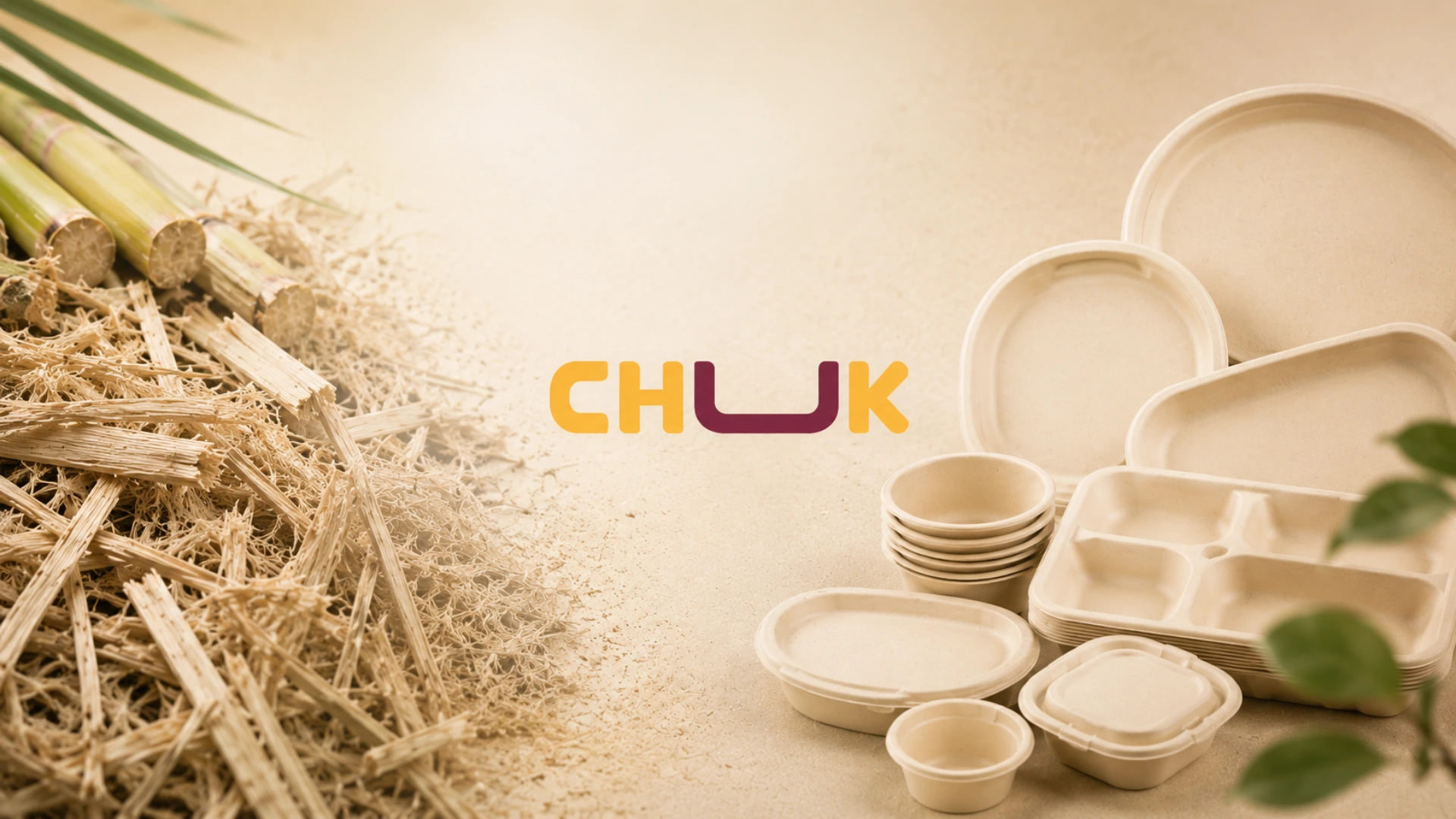
June 18, 2026: CHUK research showed India generates over 350 million tonnes of ‘sugarcane bagasse’ every year — the fibrous pulp left behind after juice is extracted from cane. For decades, this waste was simply burned or discarded. In Ayodhya, Uttar Pradesh, packaging company Yash Pakka Limited looked at that waste differently. So, in 2017, it launched CHUK, a brand of compostable sugarcane-fibre tableware aimed at one of India’s hardest environmental problems: single-use plastic.
Author: Tavisha Kanodia | EQMint | EQ Originals
Visionary: From Bagasse to Clamshell Containers
CHUK manufactures plates, bowls, trays, cups, and cutlery from bagasse instead of plastic or polystyrene. The startup offers a range of compostable packaging tableware that is safe to eat from and is 100% biodegradable, with products that are microwaveable, ovenable, and freezable and FDA-approved. The outer packaging is also designed to be plastic-free, typically starch-based, extending the sustainability claim past the product itself.
Yash Pakka began as a paper manufacturer in 1981; the tableware line only emerged after the company realised leftover sugarcane pulp also worked as a moulding fibre. Locating plants near the sugar mills supplying the raw material keeps both logistics costs and the carbon footprint of transport down.
One operational choice stands out: CHUK does not bleach its products. Most disposable tableware, CHUK’s competitors included, is bleached white, the colour associated with “clean” packaging in most markets. CHUK’s natural tan finish is a deliberate trade-off. Company lore, attributed to founder Ved Krishna, holds that he was advised Indians prefer eating off white plates and; however, he chose to keep the eco0friendly element intact. The comapny’s name reportedly plays on the Hindi word “chakh” (to taste) and the English “chuck it” (to dispose of) — company storytelling, but consistent with the product’s positioning.
The Excellency: Every planning matters
The bagasse tableware category is neither small nor monopolistic. CHUK’s differentiation comes down to structural choices, since most competitors use the same bagasse base.
First is client acquisition at a scale unusual for an Indian sustainability startup. It supplies organisations including Indian Railways, The Park, Hyatt, Haldiram’s, Lite Bite Foods, HMS Host, Google, PVR, Inox, Amazon, Devyani International, Starbucks, and Chai Point. Landing a logistics-heavy, food-safety-sensitive client like Indian Railways alongside global QSR and hospitality names is a meaningfully different go-to-market than selling compostable plates direct-to-consumer online.
Second is vertical integration. CHUK doesn’t import raw material or rely on third-party fibre suppliers; it draws on Yash Pakka’s existing relationships with regional sugar mills, the same supply chain the company has used since 1981. That history also brings captive power: the parent runs conversion of biomass waste into electricity, lowering both energy costs and net emissions.
Third is workforce composition. The company has stated that a substantial share of its Ayodhya plant workforce, roughly half by its own account, is made up of local women — notable for a manufacturing facility in a region with historically low female labour-force participation. This is a company-stated figure, not independently audited data, and should be read accordingly.
The environmental comparison anchoring CHUK’s marketing is well-supported by independent research: conventional plastic tableware takes up to 500 years to degrade, while bagasse-based tableware composts in 60 to 180 days under proper conditions. That gap is the entire commercial argument for the category, and it holds up under scrutiny.
Conclusion
CHUK’s underlying premise, that India’s enormous sugarcane residue stream can displace single-use plastic tableware at real commercial scale, is sound, and the company has done something genuinely difficult: sign large institutional and global brand clients onto an unbleached, costlier, compostable product instead of the cheapest plastic option available. That’s not a small achievement. The company has a vision to serve during an future crisis, like that of a war.
For more such information visit EQMint
Join our Whatsapp channel for timely updates: Whatsapp
Disclaimer: This article is not an investment advice and is for educational purpose only.