
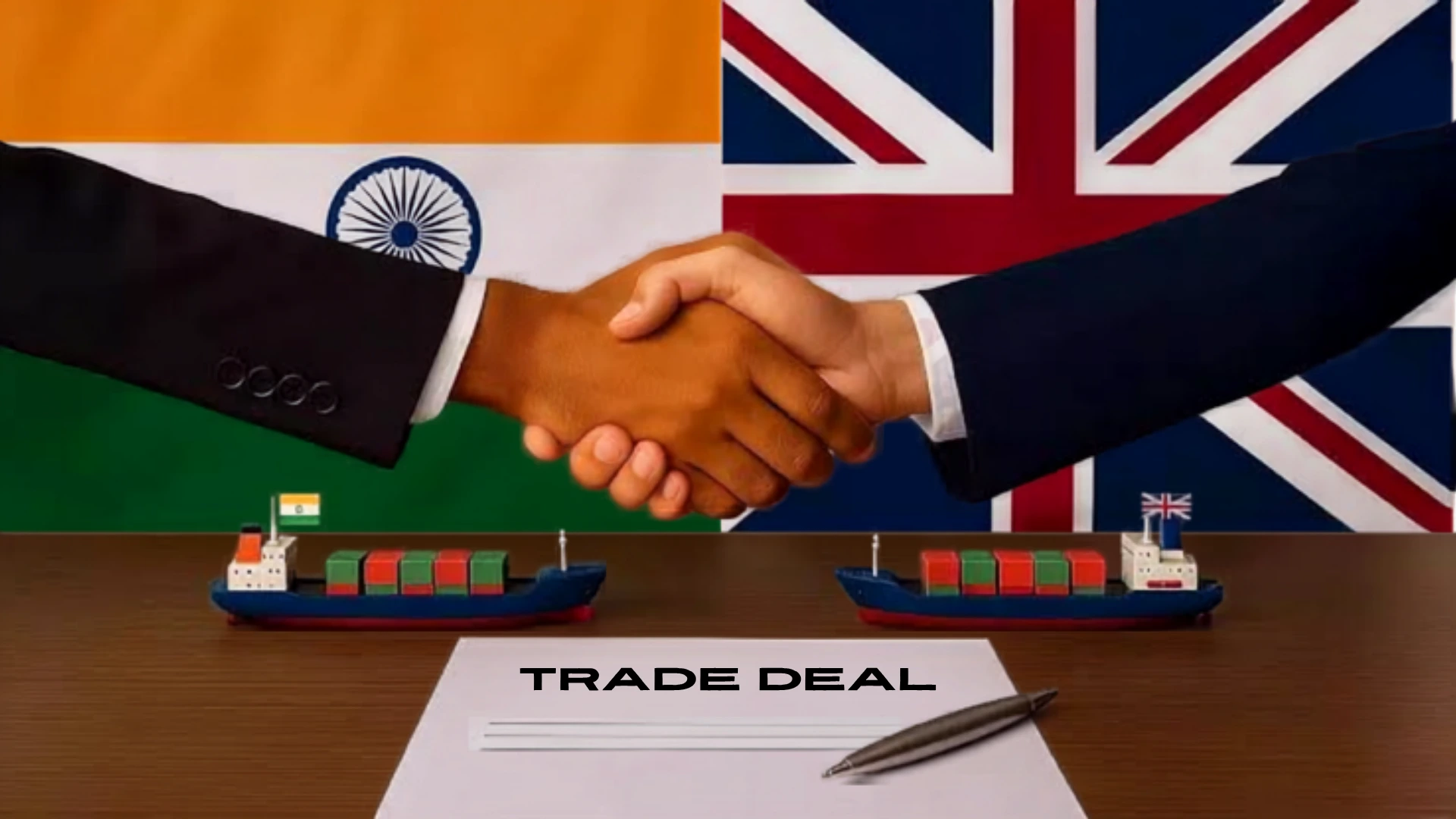
Synopsis: After years of negotiations, the India–United Kingdom Free Trade Agreement (FTA) has officially come into effect, marking one of the most significant trade milestones for both nations in recent years. While the agreement promises lower tariffs, expanded market access, and stronger economic cooperation, its true significance lies beyond trade figures. The pact has the potential to reshape India’s export landscape, create new opportunities for manufacturers and MSMEs, strengthen bilateral investment, and reinforce India’s position in global supply chains. Yet, like every major trade agreement, its long-term success will ultimately depend on execution rather than ambition.
July 16, 2026: India and the United Kingdom have officially implemented their long-awaited Free Trade Agreement (FTA), concluding negotiations that spanned several years. Leaders from both countries have described the agreement as a landmark moment in bilateral relations, with UK High Commissioner Lindy Cameron calling it a “gold standard” trade pact and Prime Minister Narendra Modi stating that it will benefit India’s farmers, entrepreneurs, workers, startups, and MSMEs. As the agreement comes into force, businesses across industries are evaluating how the new trade framework could reshape investment, exports, and economic growth.
Author: Tavisha Kanodia | EQMint
More Than a Trade Deal: A Strategic Economic Partnership
The India–UK Free Trade Agreement is not merely about reducing import duties. It represents a broader effort to deepen economic cooperation between two major economies at a time when global supply chains are undergoing significant transformation.
The agreement aims to lower or eliminate tariffs on thousands of products, making it easier for businesses in both countries to trade goods and services. Indian exporters are expected to gain improved access to one of Europe’s largest consumer markets, while British businesses will benefit from greater opportunities in one of the world’s fastest-growing economies.
Beyond trade, the agreement strengthens collaboration across investment, professional services, technology, innovation, education, and digital commerce. In an increasingly fragmented global trading environment, the pact also sends a strong signal that both countries remain committed to rules-based international trade and long-term economic cooperation.
Which Industries Stand to Benefit the Most?
While the agreement has economy-wide implications, several industries are expected to emerge as immediate beneficiaries.
India’s textile and apparel sector could receive a significant boost through improved access to the UK market. Lower tariffs may enhance the competitiveness of Indian manufacturers against exporters from other Asian economies while supporting employment across the country’s labour-intensive textile clusters.
Engineering goods, auto components, pharmaceuticals, chemicals, gems and jewellery, marine products, and processed food exporters are also expected to benefit from improved market access. For many export-oriented businesses, reduced trade barriers may translate into stronger order books and greater international competitiveness.
One of the agreement’s most significant opportunities lies with India’s MSME sector. Small and medium-sized enterprises account for a substantial share of India’s manufacturing output and exports. Easier access to overseas markets could encourage more MSMEs to participate in global supply chains while diversifying their customer base beyond domestic demand.
The services sector also stands to gain. India remains one of the world’s largest exporters of IT and professional services, and stronger cooperation with the UK could create additional opportunities for technology firms, financial service providers, consultants, and skilled professionals.
The Real Challenge Begins After the Agreement
Trade agreements create opportunities, but they do not automatically guarantee export success.
Indian businesses must still compete on product quality, pricing, logistics, innovation, sustainability, and regulatory compliance. Meeting UK standards for manufacturing, environmental practices, packaging, and product certifications will remain essential for companies seeking to expand their presence in the British market.
For MSMEs in particular, scaling production while maintaining international quality standards may prove challenging. Access to finance, export awareness, digital capabilities, and efficient logistics will play an equally important role in determining whether smaller businesses can fully capitalise on the agreement.
Similarly, UK businesses entering India will need to navigate a highly competitive and rapidly evolving marketplace where domestic companies have developed strong distribution networks and local market expertise.
EQMint Analysis: A Trade Agreement That Could Reshape India’s Export Story
The India–UK FTA is significant not because tariffs have been reduced, but because it reflects India’s broader strategy of integrating more deeply into global value chains. At a time when multinational companies are diversifying manufacturing beyond traditional production hubs, trade agreements such as this strengthen India’s attractiveness as both a manufacturing destination and an export partner.
For businesses, the agreement creates opportunities across manufacturing, services, agriculture, and technology. However, the real winners are unlikely to be those that merely gain tariff advantages. Instead, companies capable of improving productivity, investing in quality, expanding manufacturing capacity, and building long-term relationships with global customers stand to benefit the most.
The agreement also reinforces India’s ambition of becoming a global manufacturing and export hub under initiatives such as Make in India and Production Linked Incentive (PLI) schemes. By combining domestic manufacturing reforms with stronger international market access, India is positioning itself to capture a larger share of global trade.
Ultimately, the India–UK Free Trade Agreement should be viewed not as the finish line but as the beginning of a new competitive landscape. The framework has been established; the next phase will depend on how effectively businesses, policymakers, and exporters convert policy into commercial success. For India, the agreement represents an opportunity to strengthen its role in the global economy—but its long-term impact will be measured by factories expanding production, MSMEs entering new markets, and exporters translating market access into sustainable growth.
Bibliography
- The Economic Times. UK-India trade pact a ‘gold standard’ and powerful message for rules-based order, says UK envoy.
https://economictimes.indiatimes.com/news/economy/foreign-trade/uk-india-trade-pact-gold-standard-and-powerful-message-for-rules-based-order-uk-envoy-lindy-cameron/articleshow/132419128.cms - The Hindu. India-UK trade deal will boost India’s farmers, entrepreneurs and MSMEs, says PM Modi.
https://www.thehindu.com/news/national/india-uk-trade-deal-will-boost-indias-farmers-entrepreneurs-and-msmes-pm-modi/article71224934.ece - DW News. India–UK landmark trade deal comes into effect.
https://www.dw.com/en/india-news-landmark-trade-deal-with-uk-takes-effect/live-77961587 - YouTube. Analysis of the India–UK Free Trade Agreement.
https://www.youtube.com/watch?v=HGyHwMLJnoI - YouTube. India–UK FTA explained: Business and economic impact.
https://www.youtube.com/watch?v=pWLHy4In79Q - Instagram Reel. Overview of the India–UK Trade Agreement.
https://www.instagram.com/reels/Da0K6FBBspU/
For more such information visit EQMint
Join our Whatsapp channel for timely updates: Whatsapp
Disclaimer: This article is not an investment advice and is for educational purpose only.