Synopsis: Prime Minister Narendra Modi asked India Inc on 19 November whether the 2019 corporate tax cut produced more jobs and higher pay. RBI data on listed firms gives a split answer: wage bills kept pace with profits in 2025-26 outside IT, but the gap widened sharply in April-June 2026.
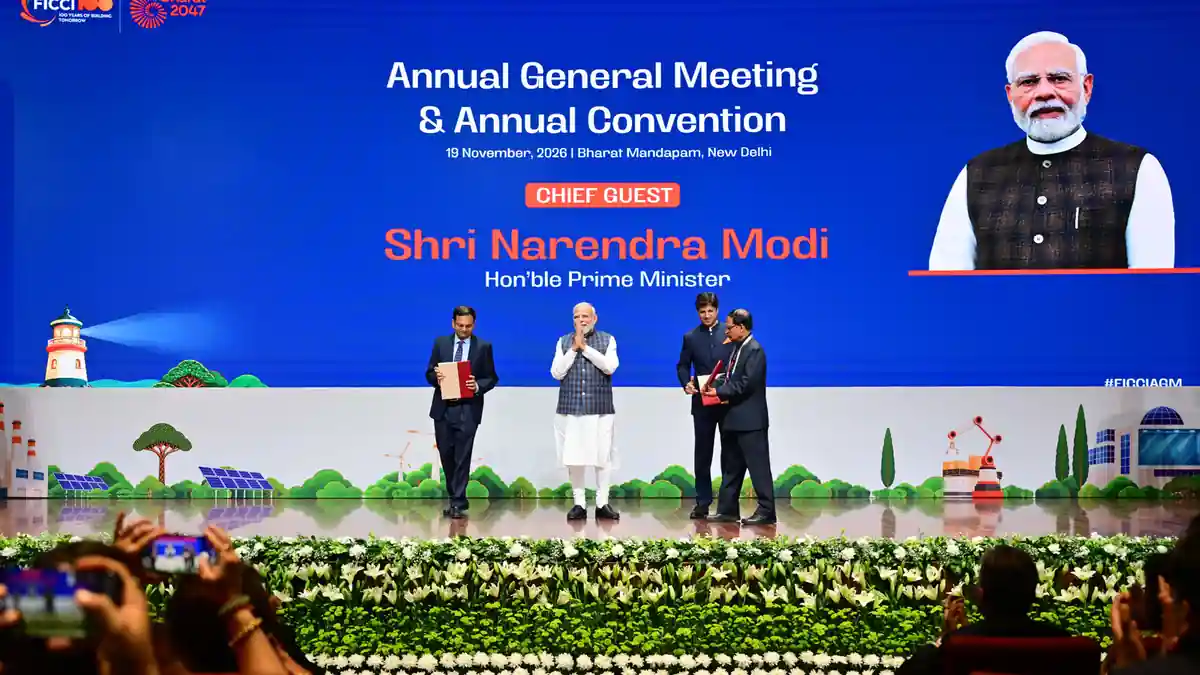
Prime Minister Narendra Modi used the centenary convention of the Federation of Indian Chambers of Commerce and Industry (FICCI) at Bharat Mandapam, New Delhi, on Thursday, 19 November 2026, to put a pointed question to business leaders. Citing the cut in the basic corporate tax rate to 22% and the income-tax exemption on earnings up to ₹12 lakh, he asked whether companies had responded by hiring more people and raising salaries, according to the official account of the speech and media reports from the event.
He also asked industry to make “India First” the foundation of every long-term investment decision over the next 20 years. EQMint checked what the official numbers say about the question he raised.
What the tax cut gave companies
On 20 September 2019 the government cut the base corporate tax rate for domestic companies from 30% to 22%, for firms that give up other exemptions. With surcharge and cess, the effective rate came to 25.17%. New manufacturing companies were offered 15%. The government estimated the package would cost about ₹1.45 lakh crore in revenue. The Prime Minister’s question is whether enough of that relief reached workers.
The full-year picture: closer than the rhetoric suggests
The Reserve Bank of India’s data on 4,278 listed non-government, non-financial companies for 2025-26 (released 24 June 2026) compares growth in staff cost, the total wage bill, with growth in operating profit (all figures year on year; Mfg is manufacturing):
| Sector | Op. profit | Wage bill | Gap |
|---|---|---|---|
| Mfg | 10.3% | 10.7% | Wages +0.4 pts |
| IT | 10.7% | 6.1% | Profit +4.6 pts |
| Non-IT | 7.1% | 9.0% | Wages +1.9 pts |
Over the full year, manufacturers and non-IT service companies grew their wage bills slightly faster than their operating profits. IT companies were the exception: their profits grew about 1.75 times as fast as their staff costs (10.7 ÷ 6.1, EQMint calculation).
The latest quarter: the gap opens
The picture changed in April-June 2026. RBI’s release of 27 August 2026, covering 3,247 listed companies, shows sales of listed private non-financial firms up 19.4% year on year, but wage bills rising much more slowly than profits (growth year on year):
| Sector | Sales | Op. profit | Wage bill | Wage vs profit |
|---|---|---|---|---|
| Mfg | 21.4% | 21.3% | 12.4% | 58% |
| IT | 14.8% | 19.9% | 7.6% | 38% |
| Non-IT | 19.7% | 12.7% | 11.2% | 88% |
The last column is an EQMint calculation (staff cost growth divided by operating profit growth). In IT, wage bills grew at well under half the pace of profits. In manufacturing, the gap between profit growth and wage growth widened from almost nothing over 2025-26 to 8.9 percentage points in a single quarter. In all three sectors, staff costs grew 7 to 9 percentage points slower than sales.
The longer record backs the concern
The government’s own Economic Survey 2024-25 had already flagged the issue. It said corporate profitability reached a 15-year peak in 2023-24 while wages lagged, and that corporate profits rose 22.3% that year while employment grew 1.5%. An SBI Research study of about 4,000 listed companies found profit after tax up 31.7% in 2023-24 against a 13% rise in employee expenses, which works out to profits growing about 2.4 times as fast as wage bills.
What the data cannot show
Staff cost is the total wage bill. It rises with headcount, pay rises and bonuses together, so it does not show whether individual salaries went up or how many jobs were added. The RBI series covers listed non-financial companies only, so banks, unlisted firms and MSMEs, which employ most of India’s workforce, are outside it. Still, on the numbers available, the question the Prime Minister asked is fair for IT companies over the past year, and for most listed companies in the latest quarter.
What to watch
RBI’s data for the July-September quarter will show whether the gap seen in April-June persisted. The Union Budget for 2027-28 in February is the next point where the government can link tax policy to hiring. Profit pools outside the RBI sample are also growing, as EQMint reported in its look at public sector banks’ ₹1.10 lakh crore first-half profit, which the non-financial data above does not capture. On the hiring side, global capability centres remain one of the larger sources of new white-collar jobs; see EQMint’s report on Karnataka’s share of new GCCs.
Photo: Prime Minister Narendra Modi at the FICCI Annual General Meeting, Bharat Mandapam, New Delhi, 19 November 2026. Source: PMIndia.
Sources
- Source: PMIndia, PM inaugurates FICCI Annual General Meeting and Annual Convention (19 November 2026)
- Source: RBI, Performance of Private Corporate Business Sector during Q1:2026-27 (27 August 2026)
- Source: RBI, Performance of Private Corporate Business Sector during 2025-26
- Source: FICCI press release on the Prime Minister’s address
- Source: Business Standard, Economic Survey 2024-25 on corporate profits and wages
- Source: Deccan Herald, SBI Research on listed companies’ profits and wage bills
- Source: Business Today, report on the Prime Minister’s remarks at FICCI
- Source: The Hans India, 2019 corporate tax cut and ₹1.45 lakh crore estimate
Disclaimer: This article is for information purposes only and is not investment advice.
For more such information, visit EQMint
Join our WhatsApp channel for timely updates: Whatsapp