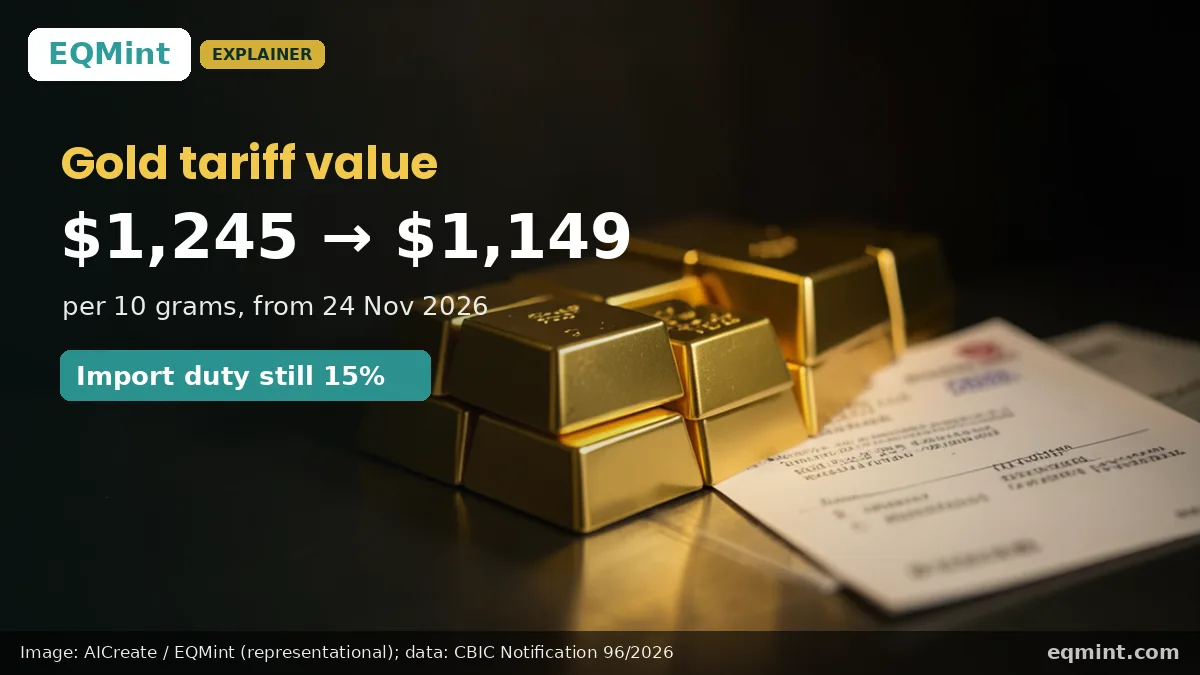
Synopsis: The government cut gold’s customs tariff value by 7.7% to $1,149 per 10 grams from 24 November 2026, but the 15% import duty rate is unchanged. EQMint explains what a tariff value is and calculates that importers now pay about ₹1,328 less duty per 10 grams than before.
Last updated on 26 November 2026. EQMint updates this explainer regularly.
Headlines saying the government has cut the “gold rate” for imports by 7.7% have caused some confusion. What actually changed is the tariff value of gold, the fixed base price on which customs duty is calculated. The duty rate itself has not been touched.
The Central Board of Indirect Taxes and Customs (CBIC) issued Notification No. 96/2026-Customs (N.T.) on 23 November 2026, setting the tariff value of gold at US$1,149 per 10 grams from 24 November 2026. The previous value, set by Notification 91/2026 from 14 November, was US$1,245, so the cut is $96, or 7.7%. Silver’s tariff value was left unchanged at US$1,496 per kilogram.
What is a tariff value?
Customs duty is normally charged on the transaction value, meaning the price an importer actually pays for the goods. For a few commodities where prices move fast or invoices can be under-reported, the government instead fixes a tariff value under Section 14(2) of the Customs Act, 1962. When a tariff value applies, duty is calculated on that notified value rather than the declared invoice price.
Gold, silver, crude and refined palm oil, soya bean oil, brass scrap and areca nuts all have tariff values. CBIC usually revises them about twice a month to track international prices. The tariff value is expressed in US dollars and converted into rupees at the customs exchange rate that CBIC also notifies.
Because the tariff value is only the base, a lower tariff value means less duty on the same quantity of gold, in the same proportion. A 7.7% cut in the base therefore means 7.7% less duty per gram, at the same duty rate and exchange rate.
EQMint analysis: the duty saving per 10 grams
The import duty on gold is an effective 15%, made up of 10% basic customs duty and 5% Agriculture Infrastructure and Development Cess, since CBIC’s notifications of 12 May 2026 raised it from 6%. Applying that rate to the last three tariff values shows how much less duty is now collected on every 10 grams imported.
| In force from | Notification | Tariff value (per 10 g) | 15% duty (US$) | Duty in ₹ (illustrative) |
|---|---|---|---|---|
| 31 Oct 2026 | 89/2026 | $1,295 | $194.25 | ₹17,918 |
| 14 Nov 2026 | 91/2026 | $1,245 | $186.75 | ₹17,226 |
| 24 Nov 2026 | 96/2026 | $1,149 | $172.35 | ₹15,898 |
Source: CBIC Notifications 89/2026, 91/2026 and 96/2026-Customs (N.T.); 15% effective duty from CBIC Notifications 15 to 18/2026-Customs. Rupee figures are illustrative, using the rupee’s 25 November 2026 close of 92.24 per dollar; actual assessments use CBIC’s notified customs exchange rate. EQMint calculations as of 26 November 2026.
On these figures, an importer now pays about $14.40, or roughly ₹1,328, less duty per 10 grams than under the previous value. That works out to about ₹1.33 lakh less per kilogram. Compared with the value in force from 31 October, the tariff value has fallen 11.3% in under four weeks, and duty per 10 grams by about ₹2,020.
The stronger rupee adds to the effect. Because the dollar tariff value is converted at the customs exchange rate, a rupee that has strengthened from about 96.8 per dollar in early October to 92.24 also lowers the rupee amount of duty on the same dollar value.
Why it is not a duty cut
The 15% rate set in May 2026 is still in force. The government has not lowered it, and no new duty notification has been issued. The tariff value fell because it is meant to follow international gold prices: when world prices fall, CBIC lowers the tariff value so that duty is charged on a base closer to the actual price. When prices rise, the tariff value goes up again, as it can in any fortnightly revision.
That is why the 7.7% figure should not be read as gold becoming 7.7% cheaper. The duty saving is a small share of the price of gold, and the price buyers pay in India also depends on international prices, the exchange rate, 3% GST and making charges for jewellery.
Who is affected
The change matters most to bullion importers, banks and nominated agencies that bring in gold bars and coins, and to jewellery manufacturers who import gold as raw material, because their duty outgo per kilogram falls straight away. Retail buyers are affected only indirectly, through the domestic price.
Readers following prices and the currency can also see EQMint’s explainer on why the rupee is getting stronger against the dollar, our report on Brent near a three-month low and the new CPI series.
Frequently asked questions
Has the government cut import duty on gold?
No. The effective duty is still 15%. Only the tariff value, the base on which duty is calculated, was reduced by 7.7%.
What is the new tariff value of gold?
US$1,149 per 10 grams from 24 November 2026, under CBIC Notification 96/2026-Customs (N.T.), down from US$1,245.
How often does the tariff value change?
CBIC typically revises tariff values about twice a month, and can make additional changes when prices move sharply.
Will gold jewellery become 7.7% cheaper?
No. Only the duty part of the cost falls by 7.7%, which is a small share of the price. Jewellery prices depend mainly on international gold prices, the rupee, GST and making charges.
Image credit: AICreate / EQMint (representational).
Sources
- Source: CBIC, Notification No. 96/2026-Customs (N.T.), 23 November 2026
- Source: Corplaw Updates, Notification 91/2026: gold tariff value cut from $1,295 to $1,245
- Source: Corplaw Updates, Notification 96/2026 and how tariff values work
- Source: TaxGuru, customs duty on gold and silver raised to 15% from 13 May 2026
- Source: Moneycontrol, rupee closes at 92.24 per dollar on 25 November 2026
Disclaimer: This article is for information purposes only and is not investment advice.
For more such information, visit EQMint
Join our WhatsApp channel for timely updates: Whatsapp
Support EQMint: tap below to add us as a preferred source on Google.
Get the EQMint Daily
Market moves, IPOs and startup funding news in your inbox every morning.