

Author : Aashiya Jain | EQMint | Sustainability News
In the lush banana-growing regions of Taiwan, piles of discarded trunks were once a familiar sight. After harvesting the fruit, farmers typically cut down the entire plant, leaving behind tons of fibrous waste that had little economic value. For decades, those remains were burned, composted, or simply left to rot. Today, however, that agricultural waste is being given a second life and it’s ending up in wardrobes around the world.
At the center of this transformation is entrepreneur Nelson Yang, who is looking to Taiwan’s past to build a more sustainable future. His work focuses on turning banana plant fibers into textiles, reviving a traditional material while addressing some of the fashion industry’s most pressing environmental problems.
A Forgotten Fiber with Deep Roots
Long before synthetic fabrics dominated global fashion, banana fiber was widely used across parts of Asia. In Taiwan, during the Japanese colonial period, banana plants were cultivated not only for food but also for their strong, versatile fibers. These fibers were used to make ropes, work clothes, and everyday household items. Over time, cheaper synthetic alternatives replaced natural fibers, and banana textiles faded into obscurity.
Yang saw opportunity where others saw waste. While researching sustainable materials, he discovered historical records of banana fiber production in Taiwan. What stood out was not just the durability of the material, but how little environmental impact it had compared with modern textiles like polyester or even cotton.
“That knowledge was always there,” Yang has said in interviews. “It just wasn’t being used anymore.”
The Environmental Cost of Fashion
The fashion industry is one of the world’s most polluting sectors. Producing synthetic fabrics relies heavily on fossil fuels, while cotton farming consumes vast amounts of water and often involves chemical-intensive processes. At the same time, millions of tons of agricultural waste are generated each year, much of it unused.
Banana plants are particularly wasteful by design. Each plant fruits only once before being cut down, even though its trunk contains strong cellulose fibers. In banana producing regions like Taiwan and Southeast Asia, this results in enormous quantities of organic waste.
By using banana trunks that would otherwise be discarded, Yang’s approach tackles two problems at once: reducing agricultural waste and lowering the environmental footprint of clothing production.
Turning Banana Trunks into Fabric
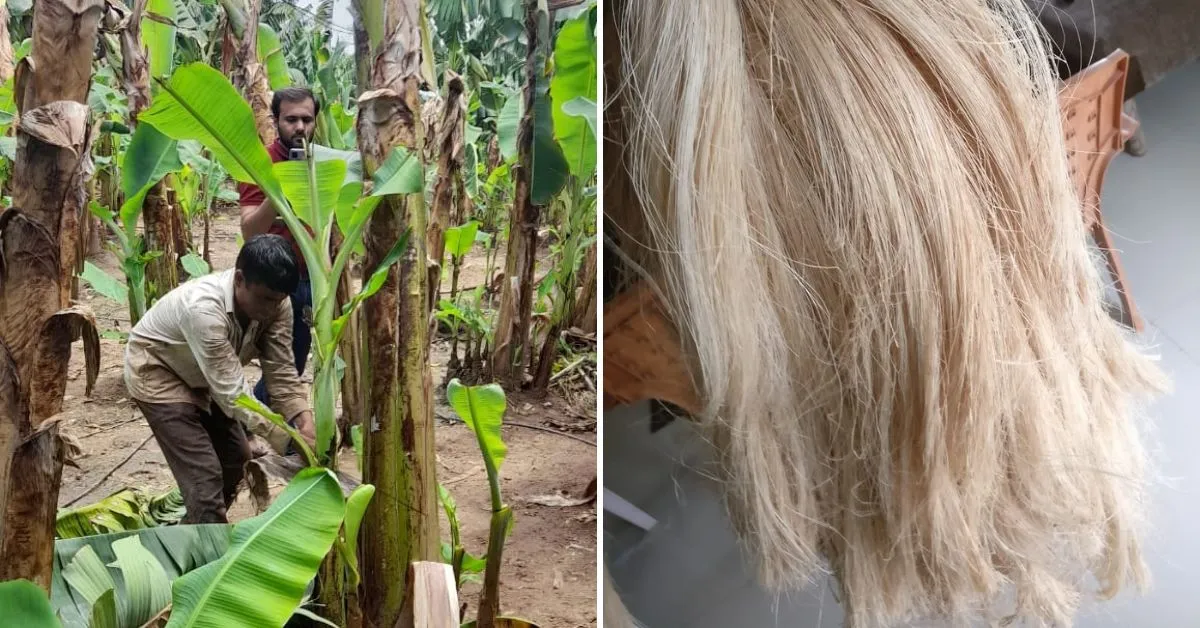
The process begins on banana farms. After harvest, the trunks are collected instead of being thrown away. These thick, water-heavy stalks are then stripped to extract long fibers hidden inside. Once cleaned and dried, the fibers are spun into yarn.
Unlike many industrial textiles, banana fiber processing can be done with relatively low energy use and minimal chemicals. The result is a fabric that is naturally breathable, strong, and slightly textured somewhere between linen and hemp in feel.
Yang and his team have spent years refining the process to make the fabric softer and more suitable for modern clothing. Early versions were coarse and best suited for industrial use. Today, improvements in spinning and weaving have made banana fiber comfortable enough for shirts, jackets, and even blended fabrics.
Blending Tradition with Modern Design
One of the challenges Yang faced was perception. Banana fiber doesn’t immediately sound like a luxury material, especially in a market used to cotton, wool, and synthetic blends. To change that mindset, he focused on design and storytelling as much as material science.
By working with designers, Yang has helped create garments that highlight the fabric’s natural qualities rather than hiding them. The slight irregularities in the weave, for example, are treated as a feature rather than a flaw, giving each piece a distinct character.
There’s also a cultural dimension. Reviving banana fiber connects modern Taiwan with its agricultural and industrial heritage. For Yang, sustainability isn’t just about carbon footprints it’s also about remembering where materials come from and valuing local knowledge.
Challenges and Realities
Despite its promise, banana fiber clothing is not without obstacles. Production is still relatively small-scale, which makes costs higher than mass-produced synthetic fabrics. Collecting and processing banana trunks requires coordination with farmers, and yields can vary depending on plant quality and weather conditions.
Scaling up responsibly is another concern. Yang has emphasized that the goal is not to replace all textiles with banana fiber, but to add another sustainable option to the mix. Overexploitation could create new environmental problems, something the project is trying to avoid.
Still, interest is growing. As consumers become more conscious of where their clothes come from, materials with transparent, low-impact supply chains are gaining attention.
A Broader Shift in Fashion
Banana fiber is part of a larger movement within fashion that looks to agricultural byproducts for solutions. Pineapple leaves, orange peels, and mushroom roots are all being explored as alternatives to traditional textiles. What makes banana fiber stand out is how abundant the raw material already is and how little extra land or water it requires.
For Yang, success isn’t measured only in sales. It’s about proving that waste can be reimagined, and that old ideas can find new relevance. Each banana fiber garment tells a story of resourcefulness, history, and possibility.
As racks of clothing made from banana plants begin to appear, they offer a quiet reminder: sometimes the future of sustainability lies not in inventing something entirely new, but in rediscovering what we once left behind.
For more such information : EQMint
Resource Link : Reuters
