Synopsis: CSIR-Central Drug Research Institute in Lucknow opened a BSL-3 high-containment lab for tuberculosis research on 27 November. EQMint’s tally of the institute’s own figures: 13 marketed drugs, 1,042 patents of which about 44% were filed abroad, and three candidates in human trials as the government pushes from generics towards new medicines.
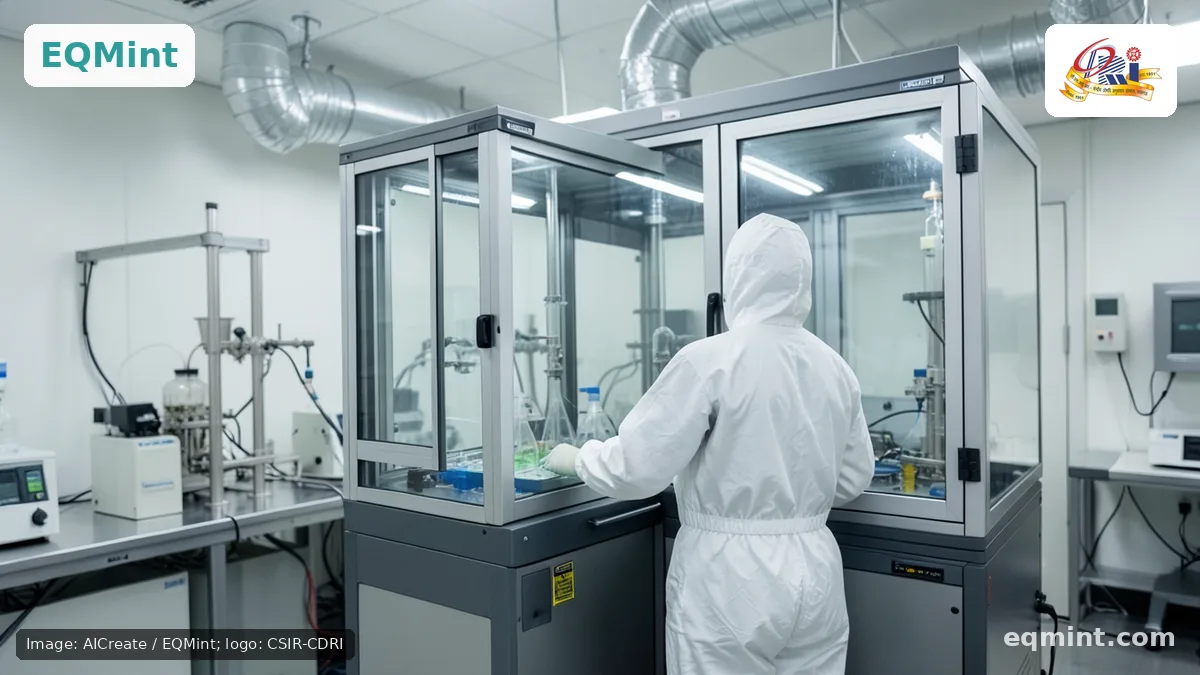
Union Minister of State for Science and Technology Dr. Jitendra Singh on Friday, 27 November 2026, inaugurated a Biosafety Level-3 and Animal Biosafety Level-3 (BSL-3/ABSL-3) facility at CSIR-Central Drug Research Institute (CDRI), Lucknow. He also opened the Dr. B. Mukerji Lecture Theatre on the campus. The new lab is meant for high-containment work on Mycobacterium tuberculosis, the bacterium that causes TB, and on non-tuberculous mycobacteria (NTM), a related group that causes lung and other infections.
Speaking at the event, Singh said “India is moving towards becoming a global hub for innovative drug discovery and development” and called for a shift from making generic medicines to discovering new ones.
EQMint analysis: CDRI’s record in numbers
The government release set out CDRI’s output over its history. Putting those figures side by side shows where the institute’s work has turned into products and where it is still at the research stage.
| Item | Figure | EQMint note |
|---|---|---|
| Drugs reaching the market | 13 | Products already sold |
| Patents in India | 586 | About 56% of the combined count |
| International patents | More than 456 | About 44% of the combined count |
| Combined patents | At least 1,042 | The release headline says “more than 1,000” |
| Process technologies licensed | More than 80 | Plus six diagnostic technologies |
| Compound library | About 90,000 molecules | With 50+ animal models and 30+ in-vitro screens |
| Centchroman strips distributed free | More than 350 lakh in five years | About 70 lakh a year on average |
Source: Ministry of Science and Technology release via PIB (27 Nov 2026). Figures are as stated by the ministry for CDRI’s history to date. EQMint calculation.
Two points stand out. First, close to half of CDRI’s patents were filed outside India, a sign that the institute has protected its work in export markets and not only at home. Second, the gap between at least 1,042 patents and 13 marketed drugs is the usual shape of drug research, where most inventions never become a product, and it is the gap the minister wants Indian science to narrow.
What is in the pipeline
| Candidate | Use | Stage |
|---|---|---|
| Standardised Picrorhiza kurroa extract | MASLD (fatty liver disease linked to metabolic problems) | Phase III completed |
| L-Ormeloxifene | Contraception | Phase I |
| S007-1500 | Fracture healing | Phase I |
Source: PIB (27 Nov 2026).
Earlier-stage research leads cover malaria, cancer, neuropathic pain and age-related macular degeneration, along with plant-based (phytopharmaceutical) candidates for cancer and Parkinson’s disease. The institute’s best-known product, Centchroman (Ormeloxifene), is a once-a-week non-steroidal oral contraceptive that entered the National Family Planning Programme in 2016. Its current user base is more than five lakh women, according to the release.
Why a BSL-3 lab matters
Biosafety levels run from 1 to 4, and BSL-3 is the tier required for work on airborne pathogens that can cause serious disease, such as the TB bacterium. Such labs use sealed rooms, controlled airflow and protective equipment. The ABSL-3 part means animal studies can also be done under the same containment, which is normally needed before a new TB drug can move into human trials. Without this kind of facility, research groups have to send live-pathogen work elsewhere, which slows testing.
CDRI also signed collaboration agreements at the event with the ICMR-National Institute of Research in Tribal Health in Jabalpur, Uttar Pradesh University of Medical Sciences in Saifai, and Medanta Hospital in Lucknow. These give the institute links to clinical sites and patient groups that drug research needs.
What it means
The ministry noted that India ranks third in the world in pharmaceutical production by volume but 11th by value, meets over half of Africa’s generic medicine needs and about 40% of US generic demand. The eight-place gap between volume and value rankings reflects an industry built on low-priced generics, which is why the push for new drug discovery is framed as a value question. CDRI already works with Zydus, Cipla, Dr. Reddy’s Laboratories, Himalaya and Themis Medicare. India’s heavy reliance on the US generics market also links this push to trade exposure, covered in our report on the USTR Section 301 tariff on India. Singh also stressed combining AI with biology and chemistry; investor interest in Indian AI is tracked in our India AI funding report for 2026.
Image credit: AICreate / EQMint (representational); logo: CSIR-CDRI (official website).
Sources
- Source: PIB (Ministry of Science and Technology) – Dr. Jitendra Singh Inaugurates BSL-3 Facility at CSIR-CDRI Lucknow (27 Nov 2026)
- Source: DD India – India moving towards becoming global hub for innovative drug discovery: Jitendra Singh (27 Nov 2026)
Disclaimer: This article is for information purposes only and is not investment advice.
For more such information, visit EQMint
Join our WhatsApp channel for timely updates: Whatsapp
Support EQMint: tap below to add us as a preferred source on Google.
Get the EQMint Daily
Market moves, IPOs and startup funding news in your inbox every morning.