
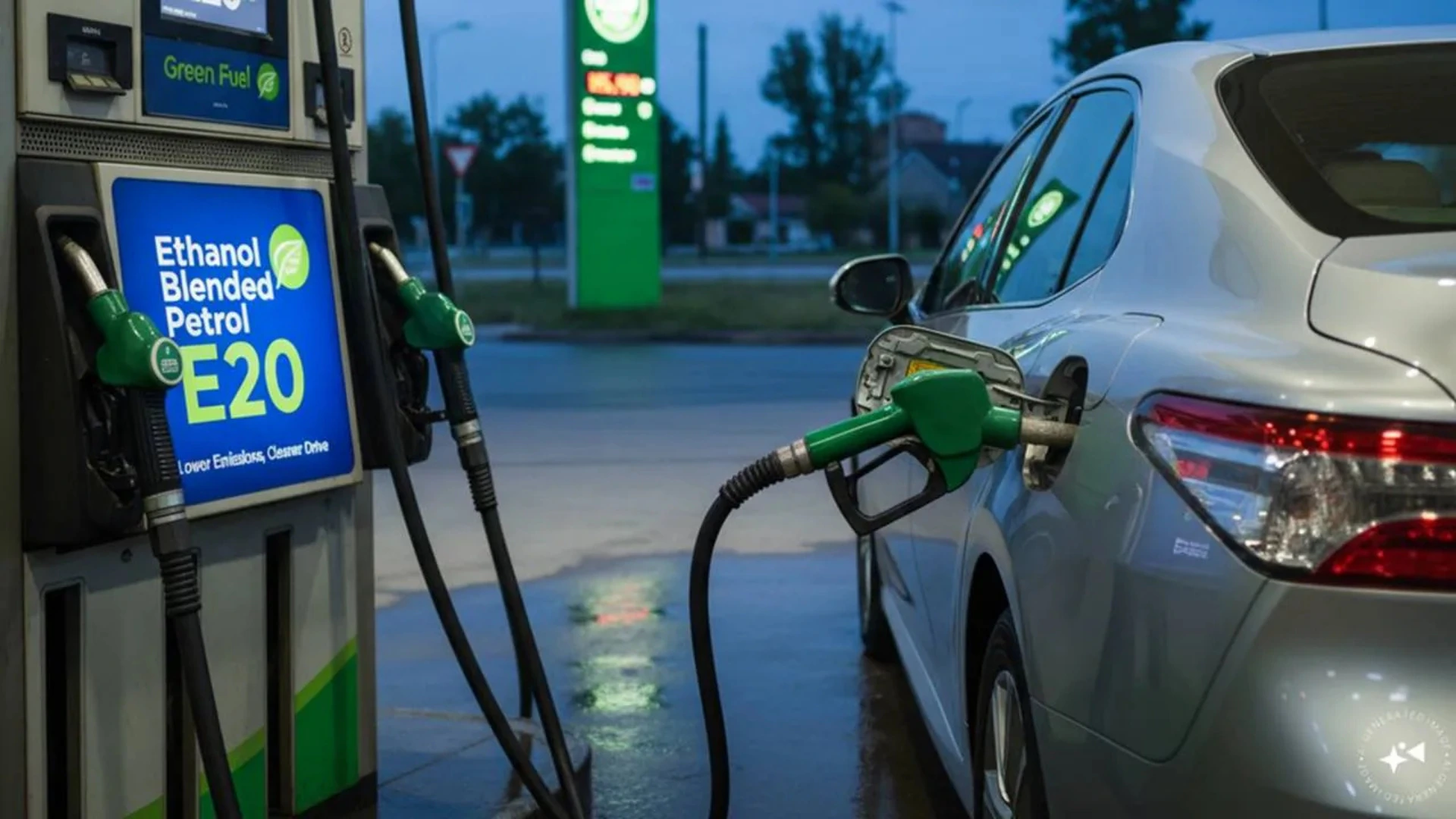
Synopsis: India’s transition towards E20 petrol has reignited a nationwide debate after motorists questioned its impact on fuel efficiency and engine performance. Union Road Transport and Highways Minister Nitin Gadkari has defended the fuel, citing scientific studies that found no evidence of engine damage in compatible vehicles. Yet the controversy extends far beyond mileage. E20 represents one of India’s most ambitious energy transition policies—one that aims to reduce crude oil imports, strengthen farmer incomes, cut carbon emissions, and build a domestic ethanol economy.
July 14, 2026: The rollout of E20 petrol has once again entered public discussion after concerns surfaced regarding reduced mileage and possible engine-related issues. Addressing the controversy, Union Minister Nitin Gadkari dismissed claims that E20 fuel damages engines, citing studies conducted by the Automotive Research Association of India (ARAI). He argued that factors such as tyre pressure, driving behaviour, servicing, and vehicle condition often have a greater influence on mileage than fuel alone. While the remarks have divided motorists, they have also brought renewed attention to India’s larger ethanol blending programme and its long-term economic objectives.
Author: Tavisha Kanodia | EQMint
The Bigger Vision Behind E20
At first glance, E20 appears to be another fuel available at petrol stations. In reality, it is part of one of India’s most significant energy policy reforms. The government has steadily increased ethanol blending in petrol to reduce dependence on imported crude oil, improve energy security, lower greenhouse gas emissions, and create additional income opportunities for India’s agricultural sector.
India imports nearly 85% of its crude oil requirements, making fluctuations in global oil prices a recurring economic challenge. Every increase in international crude prices affects inflation, transportation costs, and the country’s import bill. By replacing a larger share of petrol with domestically produced ethanol, policymakers hope to reduce this dependence while simultaneously creating a stable market for agricultural feedstocks such as sugarcane and maize.
Why the Mileage Debate Matters
Despite these long-term objectives, consumer acceptance remains one of the biggest challenges facing the E20 rollout.
Experts note that ethanol contains lower energy content than pure petrol, meaning a slight reduction in mileage is technically possible under certain operating conditions. However, the extent varies depending on engine design, vehicle compatibility, maintenance, and driving patterns. This distinction lies at the centre of the current debate.
Automobile manufacturers have already begun producing E20-compatible vehicles, while oil marketing companies have invested heavily in expanding ethanol blending infrastructure across the country. Nevertheless, older vehicles not specifically designed for higher ethanol blends continue to raise concerns among consumers, highlighting the need for clearer communication and greater awareness.
EQMint Analysis: The Business Opportunity Behind the Controversy
The E20 discussion is ultimately less about fuel efficiency and more about the creation of an entirely new economic ecosystem. India’s ethanol programme is generating opportunities across agriculture, manufacturing, infrastructure, and clean energy.
Sugar companies such as Balrampur Chini Mills, Triveni Engineering & Industries, Shree Renuka Sugars, and Dalmia Bharat Sugar have expanded ethanol production capacities to meet growing demand. Engineering firms like Praj Industries are supplying ethanol plant technologies and benefiting from increased investment in biofuel infrastructure. Oil marketing companies including Indian Oil Corporation (IOC), Bharat Petroleum (BPCL), and Hindustan Petroleum (HPCL) have invested in blending facilities, storage infrastructure, and supply-chain expansion to support nationwide distribution.
For the automotive industry, the transition has accelerated research into flex-fuel engines and ethanol-compatible technologies. At the same time, higher demand for ethanol has created additional revenue opportunities for farmers and distilleries, strengthening rural value chains. If successfully implemented, the E20 programme could evolve into a multi-billion-rupee bioeconomy that reduces import dependence while supporting domestic manufacturing and agricultural growth.
Balancing Sustainability With Consumer Confidence
The success of E20 will ultimately depend not only on government targets but also on public trust. Consumers expect lower emissions without compromising affordability or performance. Automakers require clear regulatory standards, while ethanol producers need long-term policy certainty to justify continued investment.
Environmental experts have also highlighted broader questions surrounding ethanol production, including water-intensive sugarcane cultivation and the balance between food security and fuel production. Expanding ethanol output through alternative feedstocks such as maize and agricultural waste could become increasingly important as blending targets rise.
The current debate therefore reflects more than dissatisfaction over mileage. It illustrates the challenges of managing a large-scale energy transition where environmental objectives, industrial growth, agricultural economics, and consumer interests must all move together.
Bibliography
- Deccan Herald. ‘It’s not the fuel, it’s you’: Nitin Gadkari’s mileage remarks amid E20 debate.
- India Today. Nitin Gadkari responds to E20 petrol mileage concerns.
- Team-BHP. E20 petrol does not damage engines, says Nitin Gadkari citing ARAI.
- The Telegraph. Uneasy Switch: Editorial on India’s E20 petrol rollout.
- RushLane. Nitin Gadkari responds to E20 petrol row; ARAI findings explained.
- Ministry of Petroleum and Natural Gas, Government of India – Ethanol Blended Petrol Programme.
- NITI Aayog – Roadmap for Ethanol Blending in India.
- Automotive Research Association of India (ARAI).
or more such information visit EQMint
Join our Whatsapp channel for timely updates: Whatsapp
Disclaimer: This article is not an investment advice and is for educational purpose only.