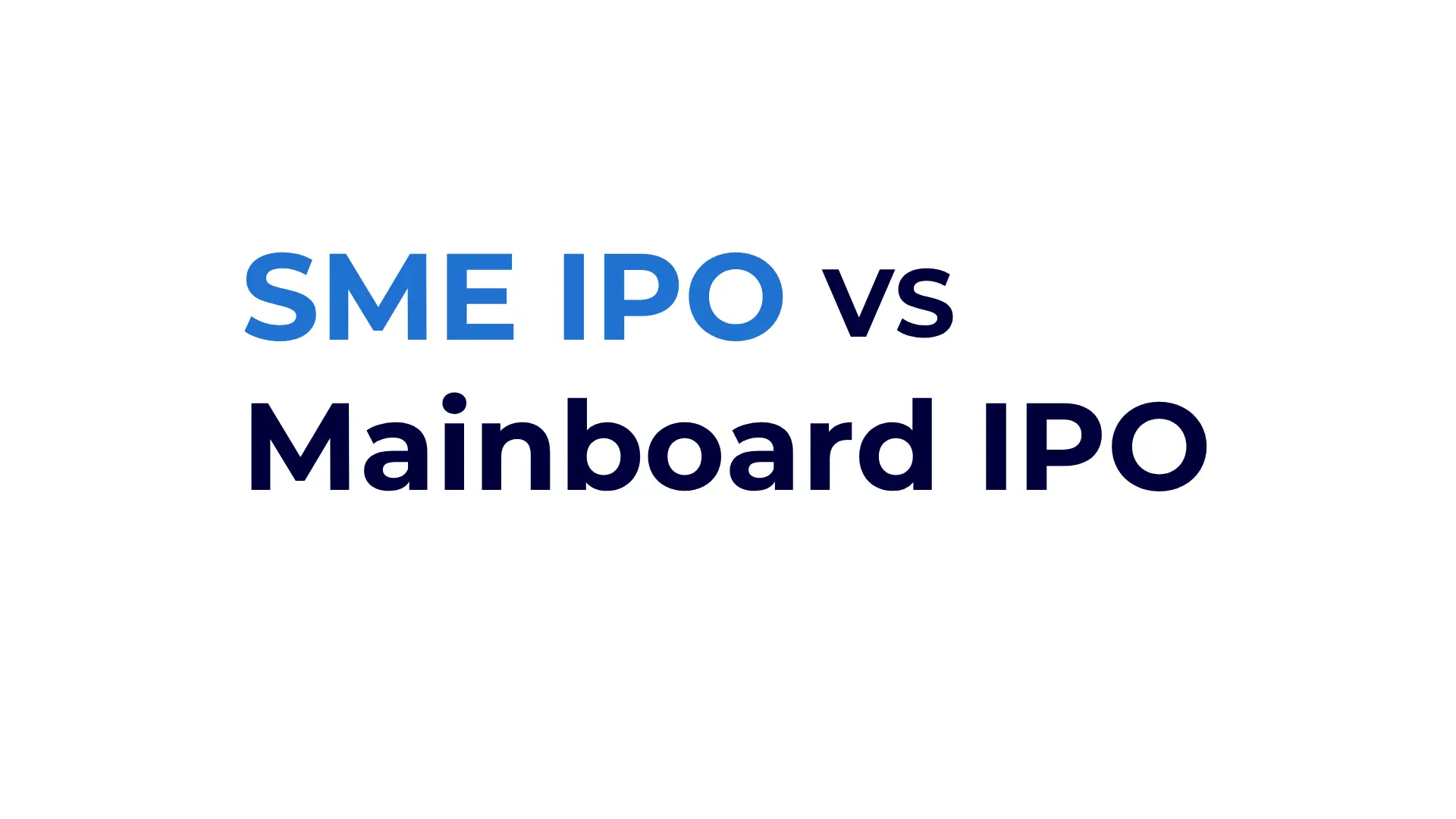
June 1, 2026: A mainboard IPO is for large, established companies that list on the main NSE and BSE platforms. An SME IPO is for smaller companies that list on the separate NSE Emerge and BSE SME platforms. The biggest practical difference for a retail investor since July 2025 is money. A mainboard IPO lets you apply with roughly 15,000 rupees. An SME IPO now needs more than 2 lakh rupees as the minimum ticket.
Author: Aadarsh Patel | EQMint | EQ Originals
That single rule change reshaped who can play in the SME space. And most retail investors still don’t know it happened.
Here’s the full breakdown of how the two differ, what the 2025 and 2026 rule changes mean for you and which one actually suits a retail investor.
What is the difference between mainboard IPO and SME IPO?
Both are initial public offerings. Both follow SEBI’s ICDR Regulations. Both use the same ASBA and UPI application process. The difference is the size of the company, the platform it lists on, the money you need to apply and the level of regulatory scrutiny it goes through.
Mainboard companies are the big names. Think Reliance Jio, NSE, PhonePe. They list on the main exchange where institutions, mutual funds and the bulk of retail money trade every day.
SME companies are smaller businesses raising their first public capital. The company must have operating profit of at least 1 crore in any 2 of the last 3 financial years to qualify for the SME route. They list on NSE Emerge or BSE SME, which are separate platforms built for smaller issuers.
So the label tells you the scale. Mainboard means established and large. SME means small and growing.
How big does a company have to be for each route?
The eligibility bars are very different. This is where the gap shows clearly.
Mainboard IPO eligibility. A company going the profitability route needs net tangible assets of at least 3 crores in each of the last 3 years, an average operating profit of at least 15 crores over the last 3 years and a minimum paid-up capital of 10 crores. The post-issue paid-up capital also has to clear 10 crores.
There’s a second door. A loss-making company can bring an IPO under rule 6(2) of SEBI ICDR Regulations, known as the QIB route. Zomato and Swiggy used it. That route demands heavy institutional backing instead of a profit record.
SME IPO eligibility. The bar sits lower but it’s no longer trivial. An SME needs net tangible assets of at least 3 crore, net worth of at least 3 crore, operating profit of 1 crore in 2 out of the last 3 years and a post-issue paid-up capital that does not exceed 25 crore.
The profit threshold is the recent one to note. SEBI added it on March 4, 2025. Before that, loss-making SMEs could list freely. Not anymore.
The 2 lakh rule that changed everything
This is the single most important thing a retail investor should understand about SME IPOs in 2026.
From July 1, 2025, the minimum application size for an SME IPO is two lots worth more than 2 lakh, replacing the earlier rules that allowed much smaller retail investments.
Compare that to a mainboard IPO. Mainboard issues usually allow investments starting from around 15,000, which keeps them far more accessible.
So the entry cost for an SME IPO is roughly 13 times higher than for a mainboard one.
Why did SEBI do this? To kill the lottery mentality. The regulator and the exchanges raised the minimum to filter out speculative short-term investors who were chasing listing gains without reading financials.
SEBI also went further on the structure. The OFS portion in SME IPOs is now limited to 20% of the total issue size, the amount set aside for general corporate purposes is capped at 15% of the issue or 10 crore whichever is lower and SMEs are barred from using IPO proceeds to repay loans taken from promoters, promoter groups or related parties.
These are good changes for retail investors. They just also mean the SME game now needs serious capital to enter.
Why SME IPOs feel riskier than mainboard ones
Three reasons. Liquidity, scrutiny and price swings.
Liquidity is thin. SME stocks trade in low volumes. To keep them tradeable at all, a market maker must be appointed for at least 3 years to provide buy and sell quotes. Without that market maker, you could be stuck holding shares nobody wants to buy.
Scrutiny is lighter. This is the one most people miss. Unlike mainboard IPOs, which are vetted by SEBI directly, SME IPO documents are primarily reviewed by the stock exchanges themselves. The regulator does not comb through every SME filing the way it does for a mainboard issue. Lighter review means the burden of due diligence falls more heavily on you.
Price moves are capped now, which actually protects you. From July 2024, listing day gains are capped at 90% above the issue price, removing the chance of extreme first-day returns. The flip side is that SME stocks were once notorious for manipulation, with aggressive oversubscription and sharp listing pops often driven by leveraged HNI funding and a very low public float.
That history is exactly why SEBI cracked down.
Do SME IPOs actually deliver better returns?
The honest answer most tipster channels won’t give you. The listing day numbers look great until you read the fine print.
In 2024 around 90% of SME IPOs delivered positive listing day gains, but past performance is no guarantee of future outcomes. Market sentiment, subscription levels, sector momentum and liquidity all decide what happens after you get allotment.
And the listing gain cap means the old story of an SME doubling on day one is gone. In 2024 the segment saw 243 companies list across NSE Emerge and BSE SME. A lot of that frenzy was speculative froth, not durable business value.
The harder truth. A big listing pop is not the same as a good investment. Plenty of SME stocks that popped on day one bled value over the following months as the thin liquidity caught up with them.
Mainboard vs SME IPO, side by side
The quick reference table.
| Factor | Mainboard IPO | SME IPO |
| Listing platform | Main NSE / BSE | NSE Emerge / BSE SME |
| Minimum application | Around 15,000 | More than 2 lakh (2 lots) |
| Post-issue paid-up capital | At least 10 crore | Up to 25 crore |
| Operating profit needed | 15 crore average over 3 years | 1 crore in 2 of last 3 years |
| Document vetting | SEBI | Stock exchanges |
| Market maker required | No | Yes, for 3 years |
| OFS limit | No fixed cap | Capped at 20% of issue |
| Liquidity | High | Low |
Can an SME company move to the mainboard later?
Yes. It’s called migration and it’s a normal part of the SME lifecycle.
After a successful run on the SME platform, a company can migrate to the mainboard once it has minimum paid-up capital of 10 crore, at least 3 years of listing on the SME platform and shareholder approval through a special resolution.
This is the path the SME platform was designed for. A small company lists on NSE Emerge, grows for a few years, crosses the size thresholds and graduates to the big board. For an investor who got in early on a genuinely good SME, migration is often where the real re-rating happens.
Which one should a retail investor pick?
Depends on your capital and your appetite for risk. Take a clear position here, because the data supports one.
For most retail investors with limited capital, mainboard IPOs are the more sensible starting point. Lower entry cost, deeper SEBI scrutiny, real liquidity and a wider base of buyers if you want to exit. You can apply with 15,000 and you’re investing in a company the regulator has examined closely.
SME IPOs suit investors who have at least 2 to 3 lakh to commit to a single application, who can afford to hold an illiquid stock and who are willing to read the entire DRHP themselves because the regulator did less of that work for them.
If you can’t comfortably lock up 2 lakh in one application, the SME route isn’t built for you right now. And that’s fine. The rules were rewritten partly to make that clear.
FAQ
What is the main difference between a mainboard and an SME IPO?
Company size and platform. Mainboard IPOs are for large companies listing on the main NSE and BSE. SME IPOs are for smaller companies listing on NSE Emerge or BSE SME, with lighter eligibility but a much higher minimum application size.
How much money do I need to apply for an SME IPO in 2026?
More than 2 lakh rupees. Since July 1, 2025, the minimum SME application is 2 lots worth above 2 lakh. A mainboard IPO needs only around 15,000.
Are SME IPOs vetted by SEBI?
Not directly. SME IPO documents are primarily reviewed by the stock exchanges. Mainboard IPOs go through SEBI’s own review process.
Can SME IPO money be used to repay promoter loans?
No. SEBI’s 2025 rules prohibit SMEs from using IPO proceeds to repay loans taken from promoters, promoter groups or related parties.
Do SME IPOs need to be profitable now?
Yes. Since March 2025, an SME must show operating profit of at least 1 crore in 2 of the last 3 financial years to qualify.
Can an SME company move to the mainboard?
Yes, through migration. It needs minimum paid-up capital of 10 crore, at least 3 years on the SME platform and a special resolution from shareholders.
Is a market maker required for SME IPOs?
Yes. A market maker has to be appointed for at least 3 years to keep the stock tradeable, since SME volumes are low.
Which is safer for a beginner, mainboard or SME?
Mainboard, for most beginners. Lower entry cost, deeper regulatory scrutiny and far better liquidity make it the more forgiving place to start.
EQMint is not a SEBI registered investment adviser. This article is for informational purposes only and is not investment advice.
For more such information visit EQMint
Join our Whatsapp channel for timely updates: Whatsapp