
Author: Aditya Pareek | EQMint | General News
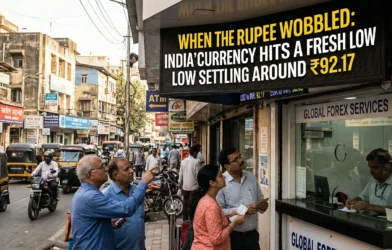
New Delhi, December 15, 2025 — The Indian rupee continued its downward spiral on Monday, slipping to an all-time low of 90.58 against the US dollar, marking a significant milestone in the currency’s prolonged weakness. This fall extends the rupee’s losing streak into a second consecutive week of record lows, after it had breached the 90.55 level on Friday. The sharp depreciation has reignited concerns over India’s external stability, trade competitiveness, and the Reserve Bank of India’s (RBI) policy balancing act.
A Symbolic and Economic Threshold
Crossing the 90-per-dollar mark is not just a numerical event but a psychologically significant one. The rupee has now lost nearly half of its value since 2011, underscoring the long-term structural pressures facing the currency. Market participants view this level as a critical threshold that could influence capital flows, investor sentiment, and inflation expectations in the months ahead.
Currency strategists note that once such symbolic levels are breached, market volatility tends to increase, as traders reassess risk premiums and hedging strategies. The latest decline suggests that despite intermittent central bank intervention, the rupee remains vulnerable to both global and domestic headwinds.
Multiple Headwinds Weigh on the Rupee
The rupee’s weakness is being driven by a confluence of factors, many of which have persisted throughout the year. Chief among them are delays in a potential US–India trade agreement, which have dampened export optimism and weighed on investor confidence. At the same time, capital inflows have remained weak, with foreign portfolio investors showing caution amid global uncertainty and relatively higher risk-free returns in developed markets.
India’s widening trade deficit has further added pressure on the currency. Elevated import bills, particularly for energy and capital goods, have kept demand for dollars strong. This has been compounded by robust corporate demand for foreign currency, as companies step up imports, service overseas debt obligations, and hedge against further depreciation.
Adding to the strain are steep US tariffs of up to 50% on certain Indian exports, which have impacted export competitiveness and foreign exchange earnings. Analysts say these tariffs have not only affected trade volumes but also contributed to cautious sentiment among exporters and overseas investors.
Rupee Among the Worst Global Performers
So far in 2025, the rupee has depreciated by over 5% against the US dollar, making it the third-worst performing currency among 31 major global currencies. Only the Turkish lira and the Argentine peso have fared worse during the same period.
This underperformance is particularly notable given that the dollar index has declined by more than 7% this year, indicating that the rupee’s weakness is not solely a function of dollar strength. Instead, it reflects India-specific challenges, including trade dynamics, capital flow trends, and domestic growth-inflation considerations.
Market participants point out that while several emerging market currencies have benefited from a softer dollar environment, the rupee has struggled to capitalise on this trend, highlighting its relative fragility.
Growing Pressure on the RBI Governor
The rupee’s slide has placed RBI Governor Sajay Malhotra under increasing scrutiny. The central bank faces the delicate task of balancing currency stability with broader macroeconomic objectives, including growth support, inflation control, and financial market stability.
Analysts argue that excessive intervention to defend a specific exchange rate level could deplete foreign exchange reserves and send unintended signals to markets. At the same time, unchecked depreciation risks importing inflation, raising the cost of essential commodities, and unsettling investor confidence.
Crossing the 90 mark has intensified calls for clarity on the RBI’s tolerance band for currency movement and its broader exchange rate strategy in a changing global environment.
RBI’s Intervention Strategy Under the Lens
In recent months, the RBI has actively intervened in the foreign exchange market to slow the pace of the rupee’s decline. However, market participants have observed that the central bank’s support appeared less aggressive after the rupee weakened beyond the 88.80 level and later crossed the 90-per-dollar mark.
The RBI plays a significant role in the rupee’s offshore and onshore trading, including through non-deliverable forwards (NDFs) settled in dollars. These interventions are typically carried out via the Bank for International Settlements, in coordination with select major global banks operating across financial hubs such as Singapore, Dubai, and London.
While such measures can smooth volatility and curb speculative attacks, experts caution that they are not a substitute for addressing underlying structural issues affecting the currency.
Implications for Inflation, Trade, and Markets
A weaker rupee has mixed implications for the Indian economy. On one hand, depreciation can support exports by making Indian goods more price-competitive globally. On the other, it raises the cost of imports, particularly crude oil, fertilisers, and electronic components, which could stoke inflationary pressures.
Higher import costs may eventually feed into consumer prices, complicating the RBI’s inflation management efforts. For businesses, currency volatility increases hedging costs and creates uncertainty around margins, especially for companies heavily dependent on imported raw materials.
Equity and bond markets are also closely watching the rupee’s movement. Sustained weakness could influence foreign investor flows, sovereign borrowing costs, and overall financial market stability.
What Lies Ahead
Looking ahead, currency experts believe the rupee’s trajectory will depend on several key factors: progress on trade negotiations, trends in capital inflows, global risk appetite, and the RBI’s policy response. Any signs of improvement in export momentum or foreign investment could offer some relief, while continued global uncertainty may keep the rupee under pressure.
For now, the breach of 90.58 underscores the challenges facing Asia’s third-largest economy as it navigates a complex global and domestic environment. Markets are likely to remain volatile in the near term, with the rupee’s next moves closely watched by policymakers, investors, and businesses alike.
For more such information visit EQMint
Disclaimer: This article is based on information available from public sources. It has not been reported by EQMint journalists. EQMint has compiled and presented the content for informational purposes only and does not guarantee its accuracy or completeness. Readers are advised to verify details independently before relying on them.