

Author : Aashiya Jain | EQMint | Business
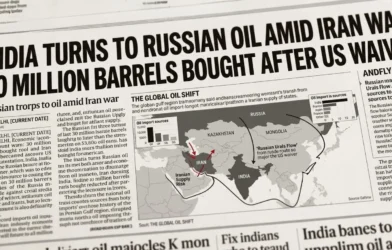
New Delhi, December 30, 2025 — India’s longstanding energy relationship with Russia is facing a pivotal moment as crude oil flows from the Kremlin’s refineries to Indian ports dip to their lowest levels in nearly three years. Recent shipping data suggests that deliveries of Russian crude once a cornerstone of India’s energy strategy are set to average around 1.1 million barrels per day in December, marking the weakest inflows since late 2022.
For decades, Russian crude particularly heavy, discount-priced Urals found a reliable home in India’s expanding refinery sector. In 2024, India overtook China as Russia’s largest oil customer, with discounted Russian oil making up a significant chunk of India’s imports. But geopolitical headwinds and intensified scrutiny from Western capitals especially Washington have tilted the scales in recent months, leading to a pronounced drop in the flows that once seemed unshakeable.
Why the Decline?
The primary reason for the slump isn’t a sudden lack of demand in India; it’s the mounting pressure from U.S. sanctions and the political push to penalize Russia over its war in Ukraine. In October, the United States imposed fresh sanctions on two of Russia’s biggest oil producers Rosneft PJSC and Lukoil PJSC — and gave international buyers a limited window to wind down existing contracts.
Shippers and refiners reacted cautiously, with several large Indian processors pausing their Russian crude purchases to avoid running afoul of the new rules. At one point in December, data showed weekly Russian oil deliveries to India plunging as low as about 712,000 barrels per day, even as other refiners continued to take limited cargoes.
This dramatic drop isn’t just about numbers on a shipping reflects the uncomfortable balance India is trying to strike between its national interests and external diplomatic pressures. For many Indian oil executives, the discounted Russian barrels were more than just cheap fuel; they were a way to keep refining costs manageable while meeting a growing population’s thirst for energy.
Reliance’s Strategic Return
Amid this turbulence, Reliance Industries Ltd. India’s largest private refiner and a key player in the country’s energy landscape may be key to softening the blow. After briefly pausing imports in the wake of the sanctions, Reliance has resumed purchases of discounted Russian crude oil from suppliers that are not on international sanction lists.
The company is routing these shipments to its Jamnagar refining complex in Gujarat, one of the largest refinery hubs in the world. By doing so, Reliance isn’t just keeping its own furnaces burning it’s helping support the overall flow of Russian oil into India at a time when other buyers remain hesitant. Analysts say this move could limit how steeply India’s imports fall this month and provide some stability to the broader oil trade.
The Jamnagar facility, which processes hundreds of thousands of barrels daily mainly for India’s domestic fuel market, has long been sensitive to shifts in crude quality and price. Sourcing discounted Russian barrels at scale can help temper refining costs and potentially keep fuel prices from spiking at the pump for ordinary consumers.
Domestic Markets Feel the Ripple Effects
For Indian consumers, any sharp disruption in crude imports holds the possibility of affecting fuel prices and the broader economy. India imports the bulk of its oil needs, and a sudden squeeze on cheap crude supplies can ripple through everything from transport costs to heating bills.
In smaller towns and cities, truck drivers, small business owners, and everyday commuters often watch petrol and diesel prices with the same anxious eyes as urban investors monitor stock indices. Even minor fluctuations at the pump can strain monthly budgets for millions of households.
That’s why Reliance’s cautious return to the Russian oil market isn’t just a boardroom maneuver it has human ramifications across the economic spectrum. Oil industry analysts have been watching closely, aware that any sharp supply disruption could reverberate through the economy, pushing up inflation or slowing down growth in sectors dependent on affordable fuel.
A Broader Geopolitical Story
India’s evolving oil trade with Russia is about more than business; it’s a reflection of the country’s diplomatic balancing act in a rapidly shifting global landscape. While New Delhi has traditionally maintained strong ties with Moscow dating back to the Cold War, it has also been keen to deepen partnerships with Western nations, particularly on trade, technology, and security.
The recent slowdown in Russian oil flows mirrors this complex recalibration. Western capitals are pressing India to diversify away from discounted Russian barrels as part of a broader strategy to cut off funding for Russia’s military activities. At the same time, Indian leaders are wary of sudden jolts to their energy supply chain a sector that underpins everything from manufacturing to farm irrigation.
Analysts note that India’s approach has been pragmatic: continue trade where possible, comply with global norms when needed, and safeguard domestic energy needs. The slight uptick in imports expected in early 2026 partly due to Reliance’s renewed buying shows that India isn’t wholly retreating from the Russian oil market even as it navigates sanctions challenges.
Looking Ahead
What happens next will depend on how global sanctions evolve and how quickly alternative suppliers especially from the Middle East and Africa can fill any lingering gaps. For now, a mix of caution and opportunity defines India’s energy strategy.
In homes across the country, where drivers fill up at petrol stations and businesses plan budgets months in advance, the hope is simple: that markets stay stable, that energy remains affordable, and that policymakers can steer a steady course through unpredictable geopolitical currents.
For more such information : EQMint
Resource Link : ET