

Author: Aditya Pareek | EQMint | Orignal article
When you walk into a boardroom for the first time — before anyone speaks, before the presentation begins — your brain is already analyzing the room. You size up the environment, observe people, assess power dynamics, and then choose a seat.
To most people, this moment feels casual or even accidental. But behavioral psychology research suggests something far deeper: your seat selection is a nonverbal expression of your identity, confidence, instincts, and interpersonal style.
Today, we decode what your subconscious choice says about who you are by Aditya Pareek.
Why Boardroom Seating Psychology Matters
In workplaces, boardroom, leadership circles, investor meetings, startup discussions, and corporate strategy sessions, seating position shapes:
- Influence and authority
- Confidence and comfort
- Communication style
- Relationship-building
- Group behavior and outcomes
This is not guesswork. Decades of behavioral studies show that humans reveal intent through small, unconscious decisions — such as where they place themselves relative to others.
The Boardroom Seating Model
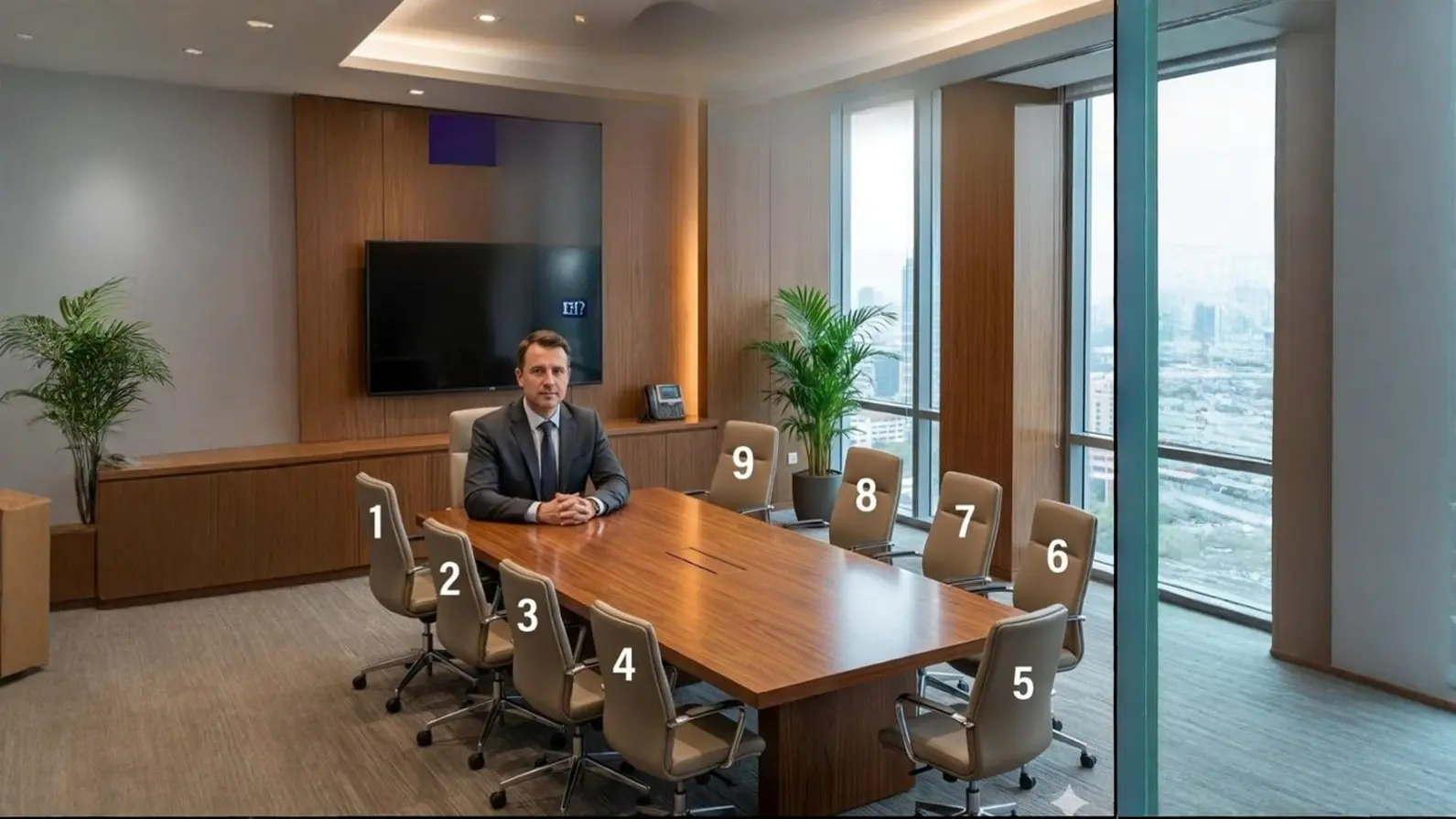
Imagine walking into a boardroom where nine seats surround the table. You sit where your instinct pulls you — not where you are told. That instinct is what reveals the truth.
Below are nine common seat choices and what they reflect about personality and leadership style.
Seat-by-Seat Personality Insights
Seat 1 — The Observer
You sit quietly first, read the boardroom, and then speak with precision. You do not chase attention. You chase understanding. People often underestimate you — until they realize that you are the sharpest listener in the room. You believe logic should precede leadership, and your timing makes you powerful.
Seat 2 — The Analyst
You want clarity, data, structure, and logic. You instinctively position yourself where you can absorb all information without stepping into the spotlight. You value correctness over consensus. For you, truth is not negotiable, and efficiency matters more than theatrics.
Seat 3 — The Contributor
You bring balance — you speak, listen, propose, and collaborate. You are not driven by ego or hierarchy. Your goal is harmony and productivity. Because your opinions are thoughtful rather than impulsive, people trust you. You are emotionally grounded and dependable.
Seat 4 — The Right-Hand Leader
You do not aggressively seek power, yet you are often the most influential person in the boardroom. You think strategically, support decisively, and solve problems without needing spotlight. Many future CEOs start here — power comes to them rather than being chased.
Seat 5 — The Challenger
You are comfortable confronting the obvious or the overlooked. You are the voice that questions decisions, challenges assumptions, and sparks deeper thinking. You do not provoke for attention — you provoke for improvement. You push the group to avoid mediocrity.
Seat 6 — The Rebel Independent
You value autonomy. You sit close enough to stay engaged but far enough to stay unrestrained. You thrive when trusted and crumble under micromanagement. You prefer creative freedom and self-directed problem solving. Rules exist, but you reserve the right to reinterpret them.
Seat 7 — The Diplomat
You bring warmth and emotional intelligence to decision-making. You build bridges, resolve conflicts, and humanize the workplace. People speak openly with you because you radiate approachability. Positive culture is your silent superpower.
Seat 8 — The Strategist
You watch the system as a whole — the people, the politics, the possibilities, and the long-term implications. You analyze patterns faster than others see them. You speak less, but when you do, your input directs the course of the discussion. You plan not for today but for tomorrow.
Seat 9 — The Leader
You step into authority effortlessly. You take responsibility, set direction, drive outcomes, and command attention not by force but by clarity. Whether formally appointed or not, people look to you for decisions. You own the room because you understand the room.
What This Experiment Really Reveals About You
This exercise is not about labeling personality as good or bad. Instead, it reveals how you instinctively behave within groups — not what you want to be, but what you already are.
It highlights:
- Comfort levels with authority and visibility
- Approach to conflict and cooperation
- Decision-making style
- Leadership instincts
- Communication preferences
- Emotional awareness
- Strategic or tactical orientation
Every seat has value. Teams succeed not when everyone tries to be the leader, but when every person embraces their natural strengths.
The Psychology Under the Surface
Your brain unconsciously:
- Scans hierarchy
- Assesses social risk
- Gauges psychological safety
- Detects opportunities
- Evaluates distance and proximity
- Calculates power and alliance
Seating is one of the oldest forms of nonverbal communication in social mammals — humans included.
In fact, even in informal settings such as restaurants, classrooms, or family events, you position yourself based on comfort, control, or observation. The boardroom simply magnifies it.
Leadership Takeaway: Know Yourself, Know the Room
Understanding your seating instinct reveals something powerful about your leadership journey:
- A Seat 1 becomes unstoppable when they learn when to speak.
- A Seat 5 becomes respected when they refine how to challenge.
- A Seat 7 becomes influential when they harness emotional intelligence strategically.
- A Seat 9 becomes visionary when they listen as strongly as they lead.
There is no wrong seat — only unawareness. Awareness turns instinct into advantage.
Final Thought
The next time you step into a boardroom, observe not just the agenda, the screen, or the files — observe where people sit.
It is a silent map of behavior, relationships, power, collaboration, tension, and trust.
When you understand the psychology of positioning, you understand the psychology of leadership.
For more such information visit EQMint