

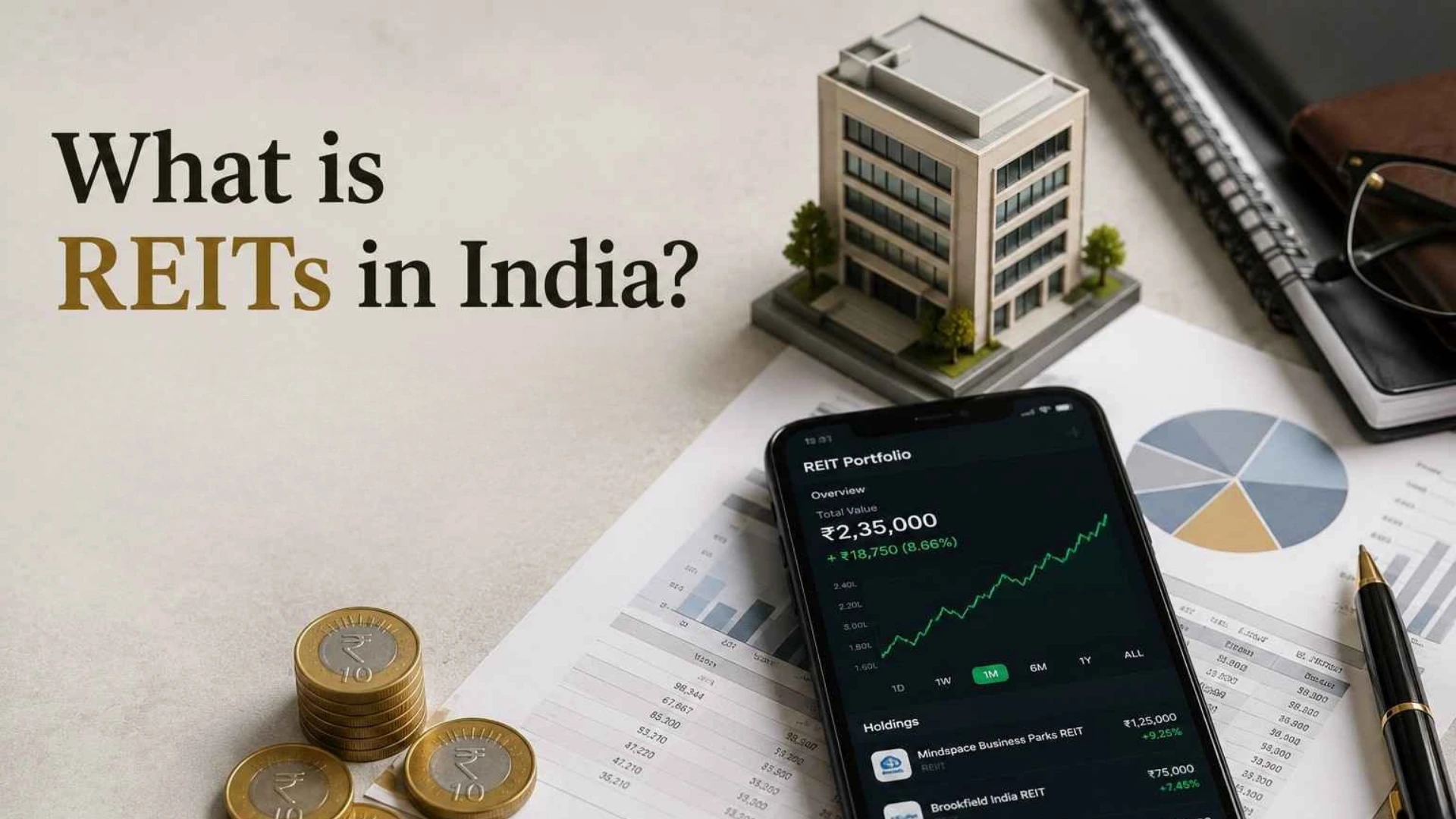
June 3, 2026: What is REIT India, or Real Estate Investment Trust, is a SEBI-regulated company that owns income-generating real estate (mostly office parks and malls) and passes the rental income to investors. You buy units on the NSE or BSE just like a stock, starting from the price of a single unit, and the trust must hand out at least 90% of its net distributable cash flow as distributions. So a REIT lets you own a slice of a Grade A office tower without buying the building. And 2026 has been the busiest year yet for new Indian REIT listings.
Author: Aadarsh Patel | EQMint | EQ Originals
Think of it as a landlord you can buy shares in. The rent shows up in your demat account as quarterly payouts.
Here’s how Indian REITs actually work, the five already listed, the new 2026 arrivals and what a retail investor should weigh before buying in.
What is REIT India in simple terms?
A REIT pools money from many investors to buy large, rent-earning properties. The tenants pay rent, the trust collects it, deducts costs and passes most of it back to unitholders.
Three features define it. SEBI regulates it. It trades on the exchanges like any listed security. And by law it must distribute at least 90% of its net distributable cash flow to unitholders, which is not optional.
That 90% rule is the whole appeal. It turns commercial rent, normally the preserve of large institutions and the very wealthy, into a quarterly payout a retail investor can hold in a demat account.
How do Indian REITs work?
The structure is straightforward once you see the flow. A sponsor (often a large developer or a global fund like Blackstone or Brookfield) puts its properties into a trust. The trust lists units on the exchange. You buy units, the trust pays you a share of the rent.
The minimum lot was cut to a single unit back in 2023. So you can start with whatever one unit costs, roughly 300 to 500 rupees for the office REITs and lower for Nexus Select.
Most Indian REITs pay distributions every quarter. Those payouts come as a mix of dividend, interest and repayment of capital, and the tax treatment differs across those components.
The thing to watch each quarter is occupancy. A REIT’s income is essentially occupancy rate multiplied by rent per square foot, so falling occupancy is the clearest early warning of trouble.
The 5 REITs already listed in India
As of early 2026, India has 5 publicly listed REITs. Together they hold around 2.4 lakh crore in gross assets under management and over 175 million square feet of Grade A office and retail space, with a combined investor base above 2.5 lakh unitholders.
| REIT | Focus | Listed |
| Embassy Office Parks | Office parks, India’s largest | 2019 |
| Mindspace Business Parks | Office, lowest volatility | 2020 |
| Brookfield India | 100% institutionally managed office | 2021 |
| Nexus Select Trust | India’s only retail mall REIT | 2023 |
| Knowledge Realty Trust | Office, Sattva and Blackstone backed | 2025 |
Embassy is the largest and most liquid, with a portfolio above 50 million square feet and a yield around 5.3% in recent quarters. Mindspace has shown the lowest volatility since listing thanks to its spread across Hyderabad, Mumbai, Pune and Chennai. Brookfield is the only fully institutionally managed office REIT. Nexus Select stands alone as the retail play, running malls with occupancy above 97%. Knowledge Realty Trust, listed in August 2025, was the fifth to join.
The new 2026 REIT listings
2026 is where the category widened. Two listings stand out, and they sit at opposite ends of the size spectrum.
Bagmane Prime Office REIT. The big one. Backed by the Bengaluru-based Bagmane Group with Blackstone as a minority backer, it raised 3,405 crore through an issue priced at 95 to 100 per unit, open from May 5 to 7 and listed around May 14 to 15, 2026. The portfolio is six Grade A+ business parks in Bengaluru with committed occupancy near 98% and tenants like Google, Amazon, Nvidia and Samsung. The issue was heavily subscribed, around 25 times overall and 26.6 times in the QIB category. Its main risk is single-city concentration in Bengaluru.
PropShare Celestia. The small one, and a different animal. It listed on the BSE on April 24, 2026, as a scheme under India’s first SEBI-registered SM REIT (Small and Medium REIT). The asset is seven floors of a Grade A+ building in Ahmedabad, 100% occupied. The issue was 245 crore with a ticket size around 10 to 10.5 lakh, and it debuted about 4.8% below its reference price on muted demand.
The contrast is the lesson. A large, diversified office REIT drew heavy institutional demand. A tiny single-asset SM REIT with a 10 lakh ticket listed soft. Size, diversification and price of entry shaped two very different debuts.
What is an SM REIT and how is it different?
SM REIT stands for Small and Medium Real Estate Investment Trust, a newer SEBI framework for smaller property assets that wouldn’t qualify for a full REIT.
The big difference for a retail investor is the ticket. A regular REIT lets you buy a single unit for a few hundred rupees. An SM REIT scheme like PropShare Celestia needs around 10 lakh to enter, which puts it firmly out of reach for most retail investors and closer to an HNI product.
PropShare runs the leading SM REIT platform, with Celestia following its earlier Platina (December 2024) and Titania (August 2025) schemes. The framework is young and the assets are single-building, so the diversification a large REIT offers is missing here.
How are REIT distributions taxed?
This is where many investors get caught out, so be precise. A REIT distribution is not one clean dividend. It arrives as a mix of components, each taxed differently.
A significant part of the payout is often tax-free in the investor’s hands, which is part of the appeal. But the blended effective tax rate on the total distribution typically lands somewhere around 15% to 25% for most investors, which makes REIT income less tax-efficient than equity dividends for those in higher brackets.
The honest takeaway. REITs are a reasonable income and diversification tool, but the headline yield is not what you keep after tax. Always look at the post-tax yield, not the gross number a brochure quotes. EQMint is not a tax adviser, so confirm the treatment of each component with a qualified professional before counting on the income.
Should a retail investor buy REITs?
Take a clear position. REITs suit an investor who wants steady, real estate backed income and is willing to accept modest capital growth, not someone chasing fast gains.
The case for them is real. Regular quarterly income, exposure to Grade A property you could never buy directly, SEBI oversight, mandatory 90% distribution and the ability to start with a single unit. Indian REITs have also distributed over 26,500 crore cumulatively since 2019, a track record that now spans several years.
The cautions matter too. Yields of 5% to 6% are not spectacular, distributions are taxed unevenly, unit prices move with interest rates and a single-geography REIT carries concentration risk. A rate cut tends to lift REIT prices, a rate hike tends to pull them down.
For income and diversification, a quality office or retail REIT earns a place in a portfolio. As a get-rich-quick bet, it does not. Match the instrument to the goal.
FAQ
What is a REIT in India?
A SEBI-regulated trust that owns income-generating real estate such as office parks and malls, lists units on the NSE and BSE, and must distribute at least 90% of its net distributable cash flow to unitholders.
How much money do I need to buy a REIT?
Just the price of a single unit, since the minimum lot was reduced to 1 unit in 2023. That is roughly 300 to 500 rupees for the office REITs and lower for Nexus Select.
How many REITs are listed in India?
Five as of early 2026: Embassy, Mindspace, Brookfield, Nexus Select and Knowledge Realty Trust. Bagmane Prime Office REIT joined as a new listing in May 2026.
What is the Bagmane Prime Office REIT?
A Bengaluru-focused office REIT backed by the Bagmane Group with Blackstone as a minority investor. It raised 3,405 crore and listed in May 2026 with occupancy near 98% and tenants including Google and Amazon.
What is an SM REIT?
A Small and Medium REIT, a SEBI framework for smaller property assets. The ticket size is far higher than a regular REIT, around 10 lakh for a scheme like PropShare Celestia, making it closer to an HNI product.
How are REIT distributions taxed?
The payout is a mix of dividend, interest and capital repayment, each taxed differently. A portion is often tax-free, but the blended effective rate is typically around 15% to 25% for most investors.
What yield do Indian REITs offer?
Most office REITs have offered distribution yields around 5% to 6% in recent quarters. Remember to look at the post-tax yield rather than the gross figure.
Are REITs a safe investment?
They are regulated and backed by real property, but unit prices move with interest rates and single-geography REITs carry concentration risk. They suit income and diversification, not quick gains.
EQMint is not a SEBI registered investment adviser. This article is for informational purposes only and is not investment advice.
For more such information visit EQMint
Join our Whatsapp channel for timely updates: Whatsapp