
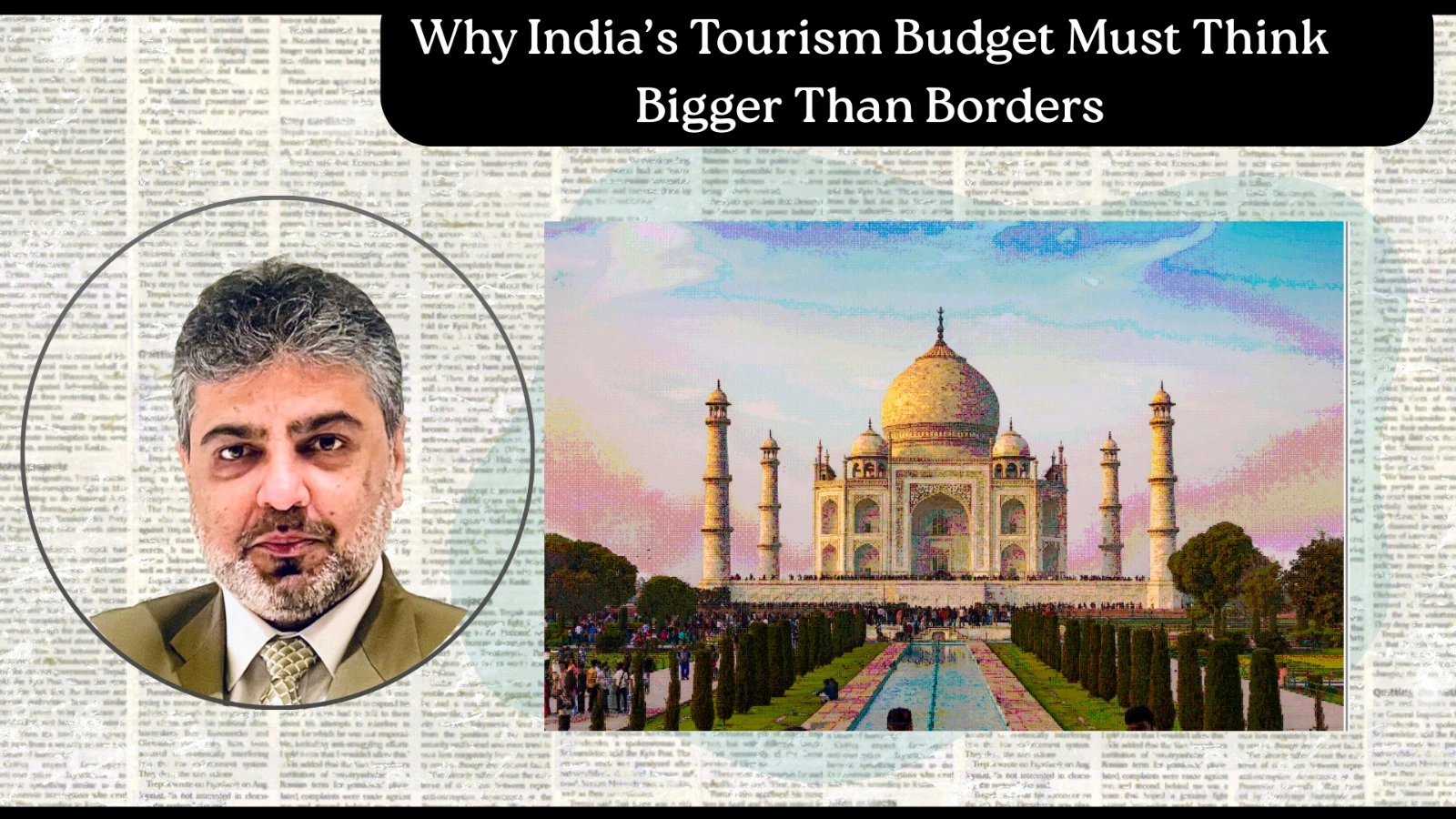
Author : Dr. Neeraj Ashok Sharma | Honorary Consul General of Palau to India | EQmint Exclusive
The world is now adjusting its travel compass after the pandemic that paused human mobility for a while, and India is at a very important turning point. The Union Budget for 2025-26 – which earmarked ₹2,541.06 crore for the tourism sector – provides a groundwork where the very attractive stories of cultural interaction and economic growth can be constructed, but at the same time, it highlights the requirement for more aggressive, globally calibrated policy tools.
The numbers are both encouraging and respectful at the same time. Based on the most recent figures, India has received around 18.9 million international tourist arrivals (ITAs), thus achieving and exceeding the pre-pandemic height of 17.9 million in 2019. This is an incredible demonstration of the world’s unbreakable attraction toward India’s diverse heritage, to be specific. Another strong point is the international tourists’ value: the international tourists’ spending has risen to an unprecedented level of ₹3.1 trillion (approximately USD 36.8 billion) in 2024. It is likely to reach ₹3.2 trillion by 2025, indicating not only recovery but also growth.
Nevertheless, India’s share has grown, yet it remains modest—a mere 1% of the global tourism market. This is the dilemma that the country faces: on the one hand, it has the potential to become one of the leading tourist destinations, but on the other hand, it is failing to attract a larger number of visitors due to various challenges.
The Asian tourist markets, which India considers its main rivals—particularly Thailand, Vietnam, and the UAE—have increased their global market share by employing a combination of effective marketing, visa facilitation, as well as providing world-class services and customer care.
India, on the contrary, has been forced to cut its overseas marketing budget drastically, attracting worldwide attention mainly for the wrong reasons, as the amount allocated for international promotion has been reduced to only ₹3.07 crore, much to the dismay of the stakeholders in the industry.
This comparison—the unquestionable opulence of India’s cultural, natural, and spiritual heritage on the one hand and the lack of sufficient global promotion on the other—implies that the new budget period should be steered towards the right direction.
It should increase the visibility of India’s tourism image on the global market and not only tell the story of ancient temples and desert forts but also of modern cosmopolitanism, leadership in wellness, sustainable ecotourism, and culinary diplomacy.
India’s Tourism potential
India’s tourism potential is not only in the numerous destinations but also in the various advantages that each area offers, so the tourist strategy must be well-defined.
The whole region of the Himalayas, from Ladakh to Sikkim, is natural and very high-value for adventure, wellness, and spiritual tourism; if the infrastructure is supported by the climate and the local people, it will be able to provide sustainable livelihoods in fragile ecosystems. The deserts of Rajasthan and Gujarat are presenting their heritage—forts, crafts, and festivals—through tourism, which is supporting not only the artisans but also MSMEs and women-led enterprises.
India’s long coastline of 7,500 kilometres from Goa to Odisha and Tamil Nadu is still not fully utilised on the international market; significant investments in cruise tourism, blue-flag beaches, and maritime connectivity can help attract foreign tourists all year round. On the other hand, the temple towns of Varanasi, Ayodhya, Puri, Madurai, and Tirupati are the centres of faith tourism- the most resilient segment in India-that is creating jobs in areas like hospitality, transport, and urban services.
The Northeast states are sometimes wrongly labelled as a hidden gem of India. They are promoting eco-tourism and biodiversity and cross-cultural exchanges with Southeast Asia through land and air routes, making it a bridge, not a barrier.
Prioritising budget for last-mile connectivity, destination branding, multilingual interpretation, and digital visitor management in these areas would not only redirect tourist crowds from the over-visited hotspots but also make tourism a contributor to balanced regional development, foreign currency generation, and India’s soft yet effective global diplomacy.
Certainly, the present budget has government and industry backing, which is mainly directed towards areas such as infrastructure, skills and connectivity—including modern air routes and e-visa systems—that are essential for the growth of the international arrivals. Nevertheless, the hard construction will not be enough if the global viewpoint of the country remains negative.
The emphasis should be placed on consolidating the “Incredible India” brand as a unified, data-driven global campaign, which is synchronised with important trade shows, bilateral tourism agreements, and digital interaction in the main source countries in Europe, North America and East Asia.
The India Association of Tour Operators (IATO) has been pushing for a common international marketing plan—preferably backed by a fund-sharing agreement with states—thus emphasising the need for cooperation rather than division.
Numbers aside, the philosophical case for promoting tourism more extensively is strong: tourism has become one of the most powerful carriers of soft power.
In a world where cultural diplomacy frequently comes before economic and strategic ties, inviting people to come and see India’s festivals, heritage walks, yoga retreats, and Himalayan views enhances mutual understanding and builds long-term relationships.
At this point in time, the Indian government should not only consider the amount of money spent on tourism advertisements but also the effectiveness of the allocation of resources in this regard. India, being a tourism destination, has to make sure that its narrative, which is already difficult to hear over the competing narratives, is developed with the same high standards of coherence, creativity, and clarity, which are the rightful attributes of a country with such a long history.
For more such information : EQmint