Synopsis: Coal India has received a letter of intent from the Ministry of Heavy Industries for a 1,200-tonne-a-year rare earth magnet plant under the ₹7,280 crore scheme. EQMint’s scheme math shows the slot equals one-fifth of the national target and could carry about ₹1,440 crore of support if fully utilised.
Coal India Ltd, the state-owned miner listed on NSE and BSE, told the exchanges on 19 November 2026 that a consortium it leads has received a letter of intent (LoI) from the Ministry of Heavy Industries to set up a facility making sintered rare earth permanent magnets. The planned capacity is 1,200 tonnes per annum (TPA). Its partner in the consortium is the Non-Ferrous Materials Technology Development Centre (NFTDC), and the company said it had been declared the L2 bidder in the selection process.
The award runs seven years, two of pre-construction and five of operation, through a special purpose vehicle under the government’s sintered rare earth permanent magnet (REPM) scheme. No investment amount or plant location was disclosed.
Four companies selected, not five
Heavy Industries Minister H D Kumaraswamy handed over LoIs to four companies on Thursday: Coal India, Prozeal Green Energy, ReNew Private and Midwest Energy. The scheme, approved by the Union Cabinet on 26 November 2025, was designed for five beneficiaries, so one slot remains unallocated for now. The government has not disclosed the capacity given to each of the other three companies or the incentive rates each won.
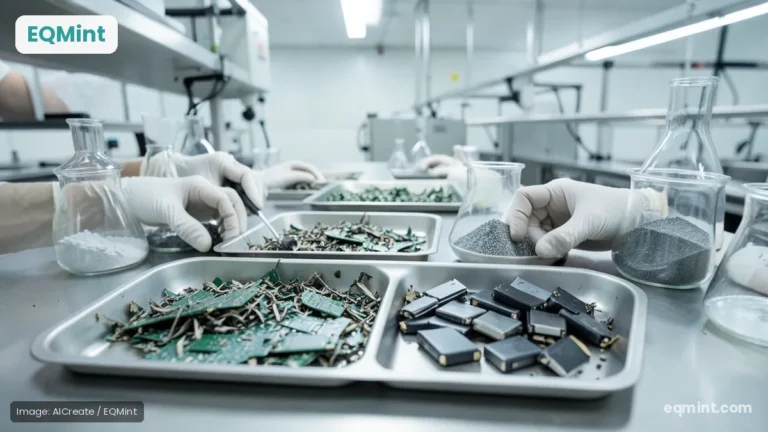
These neodymium-iron-boron (NdFeB) magnets go into EV motors, wind turbines, electronics and defence systems. India imports most of its supply and expects demand to double between 2025 and 2030.
EQMint analysis: what one 1,200-tonne slot is worth
The Cabinet note splits the ₹7,280 crore outlay into ₹6,450 crore of sales-linked incentives paid over five years and ₹750 crore of capital subsidy, across 6,000 TPA of capacity and up to 1,200 TPA per beneficiary. Dividing those pools evenly gives the ceiling for one full slot such as Coal India’s. Actual payouts depend on the incentive rate each company bid and on how many magnets it actually sells, neither of which has been made public.
| Metric | Figure | How derived |
|---|---|---|
| Total scheme outlay | ₹7,280 crore | Cabinet decision, Nov 2025 |
| Target capacity | 6,000 TPA | Cabinet decision |
| Coal India slot as share of target | 20% | 1,200 / 6,000 |
| Capacity covered by four LoIs (maximum) | 4,800 TPA (80%) | 4 x 1,200 TPA cap |
| Capital subsidy per full slot | ₹150 crore | ₹750 crore / 5 |
| Capital subsidy per tonne of capacity | ₹12.5 lakh | ₹750 crore / 6,000 t |
| Sales-linked incentive per full slot (5 yrs) | ₹1,290 crore | ₹6,450 crore / 5 |
| Average incentive per kg if all capacity sells | ₹2,150 | ₹6,450 crore / (6,000 t x 5 yrs) |
| Maximum support per full slot | ₹1,440 crore | ₹150 crore + ₹1,290 crore |
Source: Union Cabinet decision on the REPM scheme (26 Nov 2025), Coal India exchange filing (19 Nov 2026), figures as of 19 November 2026; EQMint calculations.
The ₹1,440 crore figure is a ceiling, not a disclosed number. Bidders quoted incentive rates, so lower bids draw less, and Coal India has not disclosed its rate.
Timeline: from Cabinet approval to letters of intent
The award came almost a year to the day after Cabinet approval. With a two-year gestation, plants are due around late 2028, and incentives would run to about 2033.
| Date | Step |
|---|---|
| 26 Nov 2025 | Cabinet approves ₹7,280 crore REPM scheme |
| 20 Mar 2026 | Ministry of Heavy Industries floats global tender |
| Aug 2026 | 20 bids received |
| 19 Nov 2026 | LoIs issued to four companies, including Coal India |
| About Nov 2028 / 2033 | Gestation ends / incentives end (EQMint estimate) |
Source: Cabinet decision, Ministry of Heavy Industries tender notice, Autocar Professional, Coal India filing, figures as of 19 November 2026; EQMint calculations.
For Coal India, which produces more than 80% of the country’s coal, the project is a move into a manufacturing business with a very different customer base from power utilities. It follows other recent steps in India’s push on critical materials, such as the RDI fund backing for e-waste critical minerals recovery and India’s signing of the Pax Silica declaration on technology supply chains.
What happens next
An LoI is not a final contract. The consortium still has to form the SPV, sign with the ministry and disclose location, cost and technology. The scheme also offers a limited assured raw material supply from state-run IREL (India). Next disclosures to watch: Coal India’s equity commitment in the SPV and whether the ministry re-tenders the fifth slot. Until then, the table shows scheme limits, not Coal India’s expected earnings.
Image credit: EQMint.
Sources
- Source: Coal India BSE filing on LoI for rare earth magnet facility (19 Nov 2026)
- Source: PM India: Cabinet approves ₹7,280 crore REPM scheme (26 Nov 2025)
- Source: The Pioneer: CIL-led consortium receives LoI
- Source: Millennium Post: Govt selects 4 cos for rare-earth magnet scheme
- Source: News on AIR: MHI invites global bids (20 Mar 2026)
- Source: Autocar Professional: MHI receives 20 bids (13 Aug 2026)
- Source: Arthneeti summary of Coal India Regulation 30 filing
Disclaimer: This article is for information purposes only and is not investment advice.
For more such information, visit EQMint
Join our WhatsApp channel for timely updates: Whatsapp